Loading...
Istvan Szechenyi vs Napoleon Bonaparte
Napoleon Bonaparte leads by 12.7 pts · 2 figures compared
…
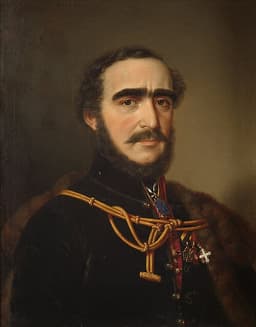
Istvan Szechenyi
Politician · Modern
58.2Total

Napoleon Bonaparte
General · Modern
70.9Total
Basic Information
Born
1791
1769
Died
1860
1821
Era
Modern
Modern
Nationality
Hungary
France
Occupation
Politician
General
Civilization
Western
Western
Score Comparison
Military (10%)
49.7
94.0
Political (20%)
72.0
72.0
Influence (20%)
56.7
40.0
Legacy (20%)
55.0
80.0
Leadership (15%)
68.0
78.0
Strategy (15%)
43.2
90.0
TOTAL
58.2
70.9
Istvan Szechenyi — Complete Timeline
1825 AD
Founding of the Hungarian Academy of SciencesCultural◆ Major
Istvan Szechenyi donated a year's income to found the Hungarian Academy of Sciences. The institution promoted scientific and cultural development in Hungary.
AcademyScienceCulture
Impact: nationalconstructive
1830 AD
Publication of 'Credit'Cultural◆ Major
Istvan Szechenyi published 'Credit', a book advocating for economic reforms in Hungary. The work argued for the abolition of serfdom and the modernization of agriculture.
PublicationReformEconomy
Impact: nationalconstructive
1849 AD
Chain Bridge ConstructionOther◆ Major
Istvan Szechenyi oversaw the construction of the Chain Bridge across the Danube in Budapest. The bridge connected Buda and Pest, symbolizing modernization and national unity.
InfrastructureBridgeModernization
Impact: nationalconstructive
1860 AD
SuicideOther◆ Major
Istvan Szechenyi died by suicide at the D
SuicideDeath
Impact: nationaltragic
Napoleon Bonaparte — Complete Timeline
1799 AD
Coup of 18 BrumaireOther◆ Major
Napoleon Bonaparte, with support from his brother Lucien and key political figures, overthrew the Directory in a bloodless coup. He established the Consulate with himself as First Consul, effectively becoming the ruler of France. This event ended the French Revolution's most unstable period.
French RevolutionCoupRise to Power
Impact: regional
1804 AD
Promulgation of the Napoleonic CodeOther◆ Major
Napoleon enacted the Civil Code of the French, known as the Napoleonic Code, a comprehensive set of laws that replaced the fragmented feudal legal systems. The code established legal equality, protected property rights, and secularized law. It became the basis for legal systems in many European and world countries.
Legal ReformNapoleonic CodeCivil Law
Impact: globalconstructive
1805 AD
Battle of AusterlitzWar◆ Major
Napoleon's Grande Arm
Napoleonic WarsBattleDecisive Victory
Impact: global
1812 AD
Invasion of RussiaWar◆ Major
Napoleon led the Grande Arm
Napoleonic WarsInvasionDisaster
Impact: globaldestructive
1815 AD
Battle of WaterlooWar◆ Major
Napoleon's French army was defeated by the combined forces of the Duke of Wellington's Anglo-Allied army and Gebhard Leberecht von Bl
Napoleonic WarsBattleFinal Defeat
Impact: globaldestructive
Expert Analysis
Origins
István Széchenyi was born on September 21, 1791, in Vienna, into one of Hungary's wealthiest aristocratic families. His father, Count Ferenc Széchenyi, founded the Hungarian National Museum. Széchenyi received a military education and served as an officer in the Napoleonic Wars, but his true calling lay in reform. He traveled extensively across Europe, studying British industrialization and political systems, which shaped his vision for modernizing Hungary.
Napoleon Bonaparte was born on August 15, 1769, in Ajaccio, Corsica, to a minor noble family. His father, Carlo Buonaparte, was a lawyer who secured a scholarship for Napoleon to attend military school in mainland France. Napoleon graduated from the École Militaire in Paris in 1785 as a second lieutenant in artillery. His Corsican origins and modest nobility set him apart from the French aristocratic elite, fueling his ambition.
Rise to Power
Széchenyi's rise came not through political office but through intellectual and philanthropic influence. In 1825, he donated one year's income (60,000 florins) to found the Hungarian Academy of Sciences, a pivotal move that established him as a national leader. His 1830 book 'Credit' (Hitel) argued for abolishing serfdom and modernizing agriculture through credit institutions. He became chairman of Hungary's public works committee and oversaw the construction of the Chain Bridge (1849), the first permanent bridge across the Danube in Budapest, symbolizing unification.
Napoleon's rise was meteoric. He became a general at age 24 after the Siege of Toulon (1793). His Italian campaign (1796-1797) defeated Austria and made him a national hero. The Egyptian expedition (1798-1799) boosted his fame. On November 9, 1799 (18 Brumaire), he staged a coup d'état, overthrowing the Directory and establishing the Consulate, with himself as First Consul. By 1804, he crowned himself Emperor of the French.
Leadership & Governance
Széchenyi led through persuasion and institutional building. He believed in gradual, top-down reform, working within the Habsburg monarchy. His governance focused on economic modernization: he promoted steamship navigation on the Danube, introduced modern horse breeding, and advocated for railway construction. He also pushed for the emancipation of serfs (achieved in 1848) and legal reforms. However, his moderate approach alienated radicals like Lajos Kossuth, who sought full independence.
Napoleon's leadership was autocratic and centralized. He consolidated power through the Napoleonic Code (1804), which standardized French law and influenced legal systems worldwide. He reformed education, establishing lycées and the University of France. Economically, he stabilized the franc and created the Bank of France (1800). His governance extended across conquered territories, where he imposed French administrative systems. However, his relentless wars drained resources and caused widespread suffering.
Triumph & Tragedy
Széchenyi's triumphs include founding the Hungarian Academy of Sciences, building the Chain Bridge, and laying groundwork for Hungary's modernization. His writings inspired a generation of reformers. Tragically, his mental health deteriorated. He suffered a nervous breakdown in 1848, and after the failed Hungarian Revolution, he was confined to a mental institution in Döbling. He died by suicide on April 8, 1860.
Napoleon's triumphs are legendary: his military genius at Austerlitz (1805), Jena (1806), and Wagram (1809); the Napoleonic Code; and his empire spanning most of Europe. His tragedy began with the disastrous invasion of Russia (1812), where his Grande Armée of over 600,000 was decimated. Exiled to Elba, he returned for the Hundred Days but was defeated at Waterloo (1815). He died in exile on Saint Helena in 1821.
Character & Destiny
Széchenyi was idealistic, visionary, but prone to melancholy. His character as a reformer who sought gradual change clashed with the revolutionary tide of 1848. He was called 'the greatest Hungarian' by Kossuth, yet his moderation made him a tragic figure caught between loyalty to the Habsburgs and love for Hungary. His destiny was to inspire modernization but not to see it fulfilled.
Napoleon was ambitious, decisive, and ruthlessly strategic. His character combined military genius with an insatiable drive for power. His destiny was shaped by his own hubris: the invasion of Russia and the refusal to compromise led to his downfall. Historians note his high military score (94.0) and strategy (93.0) but also his political miscalculations.
Legacy
Széchenyi's legacy endures in Hungary's institutions: the Hungarian Academy of Sciences, the Chain Bridge (a symbol of Budapest), and the concept of gradual reform. He scored 68.2 in legacy, reflecting his impact on Hungarian national identity. His ideas influenced later reforms and the Austro-Hungarian Compromise of 1867.
Napoleon's legacy is global: the Napoleonic Code shaped civil law in many countries, his military tactics are studied in war colleges, and his redrawing of European borders influenced nationalism. He scored 78.0 in legacy. However, his wars caused millions of deaths and his authoritarianism set precedents for later dictators.
Conclusion
Napoleon had greater overall impact, scoring 82.4 total to Széchenyi's 64.1, but their spheres were vastly different. Napoleon reshaped Europe through conquest and legal reform, while Széchenyi transformed Hungary through peaceful modernization. In terms of lasting positive influence, Széchenyi's institutional legacy arguably had more constructive effects than Napoleon's wars. Yet by any measure of power and historical force, Napoleon dominates. The score gap of 18.3 points reflects Napoleon's broader reach, but Széchenyi's moral and intellectual contributions are equally significant in their context.
Rankings
🥇
Napoleon BonaparteLeader
Mil: 94.0Pol: 72.0Inf: 40.0
70.9
🥈
Istvan Szechenyi
Mil: 49.7Pol: 72.0Inf: 56.7
58.2
+12.7 behind
How This Comparison Works
Algorithm
Each figure is scored on 6 dimensions (0—100 scale) based on structured historical data: Military (10%), Political (20%), Influence (20%), Legacy (20%), Leadership (15%), Strategy (15%). The weighted total produces the final ranking.
Data Sources
Scores are computed from structured sub-indicators in the database. Scale factors adjust for era (Ancient ×0.85, Modern ×1.0) and civilization size (Eastern ×1.05, Other ×0.80) to account for differences in population and military scale.
Maximum 3 Figures
Comparisons are limited to 2—3 figures to ensure readability and statistical meaningfulness.
Error Margins
±5 points per dimension — Sub-scores are derived from historical records with inherent uncertainty. Two figures within 5 points on a dimension should be considered roughly equivalent in that area.
Total Score Accuracy
±3 points overall — The weighted combination of 6 dimensions produces a total score with approximately ±3 points of uncertainty. Differences of less than 3 points are not statistically significant— the figures are effectively tied.
Known Limitations
- Historical records are incomplete and uneven across civilizations
- Figures from oral-tradition societies may be underrepresented
- Occupation labels can misclassify multi-role figures
- Scores measure capability and impact, not moral character
- Quantitative scoring is a comparison tool, not absolute truth
Capability Radar
Military (10%) — Battles & Warfare
Battles
31
95
Win Rate
32
90
Expansion
33
95
Political (20%) — Governance & Reform
Reform
85
95
Diplomacy
60
80
Economy
80
85
Influence (20%) — Cultural & Global Reach
Cultural
70
85
Global
55
90
Legacy (20%) — Historical Impact
Historical
75
95
Longevity
65
90
Leadership (15%) — Power & Stability
Tenure
55
85
Stability
50
70
Strategy (15%) — Tactics & Innovation
Strategy
41
95
Tactics
40
98
Reform
45
92
Similar Comparisons
Comments & Discussion
No comments yet. Be the first to share your thoughts!