Loading...
Islam Karimov vs Paul Biya
Islam Karimov leads by 0.7 pts · 2 figures compared
…
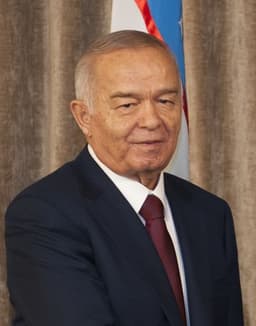
Islam Karimov
Politician · Modern
49.1Total

Paul Biya
Politician · Modern
48.4Total
Basic Information
Born
1938
1933
Died
—
—
Era
Modern
Modern
Nationality
Uzbekistan
Cameroon
Occupation
Politician
Politician
Civilization
Eastern
Other
Score Comparison
Military (10%)
32.5
36.5
Political (20%)
48.0
37.9
Influence (20%)
50.2
51.0
Legacy (20%)
41.7
50.0
Leadership (15%)
66.0
66.0
Strategy (15%)
58.1
39.2
TOTAL
49.1
48.4
Islam Karimov — Complete Timeline
1991 AD
Became First President of UzbekistanPolitical Action◆ Major
Islam Karimov was elected as the first president of independent Uzbekistan after the dissolution of the Soviet Union. He had previously served as the First Secretary of the Communist Party of Uzbekistan. His presidency established an authoritarian regime that would last for 25 years.
IndependenceAuthoritarian RegimePost-Soviet Transition
Impact: national
1994 AD
Implemented Economic ReformsReform◆ Major
Karimov pursued a gradualist approach to economic reform, maintaining state control over key sectors while allowing limited private enterprise. His policies focused on energy independence and cotton production. Uzbekistan achieved modest economic growth but remained largely isolated from global markets.
Economic PolicyState ControlGradual Reform
Impact: nationalconstructive
2005 AD
Suppressed Andijan UprisingPolitical Action◆ Major
Karimov's government violently suppressed a protest in Andijan, killing hundreds of civilians. The uprising was sparked by the trial of local businessmen accused of extremism. The crackdown drew international condemnation and led to a deterioration of relations with the West.
MassacreHuman Rights ViolationsAuthoritarian Repression
Impact: nationaldestructive
2016 AD
Died in OfficePolitical Action◆ Major
Islam Karimov died in office at the age of 78 after suffering a stroke. His death ended 25 years of authoritarian rule. He was succeeded by Shavkat Mirziyoyev, who had served as prime minister. Karimov's death marked a turning point in Uzbek politics, leading to cautious reforms.
Death in OfficeSuccessionEnd of Era
Impact: national
Paul Biya — Complete Timeline
1975 AD
Became Prime Minister of CameroonPolitical Action◆ Major
Paul Biya was appointed Prime Minister of Cameroon by President Ahmadou Ahidjo. This position made him the second-highest official in the country and positioned him as Ahidjo's successor.
AppointmentCameroonGovernment
Impact: national
1982 AD
Succeeded Ahidjo as PresidentPolitical Action
President Ahmadou Ahidjo resigned unexpectedly, and Paul Biya, as Prime Minister, succeeded him as President of Cameroon. This transition was initially peaceful but led to a power struggle with Ahidjo.
SuccessionCameroonPower Struggle
Impact: national
1984 AD
Suppressed a Coup AttemptPolitical Action◆ Major
Biya's government foiled a coup attempt led by supporters of former President Ahidjo. The failed coup resulted in executions and purges within the military and government, consolidating Biya's control.
Coup AttemptCameroonRepression
Impact: nationaldestructive
1990 AD
Introduced Multi-Party PoliticsReform◆ Major
Under pressure from domestic and international actors, Biya's government legalized opposition parties, ending the one-party system. However, the transition was managed to ensure Biya's continued dominance.
Political ReformDemocracyCameroon
Impact: national
1992 AD
Won Controversial Re-electionsPolitical Action◆ Major
Biya won the 1992 presidential election, the first multi-party election since 1964. The election was marred by allegations of fraud and irregularities, leading to opposition protests and international criticism.
ElectionCameroonControversy
Impact: national
2016 AD
Anglophone Crisis EscalationWar◆ Major
Protests by English-speaking lawyers and teachers escalated into a separatist conflict in the Anglophone regions. Biya's government responded with a military crackdown, leading to a protracted insurgency and humanitarian crisis.
ConflictAnglophone CrisisCameroon
Impact: regionaldestructive
Expert Analysis
Origins
Islam Karimov was born on January 30, 1938, in Samarkand, Uzbek SSR, into a family of collective farm workers. He studied engineering at the Tashkent Institute of Irrigation and Mechanization of Agriculture, then worked in the Soviet planning apparatus. He joined the Communist Party in 1964 and rose through the ranks of the Uzbek Soviet Socialist Republic's government, becoming First Secretary of the Communist Party of Uzbekistan in 1989. Paul Biya was born on February 13, 1933, in Mvomeka'a, French Cameroon, to a farming family. He excelled in school, studying law and political science at the Sorbonne in Paris, and later at the Institut d'Études Juridiques. He returned to Cameroon and entered the civil service, quickly rising under President Ahmadou Ahidjo.
Rise to Power
Karimov became the first president of independent Uzbekistan on March 24, 1990, after the Supreme Soviet elected him to the newly created position. Following the dissolution of the Soviet Union, he consolidated power by suppressing opposition and controlling the media. His political score of 48.0 reflects his ability to maintain control through a combination of patronage and repression. Biya succeeded Ahidjo as president on November 6, 1982, after Ahidjo's surprise resignation. Initially seen as a reformer, Biya quickly moved to consolidate power, purging Ahidjo loyalists and surviving a coup attempt in 1984. His political score of 37.9 indicates a weaker grip on power compared to Karimov.
Leadership & Governance
Karimov's leadership style was autocratic and centralized. He maintained a cult of personality and suppressed dissent through secret police and controlled elections. His governance score of 66.0 reflects his effective control over Uzbekistan's political landscape. He implemented gradual economic reforms, keeping state control over key sectors like cotton and energy. Biya's leadership score is also 66.0, but his approach has been more cautious, allowing limited political freedoms while retaining ultimate authority. He introduced multi-party politics in 1990 but ensured that opposition parties remained weak through electoral manipulation and co-optation. Both leaders prioritized stability over democratic reform.
Triumph & Tragedy
Karimov's greatest success was navigating Uzbekistan's transition from Soviet republic to independent nation without major internal conflict, maintaining stability throughout the 1990s. However, his tragic legacy is defined by the 2005 Andijan uprising, where government forces killed hundreds of unarmed protesters. This event severely damaged Uzbekistan's international reputation. Biya's triumph lies in his longevity—he has been in power for over 40 years, making him one of Africa's longest-serving leaders. He also avoided the civil wars that plagued other African nations. His tragedy is the stagnation of Cameroon's economy and governance, with widespread corruption and human rights abuses. He scored 39.2 in strategy, reflecting his reactive rather than visionary approach.
Character & Destiny
Karimov was known for his ruthless pragmatism and suspicion of both domestic and foreign threats. He cultivated an image of a fatherly protector while maintaining a vast surveillance state. His death in 2016 ended his rule without a clear succession plan. Biya is characterized by his aloofness and reliance on a small circle of advisors. He has been described as a 'benevolent dictator' but has shown little interest in deep reforms. His destiny remains tied to his ability to manage Cameroon's ethnic divisions and growing unrest.
Legacy
Karimov's legacy is mixed: he is remembered as the founder of modern Uzbekistan but also as a dictator who crushed dissent. His scores in legacy (41.7) and influence (50.2) reflect his limited impact beyond Uzbekistan's borders. Biya's legacy (50.0) is similarly ambiguous; he is seen as a stabilizing force but also as a leader who failed to develop his country. Both leaders have left their nations with entrenched authoritarian systems that have persisted after their departures.
Conclusion
While both men were authoritarian leaders with similar governance scores, Karimov had a slightly higher overall total of 49.1 compared to Biya's 48.4. Karimov's greater impact on Uzbekistan's post-Soviet trajectory and his more decisive (though brutal) actions give him a marginal edge. However, Biya's longer tenure and his role in shaping Cameroon's political landscape cannot be ignored. Ultimately, Karimov's more profound economic and social changes, despite their costs, make him the more influential figure.
Rankings
🥇
Islam KarimovLeader
Mil: 32.5Pol: 48.0Inf: 50.2
49.1
🥈
Paul Biya
Mil: 36.5Pol: 37.9Inf: 51.0
48.4
+0.7 behind
How This Comparison Works
Algorithm
Each figure is scored on 6 dimensions (0—100 scale) based on structured historical data: Military (10%), Political (20%), Influence (20%), Legacy (20%), Leadership (15%), Strategy (15%). The weighted total produces the final ranking.
Data Sources
Scores are computed from structured sub-indicators in the database. Scale factors adjust for era (Ancient ×0.85, Modern ×1.0) and civilization size (Eastern ×1.05, Other ×0.80) to account for differences in population and military scale.
Maximum 3 Figures
Comparisons are limited to 2—3 figures to ensure readability and statistical meaningfulness.
Error Margins
±5 points per dimension — Sub-scores are derived from historical records with inherent uncertainty. Two figures within 5 points on a dimension should be considered roughly equivalent in that area.
Total Score Accuracy
±3 points overall — The weighted combination of 6 dimensions produces a total score with approximately ±3 points of uncertainty. Differences of less than 3 points are not statistically significant— the figures are effectively tied.
Known Limitations
- Historical records are incomplete and uneven across civilizations
- Figures from oral-tradition societies may be underrepresented
- Occupation labels can misclassify multi-role figures
- Scores measure capability and impact, not moral character
- Quantitative scoring is a comparison tool, not absolute truth
Capability Radar
Military (10%) — Battles & Warfare
Battles
53
26
Win Rate
52
28
Expansion
58
28
Political (20%) — Governance & Reform
Reform
30
20
Diplomacy
50
40
Economy
40
25
Influence (20%) — Cultural & Global Reach
Cultural
20
15
Global
20
30
Legacy (20%) — Historical Impact
Historical
30
30
Longevity
20
70
Leadership (15%) — Power & Stability
Tenure
70
85
Stability
45
30
Strategy (15%) — Tactics & Innovation
Strategy
59
34
Tactics
62
35
Reform
68
36
Similar Comparisons
Comments & Discussion
No comments yet. Be the first to share your thoughts!