Loading...
Islam Karimov vs John Atta Mills
John Atta Mills leads by 0.2 pts · 2 figures compared
…
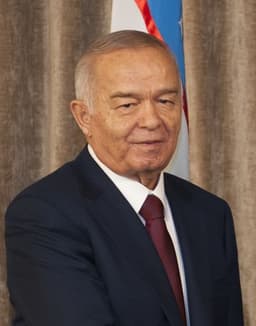
Islam Karimov
Politician · Modern
49.1Total

John Atta Mills
Politician · Modern
49.3Total
Basic Information
Born
1938
1944
Died
—
—
Era
Modern
Modern
Nationality
Uzbekistan
Ghana
Occupation
Politician
Politician
Civilization
Eastern
Other
Score Comparison
Military (10%)
32.5
50.0
Political (20%)
48.0
68.0
Influence (20%)
50.2
53.3
Legacy (20%)
41.7
43.3
Leadership (15%)
66.0
40.0
Strategy (15%)
58.1
39.4
TOTAL
49.1
49.3
Islam Karimov — Complete Timeline
1991 AD
Became First President of UzbekistanPolitical Action◆ Major
Islam Karimov was elected as the first president of independent Uzbekistan after the dissolution of the Soviet Union. He had previously served as the First Secretary of the Communist Party of Uzbekistan. His presidency established an authoritarian regime that would last for 25 years.
IndependenceAuthoritarian RegimePost-Soviet Transition
Impact: national
1994 AD
Implemented Economic ReformsReform◆ Major
Karimov pursued a gradualist approach to economic reform, maintaining state control over key sectors while allowing limited private enterprise. His policies focused on energy independence and cotton production. Uzbekistan achieved modest economic growth but remained largely isolated from global markets.
Economic PolicyState ControlGradual Reform
Impact: nationalconstructive
2005 AD
Suppressed Andijan UprisingPolitical Action◆ Major
Karimov's government violently suppressed a protest in Andijan, killing hundreds of civilians. The uprising was sparked by the trial of local businessmen accused of extremism. The crackdown drew international condemnation and led to a deterioration of relations with the West.
MassacreHuman Rights ViolationsAuthoritarian Repression
Impact: nationaldestructive
2016 AD
Died in OfficePolitical Action◆ Major
Islam Karimov died in office at the age of 78 after suffering a stroke. His death ended 25 years of authoritarian rule. He was succeeded by Shavkat Mirziyoyev, who had served as prime minister. Karimov's death marked a turning point in Uzbek politics, leading to cautious reforms.
Death in OfficeSuccessionEnd of Era
Impact: national
John Atta Mills — Complete Timeline
2008 AD
Elected President of GhanaPolitical Action◆ Major
John Atta Mills won the 2008 presidential election as the candidate of the National Democratic Congress (NDC), defeating Nana Akufo-Addo of the NPP. The election was closely contested and required a runoff.
ElectionDemocracyGhana
Impact: nationalconstructive
2009 AD
Discovery of Oil and GasOther◆ Major
Under Mills' presidency, Ghana began commercial oil production from the Jubilee field. The government established the Petroleum Revenue Management Act to manage oil revenues transparently.
Oil ProductionEconomyGhana
Impact: national
2012 AD
Died in OfficeOther◆ Major
President John Atta Mills died suddenly at the 37 Military Hospital in Accra on July 24, 2012. His death was attributed to a short illness. Vice President John Dramani Mahama was sworn in as his successor.
DeathGhanaSuccession
Impact: nationaltragic
Expert Analysis
Origins
Islam Abduganievich Karimov was born on January 30, 1938, in Samarkand, Uzbekistan, then part of the Soviet Union. He was raised in an orphanage after his father died, and he later graduated from the Tashkent State Technical University and the Tashkent Institute of National Economy. Karimov worked as an engineer and economist before joining the Communist Party of the Soviet Union, rising through the ranks to become First Secretary of the Communist Party of Uzbekistan in 1989.
John Evans Atta Mills was born on July 21, 1944, in Tarkwa, Ghana, then the Gold Coast. His father was a lawyer and his mother a teacher. Mills attended Achimota School and the University of Ghana, where he earned a law degree. He later obtained a PhD in law from the London School of Economics and became a professor of law. He entered politics in the 1990s, serving as Vice President under Jerry Rawlings from 1997 to 2001.
Rise to Power
Karimov became President of Uzbekistan on March 24, 1990, when the Supreme Soviet elected him to the newly created position. Following the dissolution of the USSR in 1991, he won a contested presidential election with 86% of the vote, though international observers noted irregularities. He consolidated power by suppressing opposition and controlling media, with his rule characterized by a tightly controlled political system.
Mills rose to prominence as the running mate of Jerry Rawlings in 1996. After Rawlings' term ended, Mills lost the 2000 and 2004 presidential elections to John Kufuor. In 2008, he ran again and won a narrow victory over Nana Akufo-Addo, with 50.23% of the vote. His victory marked a peaceful transfer of power in Ghana, a stable democracy.
Leadership & Governance
Karimov's leadership style was authoritarian. He maintained power through a security apparatus, suppressing dissent and controlling the economy. His government pursued a gradualist approach to economic reform, keeping state control over key sectors like energy and cotton. The Andijan uprising in May 2005, where security forces killed hundreds of protesters, exemplified his willingness to use violence. His political score of 48.0 reflects limited democratic governance.
Mills was a consensus builder who emphasized the rule of law. His administration focused on economic stability, anti-corruption, and social programs. Under his leadership, Ghana discovered oil and implemented the Petroleum Revenue Management Act to manage the revenues transparently. His political score of 68.0 indicates more democratic and inclusive governance compared to Karimov's 48.0.
Triumph & Tragedy
Karimov's greatest success was maintaining stability and independence for Uzbekistan after the Soviet collapse. He built a system that avoided the ethnic violence seen in other Central Asian states. His greatest failure was the Andijan massacre, which drew international condemnation and isolated Uzbekistan. His legacy score of 41.7 reflects the negative impact of his authoritarian rule.
Mills' success includes overseeing Ghana's first peaceful transfer of power from one party to another, and the discovery of oil, which promised economic growth. However, his death in office on July 24, 2012, after only 3.5 years, cut his legacy short. His legacy score of 43.3 is slightly higher than Karimov's, but the brevity of his term limited his achievements.
Character & Destiny
Karimov was pragmatic and ruthless, prioritizing control over reform. His background in the Soviet system shaped his suspicion of democracy and civil society. He died in office on September 2, 2016, at age 78, leaving a repressive system that his successor largely maintained. His leadership score of 66.0 reflects his ability to stay in power, but his strategy score of 58.1 shows limited long-term vision.
Mills was known for his humility and academic demeanor. He was a consensus builder who preferred dialogue. His sudden death at age 68, after a short illness, prevented him from completing his agenda. His leadership score of 40.0 is lower than Karimov's, partly due to his shorter tenure and less forceful style.
Legacy
Karimov's legacy is mixed: he is remembered as the father of independent Uzbekistan but also as a dictator who crushed dissent. The Karimov system of authoritarian governance persisted after his death. His influence score of 50.2 reflects his impact on Central Asian politics.
Mills is remembered as a democratic leader who strengthened institutions in Ghana. The peaceful transition after his death demonstrated the robustness of Ghana's democracy. His influence score of 53.3 is slightly higher than Karimov's, indicating a more positive global perception.
Conclusion
Though their total scores are nearly identical (Karimov 49.1, Mills 49.3), John Atta Mills had a more positive impact on his country and region. His commitment to democratic processes and rule of law set a standard for African governance. Karimov's stability came at the cost of human rights and freedom. Mills' legacy of peaceful transitions and transparent oil management arguably contributed more to long-term development. Therefore, Mills is the more admirable figure, despite his shorter tenure.
Rankings
🥇
John Atta MillsLeader
Mil: 50.0Pol: 68.0Inf: 53.3
49.3
🥈
Islam Karimov
Mil: 32.5Pol: 48.0Inf: 50.2
49.1
+0.2 behind
How This Comparison Works
Algorithm
Each figure is scored on 6 dimensions (0—100 scale) based on structured historical data: Military (10%), Political (20%), Influence (20%), Legacy (20%), Leadership (15%), Strategy (15%). The weighted total produces the final ranking.
Data Sources
Scores are computed from structured sub-indicators in the database. Scale factors adjust for era (Ancient ×0.85, Modern ×1.0) and civilization size (Eastern ×1.05, Other ×0.80) to account for differences in population and military scale.
Maximum 3 Figures
Comparisons are limited to 2—3 figures to ensure readability and statistical meaningfulness.
Error Margins
±5 points per dimension — Sub-scores are derived from historical records with inherent uncertainty. Two figures within 5 points on a dimension should be considered roughly equivalent in that area.
Total Score Accuracy
±3 points overall — The weighted combination of 6 dimensions produces a total score with approximately ±3 points of uncertainty. Differences of less than 3 points are not statistically significant— the figures are effectively tied.
Known Limitations
- Historical records are incomplete and uneven across civilizations
- Figures from oral-tradition societies may be underrepresented
- Occupation labels can misclassify multi-role figures
- Scores measure capability and impact, not moral character
- Quantitative scoring is a comparison tool, not absolute truth
Capability Radar
Military (10%) — Battles & Warfare
Battles
53
21
Win Rate
52
27
Expansion
58
28
Political (20%) — Governance & Reform
Reform
30
40
Diplomacy
50
50
Economy
40
45
Influence (20%) — Cultural & Global Reach
Cultural
20
30
Global
20
30
Legacy (20%) — Historical Impact
Historical
30
35
Longevity
20
25
Leadership (15%) — Power & Stability
Tenure
70
45
Stability
45
50
Strategy (15%) — Tactics & Innovation
Strategy
59
31
Tactics
62
36
Reform
68
37
Similar Comparisons
Comments & Discussion
No comments yet. Be the first to share your thoughts!