Loading...
Iskander Mirza vs Napoleon Bonaparte
Napoleon Bonaparte leads by 22.0 pts · 2 figures compared
…
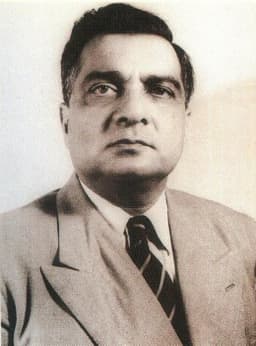
Iskander Mirza
Politician · Modern
48.9Total

Napoleon Bonaparte
General · Modern
70.9Total
Basic Information
Born
1899
1769
Died
1969
1821
Era
Modern
Modern
Nationality
Pakistan
France
Occupation
Politician
General
Civilization
Indian
Western
Score Comparison
Military (10%)
49.6
94.0
Political (20%)
39.4
72.0
Influence (20%)
51.0
40.0
Legacy (20%)
41.7
80.0
Leadership (15%)
58.8
78.0
Strategy (15%)
60.0
90.0
TOTAL
48.9
70.9
Iskander Mirza — Complete Timeline
1956 AD
Appointment as First President of PakistanPolitical Action◆ Major
Iskander Mirza became the first President of Pakistan on March 23, 1956, when the country adopted its first constitution. He had previously served as the last Governor-General. His presidency was marked by political instability and factional infighting.
PresidencyConstitutionPakistan
Impact: national
1958 AD
Imposition of Martial LawPolitical Action
On October 7, 1958, Iskander Mirza abrogated the constitution, dissolved the government, and imposed martial law, appointing General Ayub Khan as Chief Martial Law Administrator. This ended Pakistan's first parliamentary experiment.
Martial LawCoupPakistan
Impact: nationaldestructive
Exile After CoupPolitical Action◆ Major
Within weeks of imposing martial law, Iskander Mirza was forced into exile by Ayub Khan on October 27, 1958. Ayub Khan took over as President, and Mirza lived the rest of his life in London, never returning to Pakistan.
ExileCoupAyub Khan
Impact: nationaltragic
Napoleon Bonaparte — Complete Timeline
1799 AD
Coup of 18 BrumaireOther◆ Major
Napoleon Bonaparte, with support from his brother Lucien and key political figures, overthrew the Directory in a bloodless coup. He established the Consulate with himself as First Consul, effectively becoming the ruler of France. This event ended the French Revolution's most unstable period.
French RevolutionCoupRise to Power
Impact: regional
1804 AD
Promulgation of the Napoleonic CodeOther◆ Major
Napoleon enacted the Civil Code of the French, known as the Napoleonic Code, a comprehensive set of laws that replaced the fragmented feudal legal systems. The code established legal equality, protected property rights, and secularized law. It became the basis for legal systems in many European and world countries.
Legal ReformNapoleonic CodeCivil Law
Impact: globalconstructive
1805 AD
Battle of AusterlitzWar◆ Major
Napoleon's Grande Arm
Napoleonic WarsBattleDecisive Victory
Impact: global
1812 AD
Invasion of RussiaWar◆ Major
Napoleon led the Grande Arm
Napoleonic WarsInvasionDisaster
Impact: globaldestructive
1815 AD
Battle of WaterlooWar◆ Major
Napoleon's French army was defeated by the combined forces of the Duke of Wellington's Anglo-Allied army and Gebhard Leberecht von Bl
Napoleonic WarsBattleFinal Defeat
Impact: globaldestructive
Expert Analysis
iskander-mirza-vs-napoleon-bonaparte
# The Emperor and the President: Two Men Who Shaped Their Eras
On a crisp October morning in 1958, Iskander Mirza sat alone in his study in Karachi, the ink barely dry on a proclamation that had just shattered Pakistan’s fragile democracy. Three thousand miles away and a century and a half earlier, Napoleon Bonaparte had stood before his grenadiers in the snows of Russia, watching his Grand Army dissolve into a frozen wasteland. Both men had reached for absolute power. One conquered a continent and remade the laws of Europe; the other conquered nothing but his own nation’s constitution, and lost even that within weeks. What separates a titan from a footnote? The answer lies not in ambition alone, but in the soil from which each man grew.
Origins
Napoleon was born in 1769 on Corsica, an island that had just passed from Genoese to French control. His family was minor nobility, poor enough to know hunger but proud enough to nurse grievances. The French Revolution, which erupted when he was twenty, was his great windfall. It swept away the old order of birth and privilege, replacing it with a world where a young artillery officer with talent could rise as far as his cannon could carry him. Corsica’s rugged landscape and the constant jostling of Mediterranean powers taught him early that life was a contest of wills, and that the boldest gambler often won.
Iskander Mirza, born in 1899 in Bengal, grew up in a different kind of borderland. His family belonged to the Mughal aristocracy, a world that had already collapsed but whose ghosts still haunted the drawing rooms of British India. He was educated at Sandhurst, the British military academy that forged officers for the Empire. Where Napoleon learned to seize opportunity from chaos, Mirza learned to manage it from within a system. The British Raj taught him order, hierarchy, and the subtle arts of bureaucratic maneuvering. He would spend his life trying to balance forces he could never fully control.
Rise to Power
Napoleon’s ascent was meteoric. At twenty-four, he drove the British out of Toulon and was promoted to brigadier general. At twenty-six, he crushed a royalist uprising in Paris with a “whiff of grapeshot.” By thirty, he was commanding armies in Italy, winning battles against Austrian forces that outnumbered his own. Each victory was a stepping stone, but it was his political instinct that made him emperor. In 1799, he returned from Egypt to find France’s government in chaos. He seized power in a coup, not as a general serving the state, but as a general who had become the state.
Mirza’s path was slower and more cautious. He rose through the British Indian bureaucracy, serving as a political agent in the tribal regions along the Afghan frontier. He learned to negotiate with chieftains, to distribute bribes, and to maintain order through a mixture of force and patronage. When Pakistan was created in 1947, he became the new nation’s defense secretary, then governor-general, and finally, in 1956, its first president. His rise was not a conquest but a series of appointments. He never commanded an army in battle; he commanded files, committees, and loyalties.
Leadership & Governance
As emperor, Napoleon governed with a military precision that reshaped Europe. His Napoleonic Code, introduced in 1804, standardized laws across France and its conquered territories, abolishing feudal privileges, protecting property rights, and establishing secular courts. It was a legal revolution that outlasted his empire. On the battlefield, he was a master of speed and concentration, famously saying, “I may lose a battle, but I shall never lose a minute.” His campaigns from Austerlitz in 1805 to Jena in 1806 were masterpieces of maneuver, crushing coalitions and redrawing the map of Europe.
Mirza’s governance was a study in fragility. As president of Pakistan, he faced a nation divided by language, region, and religion. The Bengali majority in the east resented domination by the Punjabi elite in the west. Political parties were fractious, and the civil service was corrupt. Mirza’s solution was to play factions against each other, shifting alliances like a card sharp at a country fair. He believed that democracy was a luxury Pakistan could not afford, and that strongmen were needed to hold the nation together. On October 7, 1958, he abrogated the constitution and imposed martial law, appointing General Ayub Khan as his chief martial law administrator. It was a gamble that assumed he could control the general he had empowered.
Triumph & Tragedy
Napoleon’s greatest triumph was Austerlitz in 1805, where he lured the combined Russian and Austrian armies into a trap and destroyed them. The battle was so perfect that it became a textbook example of military genius. But his tragedy was the invasion of Russia in 1812. He marched into the vastness with 600,000 men; he returned with fewer than 100,000. The failure was not just military but psychological. He had believed that his will alone could overcome geography, climate, and human endurance. It could not.
Mirza’s triumph was more modest. He helped stabilize Pakistan’s early years, navigating the chaos of partition and the war with India over Kashmir. But his tragedy came swiftly. Within twenty days of imposing martial law, Ayub Khan turned on him. On October 27, 1958, Mirza was forced into exile. He spent his remaining years in London, a forgotten man writing letters that no one answered. His fall was not a grand defeat but a quiet erasure.
Character & Destiny
Napoleon was driven by an insatiable hunger for glory. He once wrote, “What is the throne? A bit of wood gilded and covered with velvet. I am the state.” His personality was a furnace that burned through every restraint. He trusted no one completely, demanded total loyalty, and believed that his destiny was to rule. That same confidence that carried him to power also led him to overreach, invading Spain and Russia in wars he could not win.
Mirza was a different kind of man. He was cautious, cynical, and deeply pragmatic. He saw politics as a game of survival, not glory. Where Napoleon built institutions, Mirza dismantled them. Where Napoleon inspired devotion, Mirza inspired suspicion. His personality reflected the twilight of an empire: knowing that the old order was dying, but unable to imagine anything better to replace it.
Legacy
Napoleon’s legacy is written across Europe. His legal code, his administrative reforms, and his military tactics shaped the modern world. He is remembered as both a liberator and a tyrant, a man who spread revolutionary ideals while crushing them under his heel. His name is synonymous with ambition, genius, and the terrible cost of greatness.
Iskander Mirza is barely remembered at all. He is a footnote in Pakistani history, the man who killed democracy and was then killed by the army he had unleashed. His legacy is a cautionary tale about the dangers of ruling without legitimacy. He left no code, no enduring institution, no battle that schoolchildren study. He left only a broken constitution and a precedent for military intervention that would haunt Pakistan for decades.
Conclusion
Napoleon and Iskander Mirza were both men of their times, but their times were worlds apart. Napoleon lived in an age of revolution, when one man could remake a continent. Mirza lived in an age of decolonization, when nations were being born into a world that offered no easy answers. One built an empire; the other tried to hold a nation together with string and sealing wax. In the end, Napoleon’s tragedy was that he reached too high. Mirza’s tragedy was that he never reached high enough. Both men remind us that history is not just a record of what was achieved, but of what was possible—and of the narrow line between the emperor and the exile.
Rankings
🥇
Napoleon BonaparteLeader
Mil: 94.0Pol: 72.0Inf: 40.0
70.9
🥈
Iskander Mirza
Mil: 49.6Pol: 39.4Inf: 51.0
48.9
+22.0 behind
How This Comparison Works
Algorithm
Each figure is scored on 6 dimensions (0—100 scale) based on structured historical data: Military (10%), Political (20%), Influence (20%), Legacy (20%), Leadership (15%), Strategy (15%). The weighted total produces the final ranking.
Data Sources
Scores are computed from structured sub-indicators in the database. Scale factors adjust for era (Ancient ×0.85, Modern ×1.0) and civilization size (Eastern ×1.05, Other ×0.80) to account for differences in population and military scale.
Maximum 3 Figures
Comparisons are limited to 2—3 figures to ensure readability and statistical meaningfulness.
Error Margins
±5 points per dimension — Sub-scores are derived from historical records with inherent uncertainty. Two figures within 5 points on a dimension should be considered roughly equivalent in that area.
Total Score Accuracy
±3 points overall — The weighted combination of 6 dimensions produces a total score with approximately ±3 points of uncertainty. Differences of less than 3 points are not statistically significant— the figures are effectively tied.
Known Limitations
- Historical records are incomplete and uneven across civilizations
- Figures from oral-tradition societies may be underrepresented
- Occupation labels can misclassify multi-role figures
- Scores measure capability and impact, not moral character
- Quantitative scoring is a comparison tool, not absolute truth
Capability Radar
Military (10%) — Battles & Warfare
Battles
41
95
Win Rate
44
90
Expansion
52
95
Political (20%) — Governance & Reform
Reform
30
95
Diplomacy
35
80
Economy
25
85
Influence (20%) — Cultural & Global Reach
Cultural
20
85
Global
25
90
Legacy (20%) — Historical Impact
Historical
30
95
Longevity
20
90
Leadership (15%) — Power & Stability
Tenure
40
85
Stability
15
70
Strategy (15%) — Tactics & Innovation
Strategy
53
95
Tactics
53
98
Reform
56
92
Similar Comparisons
Comments & Discussion
CorsicanCannoneer6/17/2026
Napoleon didn't just win battles; he codified civil law, reorganized education, and created the modern French state. Mirza? He staged a coup, declared martial law, and got exiled within three weeks. One man built an empire that shaped Europe for a century; the other couldn't hold onto Pakistan for a single month. Comparing them isn't history—it's malpractice.
火药将军6/17/2026
拿坡仑在奥斯特里茨用不到7万兵力击溃了俄奥联军,而伊斯科德尔·米尔扎连自己军队的忠诚都控制不了。他1958年搞政变时,巴基斯坦陆军总司令早已策划好要把他踢走。一个将军连自己的副手都防不住,还有什么资格和那个征服了意大利、埃及和半个欧洲的人相提并论?
SkepticalScribe6/17/2026
The whole "both seized power" framing is misleading. Napoleon took control of France at the height of revolutionary chaos, backed by military victories and popular acclaim. Mirza declared martial law in a country that had already had four prime ministers in eleven years, then got outmaneuvered by his own army chief Ayub Khan within two weeks. One held power for fifteen years; the other couldn't hold it for fifteen days. Apples and overripe mangoes.
法典与刀剑6/17/2026
真正衡量一个统治者的标准不是他们夺取权力的方式,而是他们留下的遗产。拿坡仑的《民法典》至今仍在法国和数十个国家执行;米尔扎留下的只有巴基斯坦第一次军事政变的记录和一场匆匆失败的赌博。历史不会记住那些只会拆除而不会建造的人——而米尔扎连拆除都没拆干净。