Loading...
Hugh of Italy vs Levon V of Armenia
Hugh of Italy leads by 8.3 pts · 2 figures compared
…

Hugh of Italy
Emperor · Medieval
43.8Total
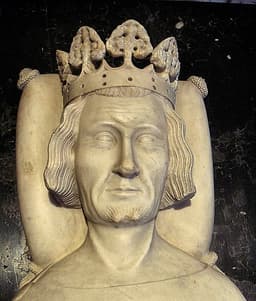
Levon V of Armenia
Emperor · Medieval
35.5Total
Basic Information
Born
880
1342
Died
947
1393
Era
Medieval
Medieval
Nationality
Italy
Cilician Armenia
Occupation
Emperor
Emperor
Civilization
Western
Middle Eastern
Score Comparison
Military (10%)
35.0
10.2
Political (20%)
37.9
26.4
Influence (20%)
48.6
47.9
Legacy (20%)
38.3
38.3
Leadership (15%)
58.8
33.6
Strategy (15%)
41.0
39.6
TOTAL
43.8
35.5
Hugh of Italy — Complete Timeline
926 AD
Crowned King of ItalyPolitical Action◆ Major
Hugh was crowned King of Italy in Pavia, succeeding Rudolf II. His reign was marked by efforts to centralize power and resist Magyar raids, but he faced constant opposition from the Italian nobility and the Papacy.
CoronationItalyKingship
Impact: regional
932 AD
Marriage to MaroziaPolitical Action◆ Major
Hugh of Italy married Marozia, the powerful Roman senator and mother of Pope John XI. This marriage aimed to strengthen his control over Rome and the Papacy, but it provoked opposition from Roman nobles and led to his downfall.
Marriage AllianceRomePapal Politics
Impact: regional
933 AD
Conflict with Pope John XIPolitical Action
Hugh attempted to control the Papacy by deposing Pope John XI, his stepson, but failed due to Roman opposition. This conflict weakened his influence in Rome and contributed to the instability of his reign.
Papal ConflictRomePower Struggle
Impact: regionaldestructive
945 AD
Defeat by Berengar of IvreaWar◆ Major
Hugh was defeated by Berengar of Ivrea (later Berengar II) near the Po River. This military loss forced Hugh to flee to Provence, where he died shortly after, ending his rule over Italy and paving the way for Berengar's rise.
Civil WarItalyDefeat
Impact: regionaltragic
Levon V of Armenia — Complete Timeline
1374 AD
Coronation as King of Cilician ArmeniaPolitical Action◆ Major
Levon V was crowned King of Cilician Armenia in Sis, the capital, after the death of his cousin King Constantine IV. His coronation was contested by rival claimants and occurred during a period of intense Mamluk pressure on the kingdom.
CoronationCilician ArmeniaMonarchy
Impact: national
1375 AD
Fall of the Kingdom of Cilician ArmeniaWar◆ Major
Mamluk forces captured the capital Sis after a siege, ending the Kingdom of Cilician Armenia. Levon V was taken prisoner and the kingdom was annexed by the Mamluk Sultanate, marking the end of Armenian statehood in Cilicia.
Fall of KingdomMamluksConquest
Impact: regionaltragic
1382 AD
Release from Captivity and Exile in EuropePolitical Action◆ Major
After seven years of Mamluk captivity, Levon V was ransomed by King John I of Castile. He traveled to Europe, seeking support for a crusade to restore his kingdom, but failed to secure military aid. He spent his remaining years in Spain and France.
ExileRansomCrusade
Impact: regionaltragic
1393 AD
Death in Paris and Burial at Saint-DenisCultural
Levon V died in Paris and was buried in the Basilica of Saint-Denis, the traditional burial place of French kings. His tomb became a symbol of the lost Armenian kingdom and a site of pilgrimage for Armenians in Europe.
DeathBurialSymbolism
Impact: nationaltragic
Expert Analysis
Origins
Hugh of Italy was born around 880 in the Arles region, the son of Theobald of Arles and Bertha of Lotharingia. He belonged to the Bosonid dynasty, which had ties to the Carolingian nobility. His early life was shaped by the political fragmentation of post-Carolingian Italy, where local magnates vied for control. Hugh's family background gave him claims to Burgundy and Italy, but his rise required strategic marriages and alliances.
Levon V of Armenia was born in 1342 in Cilician Armenia, the son of a noble family. He was the last of the Lusignan dynasty, which had ruled Cilician Armenia since 1344. His early life was marked by the kingdom's precarious position between the Mamluk Sultanate and Latin Crusader states. Educated in the courts of Cyprus and Armenia, he inherited a realm already in decline, with internal factionalism and external threats.
Rise to Power
Hugh of Italy rose to prominence after the death of King Rudolf II in 926. He was crowned King of Italy in Pavia in 926, succeeding Rudolf. His key turning point was his marriage to Marozia, the powerful Roman senator and mother of Pope John XI, in 932. This alliance aimed to give him control over Rome and the papacy. However, his rule was contested by Berengar of Ivrea, a rival noble who opposed Hugh's centralization efforts. Hugh's political score of 37.9 reflects his ability to manipulate alliances but also his failure to secure lasting power.
Levon V ascended the throne in 1374 after the death of his cousin King Constantine IV. His coronation in Sis was contested by rival factions within the Armenian nobility, who disputed his Lusignan lineage. The kingdom was already weakened by Mamluk incursions and internal strife. Levon's political score of 26.4 indicates his limited capacity to unify his realm or gain external support. His rise was overshadowed by the imminent fall of Cilician Armenia.
Leadership & Governance
Hugh of Italy governed through a mix of military force and diplomatic marriages. He sought to centralize royal authority by curbing the power of feudal lords and defending against Magyar raids. He issued laws to strengthen the crown, but his reliance on foreign mercenaries alienated local nobles. His leadership score of 58.8 suggests a competent but not exceptional ruler. For example, he attempted to depose Pope John XI, his stepson, but failed due to Roman opposition, showing his limitations in controlling the papacy.
Levon V ruled a kingdom on the brink of collapse. He tried to negotiate with the Mamluks and seek aid from European powers, but his efforts were hampered by a lack of resources and internal divisions. His leadership score of 33.6 reflects his inability to prevent the kingdom's fall. He focused on maintaining diplomatic ties with Cyprus and the West, but without substantial military or financial support, his governance was largely reactive.
Triumph & Tragedy
Hugh of Italy's greatest success was his coronation as King of Italy and his efforts to unify the kingdom, which temporarily stabilized the region. He also repelled some Magyar raids. However, his greatest failure was his defeat by Berengar of Ivrea near the Po River in 945, which forced him to flee to Provence, where he died shortly after. His marriage to Marozia initially seemed a triumph but ultimately led to conflict with the papacy and Roman aristocracy.
Levon V's coronation as king was a brief triumph, symbolizing the continuation of the Armenian kingdom. His release from Mamluk captivity in 1382, after seven years, and his subsequent exile in Europe, where he sought support for a crusade, showed his resilience. However, his greatest tragedy was the fall of Cilician Armenia in 1375, when Mamluks captured Sis and ended the kingdom. He died in Paris in 1393, a king without a realm, buried at Saint-Denis.
Character & Destiny
Hugh of Italy was pragmatic and ambitious, using marriage and diplomacy to expand his influence. However, his overreach in trying to control the papacy and his military weakness against Berengar led to his downfall. His character score of 58.8 in leadership suggests a determined but flawed ruler. Historical assessments note that his reign was a temporary consolidation in a period of fragmentation.
Levon V was a tragic figure, inheriting an impossible situation. He was persistent in seeking aid but lacked the resources to change his kingdom's fate. His character score of 33.6 highlights his limitations as a leader. He is remembered as a symbol of Armenian resilience, but his destiny was sealed by external forces beyond his control.
Legacy
Hugh of Italy's legacy is minor; he is remembered as one of the many kings of Italy during the feudal era. His attempts to centralize power had little lasting effect, and his dynasty faded after his death. His influence score of 48.6 reflects his role in the complex politics of 10th-century Italy, but he is not a major historical figure.
Levon V's legacy is more significant, especially for Armenian national identity. He is the last king of Cilician Armenia, and his exile and death in Paris symbolize the end of an era. His tomb at Saint-Denis became a pilgrimage site for Armenians. His influence score of 47.9 is similar to Hugh's, but his symbolism endures. The fall of Cilician Armenia led to the diaspora and the loss of Armenian sovereignty for centuries.
Conclusion
Hugh of Italy had a slightly higher total score (43.8 vs 35.5) and achieved more in terms of political maneuvering and temporary unification of Italy. However, his impact was limited to his lifetime. Levon V, despite a lower score, has a more enduring legacy as a symbol of Armenian nationhood. In terms of historical significance, Levon V's role as the last king of a kingdom that fell to the Mamluks and his subsequent exile in Europe carries more weight than Hugh's brief rule. Therefore, Levon V had a greater long-term impact, even though his scores are lower.
Rankings
🥇
Hugh of ItalyLeader
Mil: 35.0Pol: 37.9Inf: 48.6
43.8
🥈
Levon V of Armenia
Mil: 10.2Pol: 26.4Inf: 47.9
35.5
+8.3 behind
How This Comparison Works
Algorithm
Each figure is scored on 6 dimensions (0—100 scale) based on structured historical data: Military (10%), Political (20%), Influence (20%), Legacy (20%), Leadership (15%), Strategy (15%). The weighted total produces the final ranking.
Data Sources
Scores are computed from structured sub-indicators in the database. Scale factors adjust for era (Ancient ×0.85, Modern ×1.0) and civilization size (Eastern ×1.05, Other ×0.80) to account for differences in population and military scale.
Maximum 3 Figures
Comparisons are limited to 2—3 figures to ensure readability and statistical meaningfulness.
Error Margins
±5 points per dimension — Sub-scores are derived from historical records with inherent uncertainty. Two figures within 5 points on a dimension should be considered roughly equivalent in that area.
Total Score Accuracy
±3 points overall — The weighted combination of 6 dimensions produces a total score with approximately ±3 points of uncertainty. Differences of less than 3 points are not statistically significant— the figures are effectively tied.
Known Limitations
- Historical records are incomplete and uneven across civilizations
- Figures from oral-tradition societies may be underrepresented
- Occupation labels can misclassify multi-role figures
- Scores measure capability and impact, not moral character
- Quantitative scoring is a comparison tool, not absolute truth
Capability Radar
Military (10%) — Battles & Warfare
Battles
25
10
Win Rate
30
10
Expansion
25
5
Political (20%) — Governance & Reform
Reform
30
10
Diplomacy
40
30
Economy
30
10
Influence (20%) — Cultural & Global Reach
Cultural
15
15
Global
5
10
Legacy (20%) — Historical Impact
Historical
20
20
Longevity
10
10
Leadership (15%) — Power & Stability
Tenure
55
20
Stability
20
10
Strategy (15%) — Tactics & Innovation
Strategy
20
10
Tactics
20
10
Reform
10
5
Similar Comparisons
Comments & Discussion
No comments yet. Be the first to share your thoughts!