Loading...
Hermann Balck vs Rana Pratap
Rana Pratap leads by 2.1 pts · 2 figures compared
…

Hermann Balck
General · Modern
52.3Total
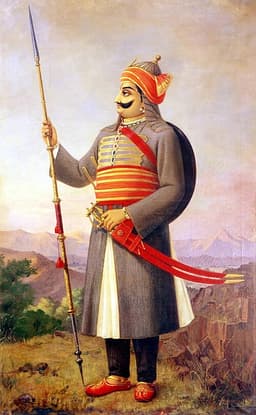
Rana Pratap
General · Modern
54.4Total
Basic Information
Born
1893
1540
Died
1982
1597
Era
Modern
Modern
Nationality
Germany
India
Occupation
General
General
Civilization
Western
Indian
Score Comparison
Military (10%)
80.8
40.0
Political (20%)
32.2
43.7
Influence (20%)
55.7
60.0
Legacy (20%)
50.0
54.0
Leadership (15%)
40.4
62.2
Strategy (15%)
69.2
60.0
TOTAL
52.3
54.4
Hermann Balck — Complete Timeline
1942 AD
Command of 11th Panzer DivisionWar
Balck commanded the 11th Panzer Division on the Eastern Front. He led the division in the battles of the Don River bend and the Chir River, where it conducted successful counterattacks against Soviet forces.
World War IIEastern FrontPanzer Division
Impact: regional
1944 AD
Battle of the Marne (1944)War◆ Major
Balck commanded the 48th Panzer Corps during the German defense against the Soviet Lvov-Sandomierz Offensive. His corps conducted a mobile defense that temporarily halted the Soviet advance, though the front ultimately collapsed.
World War IIEastern FrontMobile Defense
Impact: regional
Command of 4th Panzer ArmyWar◆ Major
Balck was appointed commander of the 4th Panzer Army on the Eastern Front. He led the army during the defensive battles in Galicia and Poland, attempting to contain the Soviet summer offensives.
World War IIEastern FrontCommand
Impact: regional
Battle of the BulgeWar◆ Major
Balck commanded Army Group G during the Battle of the Bulge, the German offensive in the Ardennes. His army group was tasked with secondary operations in Alsace, which failed to achieve their objectives.
World War IIWestern FrontArdennes
Impact: regional
Rana Pratap — Complete Timeline
1576 AD
Battle of HaldighatiWar◆ Major
Rana Pratap led Rajput forces against the Mughal army commanded by Raja Man Singh near Haldighati. Though defeated, Pratap escaped and continued guerrilla resistance. The battle became a symbol of Rajput defiance against Mughal expansion.
Mughal-Rajput WarsBattleResistance
Impact: regional
1577 AD
Alliance with the Bhil TribePolitical Action
Rana Pratap formed an alliance with the Bhil tribal chieftains, securing their support for his guerrilla campaign against the Mughals. This alliance provided him with local knowledge and resources.
AllianceGuerrilla WarfareTribal
constructive
1585 AD
Recapture of Chittor FortWar◆ Major
After years of guerrilla warfare, Rana Pratap recaptured the Chittor Fort from Mughal control. This victory restored Mewar's independence and solidified his legacy as a symbol of Rajput resistance.
MewarFortressIndependence
Impact: regionalconstructive
Expert Analysis
Origins
Hermann Balck was born on December 7, 1893, in Danzig, Germany, into a military family. His father, a Prussian officer, instilled discipline and a sense of duty. Balck entered the German army in 1913 and served in World War I, gaining experience in infantry tactics. His early career was shaped by the interwar Reichswehr, where he studied armored warfare.
Rana Pratap was born on May 9, 1540, in Kumbhalgarh, Rajasthan, to Maharana Udai Singh II, the ruler of Mewar. As a Rajput prince, he was trained in martial arts, horsemanship, and statecraft. His upbringing was steeped in Rajput honor and resistance against foreign domination, particularly the expanding Mughal Empire.
Rise to Power
Balck rose through the ranks during the interwar period, serving in staff positions and commanding panzer units. His breakthrough came in 1943 when he commanded the 11th Panzer Division on the Eastern Front, earning a reputation for mobile defense. In 1944, he was given command of the 48th Panzer Corps and later the 4th Panzer Army, where he conducted successful defensive operations against Soviet offensives.
Rana Pratap ascended the throne of Mewar in 1572, inheriting a kingdom under threat from the Mughal emperor Akbar. Unlike other Rajput rulers who submitted to Mughal suzerainty, Pratap chose resistance. His refusal to accept Akbar's authority led to the Battle of Haldighati in 1576, where he faced a Mughal army led by Raja Man Singh. Though defeated, Pratap escaped and waged a guerrilla war.
Leadership & Governance
Balck's leadership was characterized by tactical flexibility and aggressive defense. He believed in decentralized command, allowing subordinates to exploit local opportunities. On the Eastern Front, he used panzer divisions to counterattack Soviet breakthroughs, often achieving local successes despite overall strategic retreat. His governance was limited to military command, with no political role.
Rana Pratap's leadership was defined by his unwavering commitment to independence. He maintained the loyalty of his clan and tribal allies through personal example and shared sacrifice. His governance focused on preserving Rajput traditions and protecting his people from Mughal oppression. He used guerrilla tactics, avoiding pitched battles, and relied on mountain forts and local support.
Triumph & Tragedy
Balck's greatest success was his defense during the Lvov-Sandomierz Offensive in 1944, where his 48th Panzer Corps inflicted heavy casualties on Soviet forces. However, his tragedy was his involvement in the failed Ardennes Offensive (Battle of the Bulge), where his Army Group G could not achieve its objectives. He was captured in 1945 and later served as a military advisor in West Germany.
Rana Pratap's triumph was the recapture of Chittor Fort in 1585 after years of guerrilla warfare, restoring Mewar's independence. His tragedy was the loss at Haldighati, where many of his warriors died. He spent years in exile, living in forests and mountains, but never surrendered. He died in 1597, having secured his kingdom's autonomy.
Character & Destiny
Balck was a professional soldier, focused on tactical problems rather than ideology. He was known for his coolness under pressure and ability to improvise. However, his narrow focus on tactics limited his strategic influence. His destiny was tied to the Nazi regime, which he served without political engagement, leading to his postwar obscurity.
Rana Pratap was a symbol of Rajput valor and resistance. His character was defined by stubbornness and honor, refusing to compromise even when outmatched. This led to his long struggle and eventual success, but also to great personal suffering. His destiny was to become a folk hero, embodying the spirit of independence.
Legacy
Balck's legacy is primarily within military history. His mobile defense tactics are studied in war colleges, but he is largely forgotten outside specialist circles. His scores reflect this: Military 80.8, Influence 55.7, Legacy 50.0. He had no lasting political impact.
Rana Pratap's legacy is immense in India, especially in Rajasthan. He is celebrated as a symbol of resistance against foreign rule. His story is taught in schools, and his life has inspired literature and films. His scores: Influence 60.0, Legacy 54.0, Leadership 62.2. He shaped Rajput identity and continues to inspire.
Conclusion
Rana Pratap had a greater impact than Hermann Balck. While Balck was a tactical genius, his achievements were confined to a losing cause and had no long-term political or cultural effect. In contrast, Pratap's resistance preserved Mewar's independence and created a lasting symbol of defiance. His total score of 54.4 vs Balck's 52.3 reflects this, but the gap in legacy and influence is more significant. Pratap's story continues to inspire millions, while Balck is a footnote in military history. Thus, Rana Pratap is the more historically significant figure.
Rankings
🥇
Rana PratapLeader
Mil: 40.0Pol: 43.7Inf: 60.0
54.4
🥈
Hermann Balck
Mil: 80.8Pol: 32.2Inf: 55.7
52.3
+2.1 behind
How This Comparison Works
Algorithm
Each figure is scored on 6 dimensions (0—100 scale) based on structured historical data: Military (10%), Political (20%), Influence (20%), Legacy (20%), Leadership (15%), Strategy (15%). The weighted total produces the final ranking.
Data Sources
Scores are computed from structured sub-indicators in the database. Scale factors adjust for era (Ancient ×0.85, Modern ×1.0) and civilization size (Eastern ×1.05, Other ×0.80) to account for differences in population and military scale.
Maximum 3 Figures
Comparisons are limited to 2—3 figures to ensure readability and statistical meaningfulness.
Error Margins
±5 points per dimension — Sub-scores are derived from historical records with inherent uncertainty. Two figures within 5 points on a dimension should be considered roughly equivalent in that area.
Total Score Accuracy
±3 points overall — The weighted combination of 6 dimensions produces a total score with approximately ±3 points of uncertainty. Differences of less than 3 points are not statistically significant— the figures are effectively tied.
Known Limitations
- Historical records are incomplete and uneven across civilizations
- Figures from oral-tradition societies may be underrepresented
- Occupation labels can misclassify multi-role figures
- Scores measure capability and impact, not moral character
- Quantitative scoring is a comparison tool, not absolute truth
Capability Radar
Military (10%) — Battles & Warfare
Battles
85
45
Win Rate
88
30
Expansion
45
25
Political (20%) — Governance & Reform
Reform
15
30
Diplomacy
25
35
Economy
10
25
Influence (20%) — Cultural & Global Reach
Cultural
30
60
Global
35
30
Legacy (20%) — Historical Impact
Historical
55
55
Longevity
40
50
Leadership (15%) — Power & Stability
Tenure
20
40
Stability
15
20
Strategy (15%) — Tactics & Innovation
Strategy
82
40
Tactics
95
55
Reform
60
20
Similar Comparisons
Comments & Discussion
No comments yet. Be the first to share your thoughts!