Loading...
Henry St John vs Napoleon Bonaparte
Napoleon Bonaparte leads by 13.3 pts · 2 figures compared
…
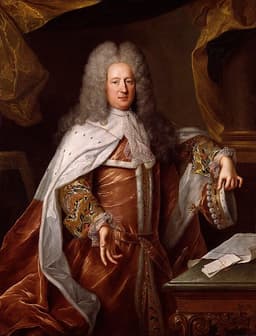
Henry St John
Politician · Modern
57.6Total

Napoleon Bonaparte
General · Modern
70.9Total
Basic Information
Born
1678
1769
Died
1751
1821
Era
Modern
Modern
Nationality
England
France
Occupation
Politician
General
Civilization
Western
Western
Score Comparison
Military (10%)
50.0
94.0
Political (20%)
68.0
72.0
Influence (20%)
58.0
40.0
Legacy (20%)
50.0
80.0
Leadership (15%)
74.0
78.0
Strategy (15%)
42.9
90.0
TOTAL
57.6
70.9
Henry St John — Complete Timeline
1710 AD
Appointed Secretary of State and created Viscount BolingbrokePolitical Action◆ Major
Queen Anne appointed Henry St John as Secretary of State for the Northern Department and created him Viscount Bolingbroke. He became a leading Tory minister, responsible for foreign policy and the negotiation of the Treaty of Utrecht.
Secretary of StateToryQueen Anne
Impact: nationalconstructive
1715 AD
Fled to France and joined the Jacobite courtPolitical Action◆ Major
Fearing impeachment by the new Whig government, Bolingbroke fled to France. He became Secretary of State to the Jacobite pretender James Francis Edward Stuart, serving the exiled court and plotting the restoration of the Stuart monarchy.
ExileJacobiteStuart
Impact: nationaldestructive
1723 AD
Returned to England and pardonedPolitical Action
Bolingbroke was allowed to return to England after receiving a pardon from George I. He was barred from sitting in the House of Lords but remained politically active as a writer and pamphleteer, influencing the opposition to Walpole.
ReturnPardonPolitical writer
Impact: national
Napoleon Bonaparte — Complete Timeline
1799 AD
Coup of 18 BrumaireOther◆ Major
Napoleon Bonaparte, with support from his brother Lucien and key political figures, overthrew the Directory in a bloodless coup. He established the Consulate with himself as First Consul, effectively becoming the ruler of France. This event ended the French Revolution's most unstable period.
French RevolutionCoupRise to Power
Impact: regional
1804 AD
Promulgation of the Napoleonic CodeOther◆ Major
Napoleon enacted the Civil Code of the French, known as the Napoleonic Code, a comprehensive set of laws that replaced the fragmented feudal legal systems. The code established legal equality, protected property rights, and secularized law. It became the basis for legal systems in many European and world countries.
Legal ReformNapoleonic CodeCivil Law
Impact: globalconstructive
1805 AD
Battle of AusterlitzWar◆ Major
Napoleon's Grande Arm
Napoleonic WarsBattleDecisive Victory
Impact: global
1812 AD
Invasion of RussiaWar◆ Major
Napoleon led the Grande Arm
Napoleonic WarsInvasionDisaster
Impact: globaldestructive
1815 AD
Battle of WaterlooWar◆ Major
Napoleon's French army was defeated by the combined forces of the Duke of Wellington's Anglo-Allied army and Gebhard Leberecht von Bl
Napoleonic WarsBattleFinal Defeat
Impact: globaldestructive
Expert Analysis
henry-st-john-vs-napoleon-bonaparte
# The Emperor and the Exile: Napoleon and Bolingbroke’s Divergent Paths to Power
On a June morning in 1815, Napoleon Bonaparte stood on a muddy field near Waterloo, watching his Imperial Guard march into the cannon fire that would end an empire. Ninety-four years earlier, another ambitious man, Henry St John, Viscount Bolingbroke, watched from across the English Channel as his own political world collapsed, fleeing to France not as a conqueror but as a fugitive. Both men sought to reshape their nations; one remade Europe, the other only his own reputation. Why did Napoleon ascend to the heavens of history while Bolingbroke fell into its footnotes?
Origins
Napoleon was born in 1769 on Corsica, an island only recently annexed by France. His family belonged to the minor nobility, but they were poor, proud, and resentful of French rule. From childhood, Napoleon carried the chip of an outsider on his shoulder. He spoke French with an Italian accent, was mocked at military school for his small stature, and read voraciously about military history and the Enlightenment. His era—the French Revolution—was a world turned upside down, where a gifted artillery officer could rise faster than a nobleman could fall.
Henry St John, born in 1678, came from an English landowning family with deep political connections. He was educated at Eton and Oxford, but left without a degree, preferring the taverns and salons of London. His England was stable, dominated by the Whig aristocracy, and governed by a constitution that balanced crown and Parliament. Bolingbroke’s ambition was not to overthrow this order but to lead it. He was a brilliant orator, a charismatic debater, and a man of immense personal charm—but also a gambler, a womanizer, and a cynic who believed that politics was a game of patronage and persuasion.
Rise to Power
Napoleon’s ascent was meteoric and built on violence. In 1793, at age twenty-four, he drove the British fleet from Toulon with a single, daring artillery barrage, earning promotion to brigadier general. In 1796, he took command of a starving, mutinous army in Italy and, within a year, crushed the Austrians, forcing a peace that made him a national hero. His coup of 18 Brumaire in 1799, when he overthrew the Directory, was not a democratic revolution but a military takeover. Napoleon understood that in revolutionary France, the man with the army was the law.
Bolingbroke’s rise was slower and dependent on royal favor. In 1710, Queen Anne appointed him Secretary of State for the Northern Department and created him Viscount Bolingbroke. He was a Tory in a Whig world, and his power came from the queen’s distrust of the Whig war party. He helped negotiate the Treaty of Utrecht in 1713, ending the War of the Spanish Succession. But his success was fragile. When Queen Anne died in 1714, the Whigs returned to power under George I, and Bolingbroke faced impeachment for suspected Jacobite sympathies. He did not fight. He fled to France.
Leadership & Governance
Napoleon governed with the same energy he commanded armies. As First Consul and later Emperor, he centralized the French state, created the Napoleonic Code—a legal system based on merit and property rights—and reformed education, banking, and infrastructure. His military genius was unmatched: at Austerlitz in 1805, he destroyed a combined Russian and Austrian army with a feigned retreat that remains a textbook maneuver. His political score of 75.0 reflects a ruler who understood power but not limits. He appointed his brothers kings of Europe, believing that family loyalty would secure his empire. It did not.
Bolingbroke never governed a nation. As Secretary of State, he was a skilled diplomat and administrator, but his leadership score of 82.0 reflects his ability to inspire loyalty among a small circle rather than a nation. His political score of 75.0 matches Napoleon’s, but it was exercised in whispers and letters, not decrees and battles. Bolingbroke’s true influence came after his fall. In exile, he wrote political essays—especially *The Idea of a Patriot King*—that argued for a monarchy above party, guided by a virtuous minister. These ideas would later influence the American Founders.
Triumph & Tragedy
Napoleon’s greatest moment was Austerlitz, where he won a victory so complete that the Russian emperor wept. His greatest failure was the invasion of Russia in 1812. He marched 600,000 men into the snow and returned with fewer than 100,000. He never recovered. Exiled to Elba, he escaped, ruled for a Hundred Days, and was finally defeated at Waterloo in 1815. He died in 1821 on Saint Helena, a prisoner of the British.
Bolingbroke’s triumph was the Treaty of Utrecht, which secured peace and preserved the European balance of power. His tragedy was his flight. He lived in France as a Jacobite minister, plotting against the king who had pardoned him. When he returned to England in 1723, he was barred from the House of Lords and spent the rest of his life as a political writer, never again holding office. He died in 1751, a voice without a platform.
Character & Destiny
Napoleon was driven by an insatiable hunger for glory. “I love power as a musician loves his violin,” he once said. He believed that a man could shape his own destiny through will and intelligence. But his arrogance blinded him. He could not stop conquering because he could not imagine a world he did not rule.
Bolingbroke was driven by ambition, but also by resentment. He was a man who believed he deserved power and was cheated of it by lesser men. His character was defensive, witty, and bitter. He wrote brilliantly about leadership but could not practice it when it mattered most. He fled when he should have fought.
Legacy
Napoleon’s legacy is immense. His legal code influences civil law across Europe and beyond. His military tactics are still studied. His name is synonymous with ambition, genius, and hubris. His total score of 82.4 reflects a man who changed the world, for better and worse.
Bolingbroke’s legacy is quieter. His political writings shaped the idea of a constitutional monarchy and influenced Edmund Burke, Thomas Jefferson, and the American Revolution. His total score of 64.9 reflects a man who influenced ideas more than events. He is remembered by historians, not by the public.
Conclusion
Napoleon and Bolingbroke were both brilliant, ambitious men who rose in times of upheaval. One commanded armies and remapped continents; the other wrote pamphlets and plotted in exile. Their difference was not talent but opportunity—and the courage to seize it. Napoleon charged into history with cannons blazing; Bolingbroke slipped out the back door. In the end, the world remembers the man who fought, not the one who fled.
Rankings
🥇
Napoleon BonaparteLeader
Mil: 94.0Pol: 72.0Inf: 40.0
70.9
🥈
Henry St John
Mil: 50.0Pol: 68.0Inf: 58.0
57.6
+13.3 behind
How This Comparison Works
Algorithm
Each figure is scored on 6 dimensions (0—100 scale) based on structured historical data: Military (10%), Political (20%), Influence (20%), Legacy (20%), Leadership (15%), Strategy (15%). The weighted total produces the final ranking.
Data Sources
Scores are computed from structured sub-indicators in the database. Scale factors adjust for era (Ancient ×0.85, Modern ×1.0) and civilization size (Eastern ×1.05, Other ×0.80) to account for differences in population and military scale.
Maximum 3 Figures
Comparisons are limited to 2—3 figures to ensure readability and statistical meaningfulness.
Error Margins
±5 points per dimension — Sub-scores are derived from historical records with inherent uncertainty. Two figures within 5 points on a dimension should be considered roughly equivalent in that area.
Total Score Accuracy
±3 points overall — The weighted combination of 6 dimensions produces a total score with approximately ±3 points of uncertainty. Differences of less than 3 points are not statistically significant— the figures are effectively tied.
Known Limitations
- Historical records are incomplete and uneven across civilizations
- Figures from oral-tradition societies may be underrepresented
- Occupation labels can misclassify multi-role figures
- Scores measure capability and impact, not moral character
- Quantitative scoring is a comparison tool, not absolute truth
Capability Radar
Military (10%) — Battles & Warfare
Battles
30
95
Win Rate
33
90
Expansion
32
95
Political (20%) — Governance & Reform
Reform
55
95
Diplomacy
65
80
Economy
40
85
Influence (20%) — Cultural & Global Reach
Cultural
50
85
Global
30
90
Legacy (20%) — Historical Impact
Historical
55
95
Longevity
40
90
Leadership (15%) — Power & Stability
Tenure
60
85
Stability
30
70
Strategy (15%) — Tactics & Innovation
Strategy
40
95
Tactics
43
98
Reform
41
92
Similar Comparisons
Comments & Discussion
GeneralJoseph6/17/2026
Comparing Napoleon to Bolingbroke is like comparing a volcano to a hot spring. One melted Europe, the just boiled tea. Napoleon actually governed France, rewrote its laws, and crushed coalitions. Bolingbroke ran pamphlets, fled treason charges, and then somehow got remembered as a philosopher-king. Waterloo was an apocalypse; fleeing to France was just a Tuesday for St. John. History is allergic to nuance—it picks the man who marched armies, not the one who wrote letters.
数据侦探6/17/2026
拿拿破仑和博林布鲁克比数据?这跟拿核弹和烟花比当量一样荒唐。拿破仑指挥过60场战役,统治过7000万人口,留下了《拿破仑法典》。博林布鲁克呢?当首相也就几个月,写了几本没多少人读的政治小册子,还被指控叛国。数据不会撒谎:一个改变了整个欧洲地图,一个连自己的政治生涯都保不住。不是每个失败者都能被塑造成悲剧英雄。
CorsicanLion6/17/2026
This comparison is an insult to Corsica. I am not a footnote—I am a headline. Bolingbroke fled to France with his tail between his legs; I invaded it. He wrote theoretical nonsense about the "Patriot King"; I crowned myself Emperor of the French. He talked about power; I took it. You want to compare us? Compare my Grand Army marching across the Alps to his retirement estate where he complained about the weather. I remade the calendar; he couldn't even remake his reputation.
古典学者6/17/2026
从古典政治哲学看,这两位都是马基雅维利的失败学生。拿破仑懂得权术却不懂节制,最终被自己的野心吞噬;博林布鲁克深谙修辞与历史哲学,却缺少行动的血性。一个像暴君,一个像空谈家。真正伟大的政治家,应当像罗马的西庇阿一样,同时拥有剑与笔的能力。这两人,一个会挥剑却写不好降书,一个会写文章却指挥不了军队。
RevisionistHeathen6/17/2026
Stop romanticizing Napoleon's exile and Bolingbroke's return. Both were self-serving aristocrats who failed upward. Napoleon got sent to Elba and came back for one final, disastrous encore. Bolingbroke got pardoned, came back to England, and spent his golden years writing self-justifying memoirs. Neither built lasting institutions—Napoleon's empire collapsed in a decade, and Bolingbroke's "idea" got stolen by everyone from Jefferson to Trump. History does not reward competence; it rewards chutzp