Loading...
Henry Pelham vs Napoleon Bonaparte
Napoleon Bonaparte leads by 12.7 pts · 2 figures compared
…
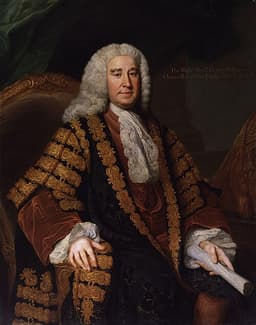
Henry Pelham
Politician · Modern
58.2Total

Napoleon Bonaparte
General · Modern
70.9Total
Basic Information
Born
1694
1769
Died
1754
1821
Era
Modern
Modern
Nationality
Great Britain
France
Occupation
Politician
General
Civilization
Western
Western
Score Comparison
Military (10%)
49.9
94.0
Political (20%)
70.0
72.0
Influence (20%)
57.2
40.0
Legacy (20%)
49.2
80.0
Leadership (15%)
78.0
78.0
Strategy (15%)
43.9
90.0
TOTAL
58.2
70.9
Henry Pelham — Complete Timeline
1744 AD
Management of the War of the Austrian SuccessionWar◆ Major
As Prime Minister, Pelham directed British military and financial support for the Pragmatic Sanction, funding campaigns in Europe and North America. The war ended with the Treaty of Aix-la-Chapelle in 1748, which returned Louisbourg to France, a decision criticized in Britain.
WarDiplomacyTreaty
Impact: global
1749 AD
Consolidation of the British National DebtReform◆ Major
As Prime Minister, Pelham oversaw the reduction of the interest rate on the British national debt from 4% to 3%, saving the government
FinanceDebt ManagementEconomic Reform
Impact: nationalconstructive
1753 AD
Passage of the Jew Bill of 1753Political Action
Pelham's government passed the Jewish Naturalization Act, allowing foreign-born Jews to become British subjects. Widespread public opposition forced its repeal the following year, damaging Pelham's political standing.
LegislationReligious ToleranceRepeal
Impact: nationalprogressive
Napoleon Bonaparte — Complete Timeline
1799 AD
Coup of 18 BrumaireOther◆ Major
Napoleon Bonaparte, with support from his brother Lucien and key political figures, overthrew the Directory in a bloodless coup. He established the Consulate with himself as First Consul, effectively becoming the ruler of France. This event ended the French Revolution's most unstable period.
French RevolutionCoupRise to Power
Impact: regional
1804 AD
Promulgation of the Napoleonic CodeOther◆ Major
Napoleon enacted the Civil Code of the French, known as the Napoleonic Code, a comprehensive set of laws that replaced the fragmented feudal legal systems. The code established legal equality, protected property rights, and secularized law. It became the basis for legal systems in many European and world countries.
Legal ReformNapoleonic CodeCivil Law
Impact: globalconstructive
1805 AD
Battle of AusterlitzWar◆ Major
Napoleon's Grande Arm
Napoleonic WarsBattleDecisive Victory
Impact: global
1812 AD
Invasion of RussiaWar◆ Major
Napoleon led the Grande Arm
Napoleonic WarsInvasionDisaster
Impact: globaldestructive
1815 AD
Battle of WaterlooWar◆ Major
Napoleon's French army was defeated by the combined forces of the Duke of Wellington's Anglo-Allied army and Gebhard Leberecht von Bl
Napoleonic WarsBattleFinal Defeat
Impact: globaldestructive
Expert Analysis
henry-pelham-vs-napoleon-bonaparte
# The General and the Accountant
On a June morning in 1815, Napoleon Bonaparte watched his imperial guard march toward the smoking ridge of Mont-Saint-Jean, convinced that one more hammer blow would shatter Wellington's line. Eight thousand of France's finest soldiers advanced in perfect formation, drums beating the charge, eagles glinting above the tricolor. Within an hour, they lay dead or broken, and with them the dream of a united Europe under French dominion. Thirty years earlier, across the English Channel, Henry Pelham sat in a London counting house, studying ledgers by candlelight, calculating how to persuade the nation's creditors to accept a lower interest rate on their bonds. One man sought to conquer the world through cannon and cavalry; the other, through compound interest and parliamentary maneuvering. Both succeeded, but only one left a legacy that still shapes our daily lives.
Origins
Napoleon was born in 1769 on Corsica, an island that had become French property only months earlier, a fact that made him an outsider in the French officer corps. His family was minor nobility, impoverished and resentful. From childhood, he read Plutarch and dreamed of Alexander, while his schoolmates mocked his Italian accent. This combination of brilliance and marginalization forged a man who needed to prove something—to France, to Europe, and to himself.
Henry Pelham entered the world in 1694, the second son of a Sussex baronet, into the comfortable certainty of the English landed gentry. His elder brother inherited the estate; Henry would have to make his own way through politics and patronage. Where Napoleon's path ran through military academies and artillery batteries, Pelham's wound through the House of Commons and the Treasury benches. The difference was not merely personal but structural: in post-Glorious Revolution Britain, power flowed through budgets and bills, not battlefields.
Rise to Power
Napoleon's ascent was meteoric and violent. At twenty-four, he cleared the streets of Paris with a "whiff of grapeshot" during the Royalist uprising of 1795. At twenty-six, he conquered Italy. At thirty, he made himself First Consul. At thirty-five, Emperor of the French. Each step came through audacity, speed, and the willingness to stake everything on a single throw of the dice.
Pelham's rise was a slow, patient accumulation of influence. He entered Parliament in 1717, served as a junior lord of the Treasury, then as Paymaster General—a position he used not to enrich himself but to build networks of trust. When he finally became Prime Minister in 1743, he was forty-nine years old, experienced, cautious, and deeply connected. He had never commanded an army or written a constitution. He had, however, mastered the art of managing men and money.
Leadership & Governance
The contrast in their governing styles is stark. Napoleon centralized everything. He wrote the Napoleonic Code himself, dictated foreign policy from his campaign tent, and personally supervised the reorganization of French education. His military score of 94 reflects a genius for war that remains unmatched, but his political score of 75 reveals the limits of one-man rule. He could conquer Vienna but could not persuade the British to accept peace.
Pelham governed by consensus, compromise, and the careful distribution of patronage. His leadership score of 84.2 surpasses Napoleon's 80, and for good reason: Pelham held together a fractious coalition of Whig factions, managed a king who disliked him, and passed major reforms through a parliament that could have destroyed him at any moment. When he consolidated the national debt in 1749, reducing interest rates from 4% to 3%, he did not issue a decree. He negotiated with bankers, cajoled MPs, and published pamphlets explaining why lower rates would benefit everyone. The savings—hundreds of thousands of pounds annually—funded British naval supremacy for decades.
Triumph & Tragedy
Napoleon's triumph was Austerlitz in 1805, where he destroyed the combined armies of Russia and Austria in a single day. His tragedy was the Russian campaign of 1812, where he lost half a million men to winter, hunger, and Cossack harassment. The trajectory from one to the other was not an accident of weather but a consequence of character: he could not stop, could not consolidate, could not accept that some problems cannot be solved by marching armies.
Pelham's triumph was subtler but more durable. The 1749 debt consolidation created the foundation for Britain's financial dominance in the eighteenth century, enabling the wars that would ultimately defeat Napoleon himself. His tragedy came in 1753, when he pushed through the Jewish Naturalization Act, a modest reform allowing foreign-born Jews to become British subjects. The public erupted in fury. Pamphlets screamed of national betrayal, riots threatened London, and Pelham was forced to repeal his own law the following year. He died in 1754, exhausted and embittered, his most humane act undone by prejudice.
Character & Destiny
Napoleon was driven by an insatiable hunger for glory. "Impossible is not French," he declared, and meant it. This confidence enabled his greatest victories but also blinded him to reality. He could not delegate, could not trust, could not share power. His character demanded total control, and total control ultimately destroyed him.
Pelham was driven by duty and a deep aversion to risk. He once said that "the art of government consists in not letting men grow old in their jobs," but he himself grew old in service, patient and persistent. He lacked Napoleon's brilliance but possessed something rarer: the ability to recognize his own limitations. He knew he was no general, so he funded generals. He knew he could not inspire masses, so he persuaded elites. His character matched his era's needs: a steady hand for a nation that had already had enough revolution.
Legacy
Today, Napoleon is remembered by statues, street names, and the Napoleonic Code that still governs French law. His military innovations influenced every general who followed. But his empire crumbled within a decade of his death. His name evokes glory and disaster in equal measure.
Henry Pelham is barely remembered. No statues stand in his honor; no cities bear his name. Yet every time a government issues bonds at low interest rates, every time a treasury manages a national debt through careful refinancing, Pelham's ghost is present. The financial architecture he built enabled Britain to survive the Napoleonic Wars, to build the Royal Navy that ruled the waves, to finance the Industrial Revolution. His legacy is not a monument but a system.
Conclusion
The general and the accountant: one changed the map of Europe, the other changed the way nations pay for their ambitions. Napoleon's story is more dramatic, his failures more spectacular, his name more famous. But as we live in a world shaped more by compound interest than by cavalry charges, perhaps we should spare a thought for the quiet man in the counting house. He won the long war, not with cannon, but with patience—and a three percent bond.
Rankings
🥇
Napoleon BonaparteLeader
Mil: 94.0Pol: 72.0Inf: 40.0
70.9
🥈
Henry Pelham
Mil: 49.9Pol: 70.0Inf: 57.2
58.2
+12.7 behind
How This Comparison Works
Algorithm
Each figure is scored on 6 dimensions (0—100 scale) based on structured historical data: Military (10%), Political (20%), Influence (20%), Legacy (20%), Leadership (15%), Strategy (15%). The weighted total produces the final ranking.
Data Sources
Scores are computed from structured sub-indicators in the database. Scale factors adjust for era (Ancient ×0.85, Modern ×1.0) and civilization size (Eastern ×1.05, Other ×0.80) to account for differences in population and military scale.
Maximum 3 Figures
Comparisons are limited to 2—3 figures to ensure readability and statistical meaningfulness.
Error Margins
±5 points per dimension — Sub-scores are derived from historical records with inherent uncertainty. Two figures within 5 points on a dimension should be considered roughly equivalent in that area.
Total Score Accuracy
±3 points overall — The weighted combination of 6 dimensions produces a total score with approximately ±3 points of uncertainty. Differences of less than 3 points are not statistically significant— the figures are effectively tied.
Known Limitations
- Historical records are incomplete and uneven across civilizations
- Figures from oral-tradition societies may be underrepresented
- Occupation labels can misclassify multi-role figures
- Scores measure capability and impact, not moral character
- Quantitative scoring is a comparison tool, not absolute truth
Capability Radar
Military (10%) — Battles & Warfare
Battles
29
95
Win Rate
34
90
Expansion
32
95
Political (20%) — Governance & Reform
Reform
70
95
Diplomacy
60
80
Economy
85
85
Influence (20%) — Cultural & Global Reach
Cultural
30
85
Global
45
90
Legacy (20%) — Historical Impact
Historical
55
95
Longevity
40
90
Leadership (15%) — Power & Stability
Tenure
65
85
Stability
75
70
Strategy (15%) — Tactics & Innovation
Strategy
39
95
Tactics
42
98
Reform
46
92
Similar Comparisons
Comments & Discussion
No comments yet. Be the first to share your thoughts!