Loading...
Henry IV of Castile vs Ruganzu I Bwimba
Ruganzu I Bwimba leads by 2.5 pts · 2 figures compared
…
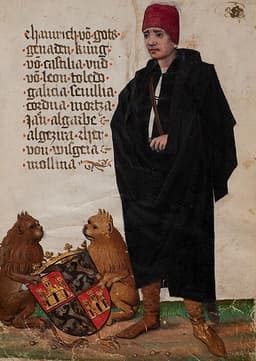
Henry IV of Castile
Emperor · Medieval
38.1Total

Ruganzu I Bwimba
Emperor · Medieval
40.6Total
Basic Information
Born
1425
1500
Died
1474
1543
Era
Medieval
Medieval
Nationality
Castile
Rwanda
Occupation
Emperor
Emperor
Civilization
Western
Other
Score Comparison
Military (10%)
21.2
14.9
Political (20%)
25.0
30.8
Influence (20%)
48.6
48.6
Legacy (20%)
41.7
38.3
Leadership (15%)
38.1
55.3
Strategy (15%)
39.6
45.0
TOTAL
38.1
40.6
Henry IV of Castile — Complete Timeline
1468 AD
Treaty of the Bulls of GuisandoPolitical Action◆ Major
Henry IV of Castile signed the Treaty of the Bulls of Guisando, recognizing his half-sister Isabella as his legitimate heir instead of his daughter Joanna. This agreement was intended to resolve the succession dispute, but Henry later repudiated it, leading to renewed conflict.
Succession crisisIsabella I
Impact: national
1474 AD
War of the Castilian SuccessionWar
After Henry IV's death, a civil war erupted between supporters of his daughter Joanna la Beltraneja and those of his half-sister Isabella. The war involved Portuguese and Aragonese intervention and ended with Isabella's victory, securing her throne and leading to the union of Castile and Aragon.
Civil warSuccession
Impact: nationaldestructive
Loss of the Canary IslandsWar
During the War of the Castilian Succession, Henry IV's forces lost control of the Canary Islands to Portuguese-backed rebels. The islands were later recovered by Isabella I, but the conflict highlighted the weakness of Henry's reign and the erosion of royal authority.
Territorial lossCanary Islands
Impact: regionaldestructive
Ruganzu I Bwimba — Complete Timeline
1520 AD
Founded the Nyiginya clan dynastyPolitical Action◆ Major
Ruganzu I Bwimba is credited with establishing the Nyiginya clan as the ruling dynasty of Rwanda, according to oral tradition. He unified several Hutu and Tutsi clans under his leadership, creating the foundation for the Rwandan kingdom that would later expand under his successors.
FoundingDynastyOral Tradition
Impact: regionalconstructive
1530 AD
Expanded territory through military campaignsWar◆ Major
Ruganzu I Bwimba led military expeditions to expand the territory under Nyiginya control, conquering neighboring regions in central Rwanda. These campaigns established the core of the Rwandan kingdom, incorporating areas that would later become the heartland of the state.
ExpansionConquestState Formation
Impact: regional
1540 AD
Established the ubuhake clientage systemReform◆ Major
Ruganzu I Bwimba is traditionally credited with formalizing the ubuhake system, a patron-client relationship between Tutsi cattle owners and Hutu farmers. This system structured social and economic relations in the kingdom, reinforcing Tutsi dominance over the Hutu majority for centuries.
Social StructureClientageInequality
Impact: regionaldestructive
Expert Analysis
Origins
Henry IV of Castile was born in 1425 to King John II of Castile and Maria of Aragon. He was the half-brother of the future Isabella I of Castile. His early life was marked by political intrigue and a weak father, leading to a fractured upbringing. Henry's education focused on military training and governance, but he lacked the decisiveness of his successors. In contrast, Ruganzu I Bwimba, a semi-legendary figure from the Nyiginya clan, is believed to have lived in the 14th or 15th century in what is now Rwanda. Little is known of his early life due to reliance on oral tradition, but he is said to have emerged as a leader during a period of Hutu and Tutsi consolidation. His origins are tied to the founding of the Nyiginya dynasty, which would rule Rwanda for centuries.
Rise to Power
Henry IV ascended to the throne of Castile in 1454 upon his father's death. His reign was immediately challenged by powerful nobles who resented his reliance on favorites. A key turning point was the 1464 Treaty of the Bulls of Guisando, where Henry recognized his half-sister Isabella as his heir instead of his daughter Joanna, whom many believed was illegitimate. This decision sowed the seeds for the War of the Castilian Succession (1475-1479). Ruganzu I Bwimba's rise is shrouded in myth. According to oral traditions, he unified several Hutu and Tutsi clans under the Nyiginya banner through a combination of diplomacy and military force. He is credited with establishing the ubuhake clientage system, which solidified Tutsi dominance over Hutu farmers. His rise was gradual, likely through a series of successful campaigns that expanded his territory in central Rwanda.
Leadership & Governance
Henry IV's leadership was marked by indecision and reliance on favorites, such as Juan Pacheco. His governance was weak, leading to noble revolts and a loss of royal authority. He failed to control the powerful magnates, and his inability to produce a clear heir caused chaos. His military score of 21.2 reflects his poor performance in conflicts, including the loss of the Canary Islands to Portuguese-backed rebels. In contrast, Ruganzu I Bwimba's leadership score of 55.3 indicates a more effective ruler. He established the ubuhake system, which structured Rwandan society into a feudal hierarchy with Tutsi patrons and Hutu clients. This system ensured stability and loyalty, though it entrenched inequality. His governance was based on oral traditions and clan alliances, which proved durable for centuries.
Triumph & Tragedy
Henry IV's greatest triumph was maintaining the throne despite numerous rebellions, but his greatest failure was the succession crisis he left behind. The War of the Castilian Succession ultimately led to the unification of Spain under Isabella and Ferdinand, but Henry's reign was seen as a period of decline. His total score of 38.1 reflects his mixed legacy. Ruganzu I Bwimba's triumphs include founding the Nyiginya dynasty and expanding territory. His formalization of the ubuhake system was a major innovation that shaped Rwandan society. However, the tragedy is that his legacy is based on oral tradition, making historical accuracy uncertain. He scored 40.6 overall, slightly higher than Henry.
Character & Destiny
Henry IV was known as "the Impotent," both physically and politically. His character was indecisive and easily manipulated, which led to his downfall. He lacked the strategic vision to secure his dynasty. Ruganzu I Bwimba, by contrast, is remembered as a strong, visionary leader who laid the foundations for the Rwandan kingdom. His character, as depicted in oral traditions, was shrewd and ambitious. His destiny was to be the progenitor of a ruling line that would last until the 20th century.
Legacy
Henry IV's legacy is largely negative: he is remembered as a weak king whose incompetence led to civil war. However, his actions indirectly enabled the rise of Isabella I and the unification of Spain. His influence score of 48.6 reflects this indirect impact. Ruganzu I Bwimba's legacy is more profound in Rwandan history. The Nyiginya dynasty he founded ruled until 1961, and the ubuhake system persisted until the colonial era. His legacy score of 38.3 is comparable to Henry's 41.7, but his influence on Rwandan society was direct and long-lasting.
Conclusion
While Henry IV of Castile (total score 38.1) is a cautionary tale of weak leadership, Ruganzu I Bwimba (total score 40.6) emerges as the more impactful figure. Despite the lack of written records, Ruganzu's establishment of a dynasty and social system that endured for centuries outweighs Henry's negative legacy. Ruganzu's higher leadership and strategy scores (55.3 and 45.0) compared to Henry's 38.1 and 39.6 indicate a more effective ruler. Therefore, Ruganzu I Bwimba had a greater impact on history.
Rankings
🥇
Ruganzu I BwimbaLeader
Mil: 14.9Pol: 30.8Inf: 48.6
40.6
🥈
Henry IV of Castile
Mil: 21.2Pol: 25.0Inf: 48.6
38.1
+2.5 behind
How This Comparison Works
Algorithm
Each figure is scored on 6 dimensions (0—100 scale) based on structured historical data: Military (10%), Political (20%), Influence (20%), Legacy (20%), Leadership (15%), Strategy (15%). The weighted total produces the final ranking.
Data Sources
Scores are computed from structured sub-indicators in the database. Scale factors adjust for era (Ancient ×0.85, Modern ×1.0) and civilization size (Eastern ×1.05, Other ×0.80) to account for differences in population and military scale.
Maximum 3 Figures
Comparisons are limited to 2—3 figures to ensure readability and statistical meaningfulness.
Error Margins
±5 points per dimension — Sub-scores are derived from historical records with inherent uncertainty. Two figures within 5 points on a dimension should be considered roughly equivalent in that area.
Total Score Accuracy
±3 points overall — The weighted combination of 6 dimensions produces a total score with approximately ±3 points of uncertainty. Differences of less than 3 points are not statistically significant— the figures are effectively tied.
Known Limitations
- Historical records are incomplete and uneven across civilizations
- Figures from oral-tradition societies may be underrepresented
- Occupation labels can misclassify multi-role figures
- Scores measure capability and impact, not moral character
- Quantitative scoring is a comparison tool, not absolute truth
Capability Radar
Military (10%) — Battles & Warfare
Battles
15
10
Win Rate
10
10
Expansion
5
10
Political (20%) — Governance & Reform
Reform
20
20
Diplomacy
20
20
Economy
15
20
Influence (20%) — Cultural & Global Reach
Cultural
20
20
Global
10
10
Legacy (20%) — Historical Impact
Historical
30
20
Longevity
20
20
Leadership (15%) — Power & Stability
Tenure
40
30
Stability
5
20
Strategy (15%) — Tactics & Innovation
Strategy
10
10
Tactics
10
10
Reform
5
10
Similar Comparisons
Comments & Discussion
No comments yet. Be the first to share your thoughts!