Loading...
Henry IV of Castile vs Napoleon Bonaparte
Napoleon Bonaparte leads by 32.8 pts · 2 figures compared
…
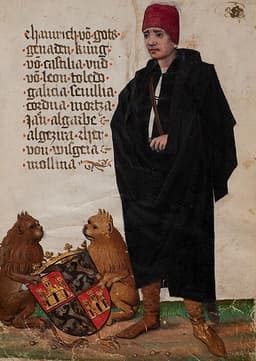
Henry IV of Castile
Emperor · Medieval
38.1Total

Napoleon Bonaparte
General · Modern
70.9Total
Basic Information
Born
1425
1769
Died
1474
1821
Era
Medieval
Modern
Nationality
Castile
France
Occupation
Emperor
General
Civilization
Western
Western
Score Comparison
Military (10%)
21.2
94.0
Political (20%)
25.0
72.0
Influence (20%)
48.6
40.0
Legacy (20%)
41.7
80.0
Leadership (15%)
38.1
78.0
Strategy (15%)
39.6
90.0
TOTAL
38.1
70.9
Henry IV of Castile — Complete Timeline
1468 AD
Treaty of the Bulls of GuisandoPolitical Action◆ Major
Henry IV of Castile signed the Treaty of the Bulls of Guisando, recognizing his half-sister Isabella as his legitimate heir instead of his daughter Joanna. This agreement was intended to resolve the succession dispute, but Henry later repudiated it, leading to renewed conflict.
Succession crisisIsabella I
Impact: national
1474 AD
War of the Castilian SuccessionWar
After Henry IV's death, a civil war erupted between supporters of his daughter Joanna la Beltraneja and those of his half-sister Isabella. The war involved Portuguese and Aragonese intervention and ended with Isabella's victory, securing her throne and leading to the union of Castile and Aragon.
Civil warSuccession
Impact: nationaldestructive
Loss of the Canary IslandsWar
During the War of the Castilian Succession, Henry IV's forces lost control of the Canary Islands to Portuguese-backed rebels. The islands were later recovered by Isabella I, but the conflict highlighted the weakness of Henry's reign and the erosion of royal authority.
Territorial lossCanary Islands
Impact: regionaldestructive
Napoleon Bonaparte — Complete Timeline
1799 AD
Coup of 18 BrumaireOther◆ Major
Napoleon Bonaparte, with support from his brother Lucien and key political figures, overthrew the Directory in a bloodless coup. He established the Consulate with himself as First Consul, effectively becoming the ruler of France. This event ended the French Revolution's most unstable period.
French RevolutionCoupRise to Power
Impact: regional
1804 AD
Promulgation of the Napoleonic CodeOther◆ Major
Napoleon enacted the Civil Code of the French, known as the Napoleonic Code, a comprehensive set of laws that replaced the fragmented feudal legal systems. The code established legal equality, protected property rights, and secularized law. It became the basis for legal systems in many European and world countries.
Legal ReformNapoleonic CodeCivil Law
Impact: globalconstructive
1805 AD
Battle of AusterlitzWar◆ Major
Napoleon's Grande Arm
Napoleonic WarsBattleDecisive Victory
Impact: global
1812 AD
Invasion of RussiaWar◆ Major
Napoleon led the Grande Arm
Napoleonic WarsInvasionDisaster
Impact: globaldestructive
1815 AD
Battle of WaterlooWar◆ Major
Napoleon's French army was defeated by the combined forces of the Duke of Wellington's Anglo-Allied army and Gebhard Leberecht von Bl
Napoleonic WarsBattleFinal Defeat
Impact: globaldestructive
Expert Analysis
henry-iv-of-castile-vs-napoleon-bonaparte
# The Emperor and the Impotent: Two Faces of Medieval and Modern Power
On a June morning in 1815, Napoleon Bonaparte watched his Imperial Guard march into the cannons of Waterloo, knowing that the fate of Europe hung in the balance. Three centuries earlier, in the dusty plains of Castile, another ruler faced his own moment of truth—not on a battlefield, but at a negotiating table, signing away his daughter’s inheritance to his half-sister. One man reshaped a continent; the other watched his kingdom crumble. What separated these two rulers, born worlds apart in time and temperament, was not merely luck but the very fabric of their characters and the eras that forged them.
Origins
Napoleon Bonaparte entered the world in 1769 on the island of Corsica, a land recently annexed by France. His family was minor nobility, poor enough to feel the sting of social climbing but proud enough to dream. The Corsican boy grew up speaking Italian, mocked by French classmates for his accent, and carried a lifelong chip on his shoulder that he would grind into a throne. The French Revolution, erupting when he was twenty, shattered the old order and created a ladder for talent. Napoleon climbed it with ruthless ambition.
Henry IV of Castile, born in 1425, inherited a very different world. Medieval Castile was a kingdom of crusading knights, rigid hierarchies, and dynastic bloodlines where birth mattered more than brilliance. As the son of King John II, Henry was raised to rule, but the crown he inherited was heavy with the debts of a long Reconquista against the Moors. His world was one of oaths and relics, not revolutionary pamphlets and artillery. Where Napoleon would be forged by chaos, Henry was suffocated by tradition.
Rise to Power
Napoleon’s ascent was a masterpiece of timing and talent. At twenty-four, he captured Toulon from the British and was promoted to brigadier general. By thirty, he had conquered Italy and Egypt, each campaign a dazzling display of speed and audacity. The Directory, France’s corrupt government, needed a sword—and Napoleon was the sharpest blade available. In 1799, he seized power in a coup, becoming First Consul, then Emperor in 1804. Every step was earned through victory, but also through an unblinking willingness to sacrifice lives—including his own soldiers—for glory.
Henry IV’s path was slower and more painful. He became king in 1454, inheriting a realm exhausted by war and plagued by rebellious nobles. His nickname, “the Impotent,” was cruelly literal—rumors spread that he could not consummate his marriage, casting doubt on the legitimacy of his daughter Joanna. Unlike Napoleon, who commanded armies with genius, Henry tried to rule through negotiation and concession. He bought peace with land grants to powerful families, weakening the crown with every compromise. It was not cowardice but a different philosophy of power—one that failed in an age that demanded iron.
Leadership and Governance
As a military leader, Napoleon stands among history’s giants, with a strategy score of 93 and a military rating of 94. He revolutionized warfare with the corps system, massed artillery, and rapid maneuvers that shattered armies at Austerlitz and Jena. His political reforms were equally transformative: the Napoleonic Code standardized law across Europe, abolishing feudal privileges and establishing meritocracy. Yet his governance was autocratic. He crowned himself emperor, silenced dissent, and treated conquered nations as colonies.
Henry IV’s leadership, by contrast, was a study in weakness. His military score of 30 and strategy of 32 reflect a ruler who avoided war rather than winning it. The Treaty of the Bulls of Guisando in 1468 was his defining political act—he recognized his half-sister Isabella as heir, disinheriting his own daughter Joanna. It was a desperate attempt to prevent civil war, but it only delayed the inevitable. When Henry died in 1474, the War of the Castilian Succession erupted immediately, pitting Joanna’s supporters against Isabella’s. During this conflict, Henry’s forces lost the Canary Islands to Portugal—a humiliating cession that symbolized his reign’s failure to defend even distant territories.
Triumph and Tragedy
Napoleon’s greatest triumph was the Empire of 1810, stretching from Spain to Poland, with his brothers on thrones across Europe. His greatest tragedy was the invasion of Russia in 1812. The Grande Armée of 600,000 men marched into a frozen grave; fewer than 40,000 returned. He never recovered, exiled first to Elba, then to Saint Helena after Waterloo. The man who conquered Europe died a prisoner, dictating memoirs to justify his legacy.
Henry IV’s tragedy was quieter but no less devastating. His greatest triumph was simply holding Castile together for twenty years. His greatest failure was his own body—the impotence that made his reign a joke among nobles and a crisis for the kingdom. He died at forty-nine, likely poisoned by his own court, leaving a legacy of civil war. The daughter he tried to protect, Joanna la Beltraneja, spent decades as a pawn, eventually retiring to a convent.
Character and Destiny
Napoleon was a creature of will—arrogant, tireless, and brilliant. He believed he could bend history to his ambition, and for a decade, he was right. But his hubris was his undoing. He refused to compromise, invaded Russia against all advice, and rejected peace offers that could have preserved his dynasty. His character drove him to conquer, and to fall.
Henry IV was a creature of circumstance—cautious, generous, but ultimately passive. He tried to rule through consensus in an age that rewarded ruthlessness. His character was not weak, but ill-suited to a kingdom that needed a warrior-king. The Castilian nobles smelled blood, and they took it.
Legacy
Napoleon’s legacy is written across Europe—in the legal codes, the metric system, the modern nation-state. He is remembered as both a liberator and a tyrant, a genius and a warmonger. His influence score of 82 and legacy of 78 reflect a figure who still sparks debate, still inspires films and books, still sits in the pantheon of history’s greats.
Henry IV of Castile is largely forgotten outside specialist circles. His legacy score of 55 and influence of 64.6 are those of a footnote—the king who lost his kingdom to Isabella of Castile, who went on to sponsor Columbus and unify Spain. Henry is remembered, if at all, as the “Impotent,” a cruel epithet that reduces a complex reign to a biological failure.
Conclusion
What separates Napoleon from Henry IV is not just talent but the shape of their times. Napoleon was born into a revolution that rewarded ambition; Henry was born into a medieval order that demanded lineage. One rose on a tide of gunpowder and glory; the other sank under the weight of tradition and treachery. Yet both men remind us that history judges rulers not by their intentions but by their outcomes. Napoleon’s ambition built an empire and destroyed it; Henry’s caution preserved a kingdom only to lose it. In the end, the difference between triumph and tragedy is often not what a ruler does, but what the age allows him to become.
Rankings
🥇
Napoleon BonaparteLeader
Mil: 94.0Pol: 72.0Inf: 40.0
70.9
🥈
Henry IV of Castile
Mil: 21.2Pol: 25.0Inf: 48.6
38.1
+32.8 behind
How This Comparison Works
Algorithm
Each figure is scored on 6 dimensions (0—100 scale) based on structured historical data: Military (10%), Political (20%), Influence (20%), Legacy (20%), Leadership (15%), Strategy (15%). The weighted total produces the final ranking.
Data Sources
Scores are computed from structured sub-indicators in the database. Scale factors adjust for era (Ancient ×0.85, Modern ×1.0) and civilization size (Eastern ×1.05, Other ×0.80) to account for differences in population and military scale.
Maximum 3 Figures
Comparisons are limited to 2—3 figures to ensure readability and statistical meaningfulness.
Error Margins
±5 points per dimension — Sub-scores are derived from historical records with inherent uncertainty. Two figures within 5 points on a dimension should be considered roughly equivalent in that area.
Total Score Accuracy
±3 points overall — The weighted combination of 6 dimensions produces a total score with approximately ±3 points of uncertainty. Differences of less than 3 points are not statistically significant— the figures are effectively tied.
Known Limitations
- Historical records are incomplete and uneven across civilizations
- Figures from oral-tradition societies may be underrepresented
- Occupation labels can misclassify multi-role figures
- Scores measure capability and impact, not moral character
- Quantitative scoring is a comparison tool, not absolute truth
Capability Radar
Military (10%) — Battles & Warfare
Battles
15
95
Win Rate
10
90
Expansion
5
95
Political (20%) — Governance & Reform
Reform
20
95
Diplomacy
20
80
Economy
15
85
Influence (20%) — Cultural & Global Reach
Cultural
20
85
Global
10
90
Legacy (20%) — Historical Impact
Historical
30
95
Longevity
20
90
Leadership (15%) — Power & Stability
Tenure
40
85
Stability
5
70
Strategy (15%) — Tactics & Innovation
Strategy
10
95
Tactics
10
98
Reform
5
92
Similar Comparisons
Comments & Discussion
破轮摔瓦6/17/2026
亨利四世连老婆都管不住,还签什么协议让位给妹妹?拿破仑从科西嘉土包子爬到法兰西皇帝,25岁就打赢意大利战役,逼得奥地利割地求和。亨利四世要是有这本事,卡斯蒂利亚早统一伊比利亚半岛了。拿天桥卖艺的跟杂耍班主比,真是离谱到家了。
Codex Crusher6/17/2026
From a classics perspective, these rulers’ biggest difference isn’t size but impact on law. Napoleon’s Napoleonic Code—1804—standardized civil law across Europe, still influencing 70+ countries today. Henry IV? His 1465 Sentencia de Medina del Campo just confirmed nobles’ privileges and pissed off everyone. One built a legal foundation that outlives his empire; the other couldn’t even hold his own throne. That’s the real legacy gap.
数据屠夫6/17/2026
军事对比?拿破仑在奥斯特里茨、耶拿、弗里德兰三场战役中指挥超过200万士兵,损失率控制极佳。亨利四世最著名的“战斗”是1467年奥梅多之战,双方加起来不到5000人,结果亨利还输了。拿水牛和兔子比奔跑速度?数据会说话:皇帝这称号,亨利配不上。
反骨史学佬6/17/2026
你们吹拿破仑,却忽略他最终两度流放、帝国崩塌的结局。亨利四世至少死时还是国王,而拿破仑最后穿着旧军装困在圣赫勒拿岛等死。没错,拿破仑地盘大、战役猛,可亨利的内外交困更真实——卡斯蒂利亚贵族叛乱、摩尔人南侵,他没跑没跪,撑了二十年。纸面上的荣耀哪比得了守土的韧劲。
Historian5506/17/2026
Henry of Castile looks like a child playing with toy soldiers next to Napoleon’s empire-building. Sure, Henry’s nickname “El Impotente” reflects his real struggle—there are even claims he couldn’t physically father heirs, which led to a civil war over succession. But Napoleon’s campaigns directly killed over a million people and rewrote Europe’s borders. Comparing them is like putting a candle next to a bomb. One fizzled, the other exploded.