Loading...
Henry II of France vs Nguyen Hue
Nguyen Hue leads by 7.5 pts · 2 figures compared
…
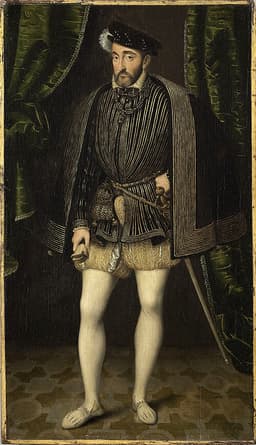
Henry II of France
Emperor · Modern
55.5Total

Nguyen Hue
Emperor · Modern
63.0Total
Basic Information
Born
1519
1753
Died
1559
1792
Era
Modern
Modern
Nationality
France
Vietnam
Occupation
Emperor
Emperor
Civilization
Western
Eastern
Score Comparison
Military (10%)
45.0
79.2
Political (20%)
68.0
72.0
Influence (20%)
60.0
55.0
Legacy (20%)
48.3
54.0
Leadership (15%)
53.2
68.0
Strategy (15%)
57.5
68.7
TOTAL
55.5
63.0
Henry II of France — Complete Timeline
1557 AD
Battle of St. QuentinWar◆ Major
Henry II's French army was decisively defeated by Spanish forces under Emmanuel Philibert of Savoy at St. Quentin. The defeat forced Henry to negotiate the Treaty of Cateau-Cambr
Italian WarsBattleDefeat
Impact: regionaldestructive
1559 AD
Treaty of Cateau-CambrésisPolitical Action◆ Major
Henry II signed the Treaty of Cateau-Cambr
TreatyItalian WarsPeace
Impact: regional
Death in a jousting accidentOther◆ Major
Henry II was mortally wounded during a jousting tournament held to celebrate the Treaty of Cateau-Cambr
DeathAccidentSuccession Crisis
Impact: nationaltragic
Nguyen Hue — Complete Timeline
1786 AD
Conquered Thang LongWar◆ Major
Nguyen Hue led his forces to capture Thang Long (Hanoi), overthrowing the Trinh lords who had ruled northern Vietnam. This victory unified the country under Tay Son control, ending centuries of division.
ConquestUnificationTrinh
Impact: national
1788 AD
Proclaimed Emperor Quang TrungPolitical Action◆ Major
Nguyen Hue proclaimed himself Emperor Quang Trung, establishing the Tay Son dynasty's rule over a unified Vietnam. He implemented reforms including land redistribution and promotion of education.
EmperorTay SonUnification
Impact: nationalconstructive
1789 AD
Battle of Ngoc Hoi-Dong DaWar
Nguyen Hue led the Tay Son army to a surprise victory over a Qing Chinese invasion force at the Battle of Ngoc Hoi-Dong Da near Thang Long (Hanoi). The attack occurred during the Tet holiday, catching the Qing off guard and securing Vietnamese independence.
BattleIndependenceQing
Impact: regionalconstructive
Expert Analysis
Origins
Henry II of France was born in 1519 at the Château de Saint-Germain-en-Laye, the second son of King Francis I and Claude of France. His elder brother Francis died in 1536, making Henry heir. He received a military education and was influenced by his father's rivalry with the Habsburgs. He married Catherine de' Medici in 1533, a political alliance.
Nguyen Hue was born in 1753 in Binh Dinh province, central Vietnam, into the Nguyen family, which was not of royal blood. He was the second son of Nguyen Nhac and grew up amid peasant unrest. Along with his brothers, he joined the Tay Son rebellion against the corrupt Nguyen lords in the south and Trinh lords in the north. He was self-taught in military tactics and charismatic leadership.
Rise to Power
Henry II ascended the French throne in 1547 upon his father's death. He continued the Italian Wars against the Habsburgs, focusing on reclaiming territories in Italy and challenging Charles V. His early reign saw the capture of Boulogne from the English in 1550 and the annexation of the Three Bishoprics (Metz, Toul, Verdun) in 1552. However, his military campaigns were hampered by financial constraints and the growing influence of the Guise family.
Nguyen Hue rose to prominence in 1771 when the Tay Son rebellion began. By 1777, he and his brothers had overthrown the Nguyen lords in the south. In 1786, Nguyen Hue led a lightning campaign north, capturing Thang Long (Hanoi) and overthrowing the Trinh lords, unifying Vietnam under Tay Son control. His greatest military feat came in 1789 when he defeated a Qing Chinese invasion force at the Battle of Ngoc Hoi-Dong Da, securing Vietnamese independence.
Leadership & Governance
Henry II ruled as an absolute monarch but was heavily influenced by his mistress Diane de Poitiers and the Guise family. He centralized royal power but failed to address religious tensions between Catholics and Huguenots. His persecution of Protestants, including the Edict of Châteaubriant (1551), sowed seeds for the French Wars of Religion. In foreign policy, he secured the Treaty of Cateau-Cambrésis (1559), which ended the Italian Wars but left France with only Calais and a few border towns. His political score of 68.0 reflects moderate statecraft.
Nguyen Hue, as Emperor Quang Trung, implemented progressive reforms. He promoted land redistribution, reduced taxes, and encouraged trade. He reformed education, using Chinese and Vietnamese vernacular, and promoted cultural unity. His military score of 79.2 and strategy score of 68.7 indicate his prowess, but his reign was short (1788-1792). He failed to consolidate power before his death, leaving his son a child heir, which led to the collapse of the Tay Son dynasty.
Triumph & Tragedy
Henry II's triumph was the Treaty of Cateau-Cambrésis, which brought peace to France after decades of war. However, the treaty was a strategic compromise, ceding French claims in Italy. His tragedy was his death: during a joust celebrating the treaty, a lance pierced his eye, causing a fatal infection. This left France with a weak successor (Francis II) and religious strife. His military score of 45.0 reflects his mixed success in battle.
Nguyen Hue's triumph was the defeat of the Qing at Tet 1789, a surprise attack that crushed a 200,000-strong Chinese army. He unified Vietnam and implemented reforms. His tragedy was his early death at age 39, likely from illness, which left the Tay Son dynasty vulnerable. His successor, Nguyen Quang Toan, was overthrown by Nguyen Anh (later Emperor Gia Long) in 1802, ending the Tay Son era.
Character & Destiny
Henry II was a stern, devout Catholic, influenced by his father's captivity and his wife's family. He was a capable administrator but not a brilliant general. His obsession with jousting led to his death, a fitting end for a king who valued chivalry but lacked strategic foresight. Historians rate his leadership at 53.2, reflecting a rule that maintained stability but failed to adapt to religious change.
Nguyen Hue was a charismatic, decisive leader, known for his strategic brilliance and ability to inspire troops. He was pragmatic, using surprise and speed in warfare. His early death truncated his potential. His leadership score of 68.0 reflects his effectiveness, but the lack of a stable succession doomed his legacy.
Legacy
Henry II's legacy is mixed. He ended the Italian Wars but ceded Italian ambitions. His religious persecution contributed to the French Wars of Religion. His total score of 55.5 reflects a reign of moderate impact. He is remembered for the Treaty of Cateau-Cambrésis and his accidental death.
Nguyen Hue is a national hero in Vietnam, celebrated for defeating the Chinese and unifying the country. His reforms influenced later Vietnamese rulers. However, his dynasty fell quickly. His total score of 63.0 reflects higher military and political achievements. He is commemorated annually at the Dong Da festival.
Conclusion
Nguyen Hue had greater impact than Henry II. With a total score of 63.0 vs 55.5, he excelled in military (79.2 vs 45.0), strategy (68.7 vs 57.5), and leadership (68.0 vs 53.2). While Henry II's reign ended a war, he failed to prevent internal conflict. Nguyen Hue's victory over the Qing preserved Vietnamese independence and unified the country. His short reign limited his legacy, but his military achievements surpass Henry's. Therefore, Nguyen Hue is the more impactful figure.
Rankings
🥇
Nguyen HueLeader
Mil: 79.2Pol: 72.0Inf: 55.0
63.0
🥈
Henry II of France
Mil: 45.0Pol: 68.0Inf: 60.0
55.5
+7.5 behind
How This Comparison Works
Algorithm
Each figure is scored on 6 dimensions (0—100 scale) based on structured historical data: Military (10%), Political (20%), Influence (20%), Legacy (20%), Leadership (15%), Strategy (15%). The weighted total produces the final ranking.
Data Sources
Scores are computed from structured sub-indicators in the database. Scale factors adjust for era (Ancient ×0.85, Modern ×1.0) and civilization size (Eastern ×1.05, Other ×0.80) to account for differences in population and military scale.
Maximum 3 Figures
Comparisons are limited to 2—3 figures to ensure readability and statistical meaningfulness.
Error Margins
±5 points per dimension — Sub-scores are derived from historical records with inherent uncertainty. Two figures within 5 points on a dimension should be considered roughly equivalent in that area.
Total Score Accuracy
±3 points overall — The weighted combination of 6 dimensions produces a total score with approximately ±3 points of uncertainty. Differences of less than 3 points are not statistically significant— the figures are effectively tied.
Known Limitations
- Historical records are incomplete and uneven across civilizations
- Figures from oral-tradition societies may be underrepresented
- Occupation labels can misclassify multi-role figures
- Scores measure capability and impact, not moral character
- Quantitative scoring is a comparison tool, not absolute truth
Capability Radar
Military (10%) — Battles & Warfare
Battles
55
75
Win Rate
45
85
Expansion
50
72
Political (20%) — Governance & Reform
Reform
45
65
Diplomacy
55
70
Economy
50
55
Influence (20%) — Cultural & Global Reach
Cultural
45
60
Global
45
45
Legacy (20%) — Historical Impact
Historical
50
65
Longevity
40
50
Leadership (15%) — Power & Stability
Tenure
60
60
Stability
40
45
Strategy (15%) — Tactics & Innovation
Strategy
55
78
Tactics
50
80
Reform
40
70
Similar Comparisons
Comments & Discussion
No comments yet. Be the first to share your thoughts!