Loading...
Henry II of France vs Julius Caesar
Julius Caesar leads by 27.3 pts · 2 figures compared
…
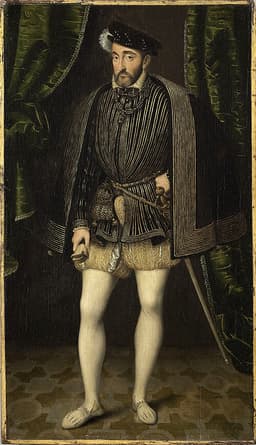
Henry II of France
Emperor · Modern
55.5Total

Julius Caesar
General · Ancient
82.8Total
Basic Information
Born
1519
-100
Died
1559
-44
Era
Modern
Ancient
Nationality
France
Roman Republic
Occupation
Emperor
General
Civilization
Western
Western
Score Comparison
Military (10%)
45.0
88.0
Political (20%)
68.0
78.0
Influence (20%)
60.0
85.0
Legacy (20%)
48.3
82.0
Leadership (15%)
53.2
80.0
Strategy (15%)
57.5
85.0
TOTAL
55.5
82.8
Henry II of France — Complete Timeline
1557 AD
Battle of St. QuentinWar◆ Major
Henry II's French army was decisively defeated by Spanish forces under Emmanuel Philibert of Savoy at St. Quentin. The defeat forced Henry to negotiate the Treaty of Cateau-Cambr
Italian WarsBattleDefeat
Impact: regionaldestructive
1559 AD
Treaty of Cateau-CambrésisPolitical Action◆ Major
Henry II signed the Treaty of Cateau-Cambr
TreatyItalian WarsPeace
Impact: regional
Death in a jousting accidentOther◆ Major
Henry II was mortally wounded during a jousting tournament held to celebrate the Treaty of Cateau-Cambr
DeathAccidentSuccession Crisis
Impact: nationaltragic
Julius Caesar — Complete Timeline
58 BC
Gallic WarsWar◆ Major
Caesar, as proconsul of Gaul, launched a series of campaigns that conquered all of Gaul (modern France, Belgium, and parts of Switzerland). He fought numerous battles, including against the Helvetii, the Belgae, and the Gallic chieftain Vercingetorix. The wars brought immense wealth and a loyal army to Caesar.
Gallic WarsConquestRoman Expansion
Impact: regional
49 BC
Crossing the RubiconPolitical Action◆ Major
Caesar led Legio XIII across the Rubicon River into Italy, defying the Roman Senate's order to disband his army. This act triggered a civil war against Pompey and the Optimates, ultimately leading to Caesar's dictatorship and the end of the Roman Republic.
Roman Civil WarEnd of RepublicPower Struggle
Impact: global
48 BC
Battle of PharsalusWar◆ Major
Caesar's outnumbered army defeated the larger forces of Pompey the Great at Pharsalus in Greece. Caesar's tactical use of a reserve line to counter Pompey's cavalry charge proved decisive. Pompey fled to Egypt, where he was assassinated, leaving Caesar as the undisputed master of the Roman world.
Roman Civil WarBattleDecisive Victory
Impact: regional
44 BC
Appointment as Dictator for LifePolitical Action◆ Major
The Roman Senate appointed Caesar dictator perpetuo (dictator for life), granting him unprecedented personal power. This move concentrated military, legislative, and judicial authority in one person, effectively ending the Roman Republic's traditional system of checks and balances and alarming many senators.
DictatorshipEnd of RepublicPower Consolidation
Impact: regionaldestructive
Assassination on the Ides of MarchPolitical Action◆ Major
A group of Roman senators, led by Marcus Junius Brutus and Gaius Cassius Longinus, stabbed Caesar to death at a meeting of the Senate in the Theatre of Pompey. The assassination was intended to restore the Republic, but instead triggered another civil war that led to the rise of the Roman Empire.
AssassinationRoman PoliticsEnd of Republic
Impact: globaldestructive
Expert Analysis
henry-ii-of-france-vs-julius-caesar
# The Two Faces of Power: Caesar and Henry II
On a spring morning in 44 BCE, Julius Caesar walked into the Senate chamber, a man who had conquered Gaul, crossed the Rubicon, and bent the Roman Republic to his will. Moments later, he lay bleeding from twenty-three dagger wounds. Fourteen hundred miles away and sixteen centuries later, on a summer day in 1559, Henry II of France donned his jousting armor to celebrate a peace treaty. A splintered lance pierced his eye, and ten days later he was dead. Two rulers, two eras, two vastly different endings—yet both men’s fates were sealed by the same force: the collision between ambition and the limits of power.
Origins
Julius Caesar was born into the patrician Julian clan, a family with ancient lineage but modest wealth in the turbulent final decades of the Roman Republic. His uncle Marius had been a populist general, his aunt married to the great Sulla’s rival. This was a world where political violence was routine, where the Senate and popular assemblies fought for control, and where a man could rise or fall on the strength of his military reputation and his ability to manipulate the masses. Caesar learned early that in Rome, glory and danger walked hand in hand.
Henry II of France entered the world in 1519, the second son of Francis I, a Renaissance king who had fought the Habsburgs for supremacy in Europe. Henry was never meant to rule; his older brother Francis was the heir. But when that brother died in 1536, Henry found himself thrust into a role for which he had little preparation. His childhood was spent in Spanish captivity as a hostage, an experience that left him brooding, reserved, and deeply attached to his Italian mistress, Diane de Poitiers, who was twenty years his senior. Unlike Caesar, who grew up in the forum and on the battlefield, Henry grew up in the shadows.
Rise to Power
Caesar’s ascent was a masterclass in calculated risk. He served as a military tribune, then quaestor in Spain, where he supposedly wept before a statue of Alexander the Great, lamenting that he had achieved nothing at an age when Alexander had already conquered the world. He forged the First Triumvirate with Pompey and Crassus, using their wealth and influence to secure the consulship in 59 BCE. Then came the Gallic Wars—a decade of brutal campaigns that made him fabulously rich, gave him a loyal army, and turned him into the most famous man in the Roman world. When the Senate ordered him to disband his legions, he crossed the Rubicon River in 49 BCE, plunging the Republic into civil war. He gambled everything—and won.
Henry II’s path was more passive. He became king in 1547 upon his father’s death, inheriting a kingdom already locked in the Italian Wars against the Habsburg Empire of Charles V and later Philip II of Spain. He did not seize power; it was handed to him. His key turning point was not a river crossing but a treaty: the Peace of Cateau-Cambrésis in 1559, which ended decades of conflict. But even that peace was forced upon him by military defeat—most notably at the Battle of St. Quentin in 1557, where Spanish forces crushed his army. Where Caesar created his own opportunities, Henry was shaped by events he could not control.
Leadership & Governance
Caesar governed as a revolutionary reformer. As dictator, he overhauled the Roman calendar, granted citizenship to provincials, initiated public works projects, and centralized authority in his own hands. He was a military genius who combined tactical brilliance—as at the Siege of Alesia in 52 BCE, where he defeated a Gallic coalition by building a double ring of fortifications—with political acumen. He knew how to reward loyalty, how to inspire devotion in his legions, and how to use spectacle and mercy to win over enemies. But his fatal flaw was his belief that he could reshape the Republic into a monarchy without destroying the very traditions that gave Rome its identity.
Henry II ruled as a traditional monarch, guided by the conservative instincts of the French nobility and the Catholic Church. He continued his father’s wars but without his father’s flair. His military record was mediocre; his political wisdom was limited. He did, however, strengthen the royal administration and patronized the arts—he built the magnificent Château de Chenonceau for Diane de Poitiers. But he lacked Caesar’s vision. He was a king who maintained order, not a leader who transformed his world.
Triumph & Tragedy
Caesar’s greatest moment was his triumph over Gaul, a conquest that brought immense wealth to Rome and established him as the greatest general of his age. His most devastating failure was his assassination—a death that proved he had misread the depth of republican sentiment among the senatorial elite. He had pardoned his enemies, but they did not forgive him.
Henry II’s triumph was the Treaty of Cateau-Cambrésis, which finally brought peace to a war-weary France—though at the cost of abandoning Italian ambitions. His tragedy was the jousting accident that killed him at age forty, a death so senseless that it seemed almost symbolic: a king who had spent his life fighting wars died not in battle but in a sporting event meant to celebrate their end.
Character & Destiny
Caesar was audacious, calculating, and supremely confident. He wrote his own commentaries, controlled his own narrative, and believed he could bend history to his will. That confidence made him great—and made him blind to the conspiracy that ended his life. Henry II was cautious, devout, and dominated by the women in his life—his wife Catherine de’ Medici and his mistress Diane. He lacked Caesar’s drive, his genius, and his hunger. Where Caesar forged destiny, Henry was consumed by it.
Legacy
Caesar’s legacy is immeasurable. His name became synonymous with imperial power—kaiser, tsar—and his reforms laid the foundation for the Roman Empire. His writings remain classics of military literature. He is remembered as a titan, a man who changed the course of Western civilization.
Henry II is remembered, if at all, as a footnote—the king who ended the Italian Wars and died in a joust. His reign was competent but unremarkable, overshadowed by the religious wars that erupted after his death. He left no lasting reforms, no enduring institutions, no legend.
Conclusion
Standing at the edge of the Rubicon, Caesar chose to cross. Henry II, standing at the edge of a jousting list, chose to mount his horse. Both decisions led to death, but only one led to immortality. The difference between them is not just talent or luck—it is the willingness to risk everything for something greater than oneself. Caesar understood that power must be seized, not inherited. Henry II learned that even inherited power can slip through a king’s fingers. In the end, the Ides of March and a shattered lance both tell the same story: greatness is not given. It is taken.
Rankings
🥇
Julius CaesarLeader
Mil: 88.0Pol: 78.0Inf: 85.0
82.8
🥈
Henry II of France
Mil: 45.0Pol: 68.0Inf: 60.0
55.5
+27.3 behind
How This Comparison Works
Algorithm
Each figure is scored on 6 dimensions (0—100 scale) based on structured historical data: Military (10%), Political (20%), Influence (20%), Legacy (20%), Leadership (15%), Strategy (15%). The weighted total produces the final ranking.
Data Sources
Scores are computed from structured sub-indicators in the database. Scale factors adjust for era (Ancient ×0.85, Modern ×1.0) and civilization size (Eastern ×1.05, Other ×0.80) to account for differences in population and military scale.
Maximum 3 Figures
Comparisons are limited to 2—3 figures to ensure readability and statistical meaningfulness.
Error Margins
±5 points per dimension — Sub-scores are derived from historical records with inherent uncertainty. Two figures within 5 points on a dimension should be considered roughly equivalent in that area.
Total Score Accuracy
±3 points overall — The weighted combination of 6 dimensions produces a total score with approximately ±3 points of uncertainty. Differences of less than 3 points are not statistically significant— the figures are effectively tied.
Known Limitations
- Historical records are incomplete and uneven across civilizations
- Figures from oral-tradition societies may be underrepresented
- Occupation labels can misclassify multi-role figures
- Scores measure capability and impact, not moral character
- Quantitative scoring is a comparison tool, not absolute truth
Capability Radar
Military (10%) — Battles & Warfare
Battles
55
95
Win Rate
45
92
Expansion
50
97
Political (20%) — Governance & Reform
Reform
45
90
Diplomacy
55
85
Economy
50
82
Influence (20%) — Cultural & Global Reach
Cultural
45
88
Global
45
94
Legacy (20%) — Historical Impact
Historical
50
95
Longevity
40
96
Leadership (15%) — Power & Stability
Tenure
60
75
Stability
40
60
Strategy (15%) — Tactics & Innovation
Strategy
55
94
Tactics
50
96
Reform
40
88
Similar Comparisons
Comments & Discussion
JuliusNotJulius6/17/2026
Comparing Caesar to Henry II is like comparing a hurricane to a sneeze. Caesar conquered Gaul, fought a civil war, and rewrote Roman governance in blood—while Henry II was literally killed by a jousting tournament. Not a battlefield, not an assassination. A SPORTING EVENT. Caesar died because 60 senators coordinated his murder; Henry died because he wanted to look cool in armor one last time. These aren't parallel tragedies—one's a political earthquake, the other is a cautionary tale about vanit
竞技场勘误者6/17/2026
作为古典学学者,我必须指出这种对比本质上是错误的。凯撒死于60位元老精心策划的政治暗杀,这反映了罗马共和末期权力失衡的系统性危机;而亨利二世死于比武大会——一种完全可避免的个人娱乐活动。凯撒的死改写了西方历史走向,亨利二世的死除了让法国陷入宗教战争外没有战略意义。把这两种死亡并列,就像把核弹事故和厨房火灾相提并论。历史类比需要结构合理性,不是表面相似性。