Loading...
Henry II of France vs Napoleon Bonaparte
Napoleon Bonaparte leads by 15.4 pts · 2 figures compared
…
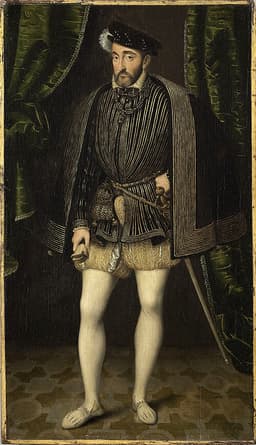
Henry II of France
Emperor · Modern
55.5Total

Napoleon Bonaparte
General · Modern
70.9Total
Basic Information
Born
1519
1769
Died
1559
1821
Era
Modern
Modern
Nationality
France
France
Occupation
Emperor
General
Civilization
Western
Western
Score Comparison
Military (10%)
45.0
94.0
Political (20%)
68.0
72.0
Influence (20%)
60.0
40.0
Legacy (20%)
48.3
80.0
Leadership (15%)
53.2
78.0
Strategy (15%)
57.5
90.0
TOTAL
55.5
70.9
Henry II of France — Complete Timeline
1557 AD
Battle of St. QuentinWar◆ Major
Henry II's French army was decisively defeated by Spanish forces under Emmanuel Philibert of Savoy at St. Quentin. The defeat forced Henry to negotiate the Treaty of Cateau-Cambr
Italian WarsBattleDefeat
Impact: regionaldestructive
1559 AD
Treaty of Cateau-CambrésisPolitical Action◆ Major
Henry II signed the Treaty of Cateau-Cambr
TreatyItalian WarsPeace
Impact: regional
Death in a jousting accidentOther◆ Major
Henry II was mortally wounded during a jousting tournament held to celebrate the Treaty of Cateau-Cambr
DeathAccidentSuccession Crisis
Impact: nationaltragic
Napoleon Bonaparte — Complete Timeline
1799 AD
Coup of 18 BrumaireOther◆ Major
Napoleon Bonaparte, with support from his brother Lucien and key political figures, overthrew the Directory in a bloodless coup. He established the Consulate with himself as First Consul, effectively becoming the ruler of France. This event ended the French Revolution's most unstable period.
French RevolutionCoupRise to Power
Impact: regional
1804 AD
Promulgation of the Napoleonic CodeOther◆ Major
Napoleon enacted the Civil Code of the French, known as the Napoleonic Code, a comprehensive set of laws that replaced the fragmented feudal legal systems. The code established legal equality, protected property rights, and secularized law. It became the basis for legal systems in many European and world countries.
Legal ReformNapoleonic CodeCivil Law
Impact: globalconstructive
1805 AD
Battle of AusterlitzWar◆ Major
Napoleon's Grande Arm
Napoleonic WarsBattleDecisive Victory
Impact: global
1812 AD
Invasion of RussiaWar◆ Major
Napoleon led the Grande Arm
Napoleonic WarsInvasionDisaster
Impact: globaldestructive
1815 AD
Battle of WaterlooWar◆ Major
Napoleon's French army was defeated by the combined forces of the Duke of Wellington's Anglo-Allied army and Gebhard Leberecht von Bl
Napoleonic WarsBattleFinal Defeat
Impact: globaldestructive
Expert Analysis
henry-ii-of-france-vs-napoleon-bonaparte
# The Emperor and the Jousting King: Two Visions of French Glory
On a June afternoon in 1815, Napoleon Bonaparte stood on a muddy ridge near Waterloo, watching his Imperial Guard march into the muzzles of British cannon. Two hundred and fifty-six years earlier, on a summer evening in 1559, Henry II of France lay dying in a Paris palace, a splintered lance lodged in his eye. Both men were French sovereigns. Both sought to shape Europe in their image. One remade a continent and left a legal code that still governs millions. The other ended his reign with a treaty that surrendered everything his father had won—and died in a sporting accident. The question is not merely *what* they did, but *why* the gap between them is so vast.
Origins
Napoleon Bonaparte was born in 1769 on Corsica, an island that had been French for barely a year. His family were minor nobles in a land of vendettas and mountain fortresses. He spoke Italian before French, and his childhood was shaped by the fierce independence of a people who had been conquered repeatedly. When he entered the military academy at Brienne, his classmates mocked his accent and his poverty. That humiliation forged a will of iron: he would prove them all wrong, or die trying.
Henry II was born in 1519 into the House of Valois, the most powerful dynasty in France. His father was Francis I, the Renaissance king who brought Leonardo da Vinci to Amboise. Henry grew up in a world of velvet and marble, but also of ceaseless war with the Habsburgs. As a child, he was sent to Spain as a hostage for four years—a captivity that left him brooding, pious, and deeply suspicious of the Spanish. Where Napoleon learned to fight from the bottom up, Henry learned to rule from the top down, but with a crucial flaw: he never learned to think for himself.
Rise to Power
Napoleon’s ascent was a masterpiece of audacity. At twenty-four, he drove the British out of Toulon with a plan so bold it made him a brigadier general overnight. By twenty-six, he commanded the Army of Italy and crushed the Austrians in a campaign of lightning marches and flank attacks. In 1799, he overthrew the corrupt Directory in a coup d’état and made himself First Consul. By 1804, he crowned himself Emperor in Notre Dame, taking the crown from the Pope’s hands and placing it on his own head—a gesture that said everything about his view of authority.
Henry’s rise was quieter. He became Dauphin at age seventeen when his older brother died suddenly, and king at twenty-eight when his father died in 1547. He inherited a kingdom already at war, already in debt, and already dominated by two powerful families: the Guises, who were Catholic hardliners, and the Montmorencys, who were more pragmatic. Henry did not choose his path; he fell into it, guided by his mistress Diane de Poitiers and his constable Anne de Montmorency. He was a dutiful king, but never a visionary one.
Leadership & Governance
Napoleon governed like a force of nature. He centralized the state, created the Bank of France, and established the Napoleonic Code—a system of civil law that abolished feudal privileges, protected property rights, and enshrined equality before the law. It spread across Europe as his armies marched. He built roads, canals, and schools. He also suppressed dissent, censored newspapers, and reestablished slavery in French colonies. His genius was organizational: he could see the whole machine and turn any cog.
Henry governed like a steward. He continued his father’s wars against the Habsburgs, but without his father’s flair. His military score of 45.0 and strategy of 56.8 reflect a commander who relied on subordinates and lost the decisive battles. At St. Quentin in 1557, his army was crushed by Spanish forces under Emmanuel Philibert of Savoy; Paris itself was threatened. Henry’s political score of 62.1 shows a man who could maintain his court but could not reshape his kingdom. He persecuted Protestants with increasing severity, setting the stage for the Wars of Religion that would tear France apart after his death.
Triumph & Tragedy
Napoleon’s greatest triumph was Austerlitz in 1805, where he lured the combined Russian and Austrian armies into a trap and destroyed them. “I have fought sixty battles and learned nothing I did not know at Austerlitz,” he later said. His greatest tragedy was the invasion of Russia in 1812. He marched with 600,000 men and returned with fewer than 100,000. The disaster broke his aura of invincibility and led to his first abdication in 1814. He returned from exile on Elba in 1815, rallied France for a hundred days, and met his final defeat at Waterloo—a battle he might have won if his generals had arrived in time, if the rain had stopped earlier, if Grouchy had marched to the sound of the guns.
Henry’s greatest triumph was the Treaty of Cateau-Cambrésis in 1559, which ended sixty-five years of Italian Wars. But it was a triumph of exhaustion, not victory. France renounced claims to Italy and surrendered most of its conquests. His greatest tragedy came immediately after: a jousting tournament held to celebrate the peace. Henry, wearing the colors of his mistress, was struck in the eye by a splintered lance from Gabriel de Montgomery, captain of his Scottish Guard. He died ten days later, leaving four young sons and a kingdom sliding toward civil war.
Character & Destiny
Napoleon’s character was a paradox: brilliant and petty, generous and ruthless, tireless and impatient. He could charm a room or terrify it. He believed in destiny but also in hard calculation. “Impossible is a word to be found only in the dictionary of fools,” he said. That confidence drove him to conquer Europe—and to overreach so badly that he lost everything. His personality shaped his decisions: he could not stop, could not delegate, could not accept limits. The same engine that drove him to glory drove him to ruin.
Henry’s character was quieter but no less fateful. He was brave, pious, and loyal to his friends—but also stubborn, easily influenced, and unable to see beyond the chivalric ideals of his youth. He still believed in jousting in an age of gunpowder and pike squares. His death was not an accident of fate; it was the logical outcome of a man who lived in a world that was already passing him by. He died as he had reigned: gallantly, but pointlessly.
Legacy
Napoleon’s legacy is monumental. The Napoleonic Code still governs France and influenced legal systems from Brazil to Japan. His military innovations—the corps system, the use of artillery, the emphasis on speed and surprise—are studied in war colleges today. He reshaped the map of Europe, toppled old dynasties, and spread the ideals of the French Revolution across a continent. His legacy score of 78.0 reflects a figure who is still debated, still admired, still reviled—but never forgotten.
Henry’s legacy is more modest. He is remembered primarily for the treaty that ended the Italian Wars and for his bizarre, tragic death. The Wars of Religion that erupted after his reign killed hundreds of thousands and nearly destroyed France. His influence score of 72.5 is inflated by his position as a Renaissance king, but his real impact was negative: he failed to prevent the catastrophes that followed. He is a footnote in the story of the Valois dynasty, a cautionary tale about the limits of chivalry.
Conclusion
Standing at Waterloo, Napoleon watched his dreams dissolve into smoke and mud. Lying in his deathbed, Henry II felt his blood seep into the sheets while his courtiers wept. Both were French kings; both left their mark on history. But the difference between them is not just one of talent or luck. It is a difference of vision. Napoleon saw the future and tried to seize it. Henry saw the past and tried to preserve it. One remade the world; the other was unmade by it. In the end, the measure of a leader is not the crown he wears, but the world he leaves behind.
Rankings
🥇
Napoleon BonaparteLeader
Mil: 94.0Pol: 72.0Inf: 40.0
70.9
🥈
Henry II of France
Mil: 45.0Pol: 68.0Inf: 60.0
55.5
+15.4 behind
How This Comparison Works
Algorithm
Each figure is scored on 6 dimensions (0—100 scale) based on structured historical data: Military (10%), Political (20%), Influence (20%), Legacy (20%), Leadership (15%), Strategy (15%). The weighted total produces the final ranking.
Data Sources
Scores are computed from structured sub-indicators in the database. Scale factors adjust for era (Ancient ×0.85, Modern ×1.0) and civilization size (Eastern ×1.05, Other ×0.80) to account for differences in population and military scale.
Maximum 3 Figures
Comparisons are limited to 2—3 figures to ensure readability and statistical meaningfulness.
Error Margins
±5 points per dimension — Sub-scores are derived from historical records with inherent uncertainty. Two figures within 5 points on a dimension should be considered roughly equivalent in that area.
Total Score Accuracy
±3 points overall — The weighted combination of 6 dimensions produces a total score with approximately ±3 points of uncertainty. Differences of less than 3 points are not statistically significant— the figures are effectively tied.
Known Limitations
- Historical records are incomplete and uneven across civilizations
- Figures from oral-tradition societies may be underrepresented
- Occupation labels can misclassify multi-role figures
- Scores measure capability and impact, not moral character
- Quantitative scoring is a comparison tool, not absolute truth
Capability Radar
Military (10%) — Battles & Warfare
Battles
55
95
Win Rate
45
90
Expansion
50
95
Political (20%) — Governance & Reform
Reform
45
95
Diplomacy
55
80
Economy
50
85
Influence (20%) — Cultural & Global Reach
Cultural
45
85
Global
45
90
Legacy (20%) — Historical Impact
Historical
50
95
Longevity
40
90
Leadership (15%) — Power & Stability
Tenure
60
85
Stability
40
70
Strategy (15%) — Tactics & Innovation
Strategy
55
95
Tactics
50
98
Reform
40
92
Similar Comparisons
Comments & Discussion
THE GUARD DIES BUT DOES NOT SU6/17/2026
Waterloo was a disaster, sure, but Napoleon's Civil Code is still the backbone of European law. Henry II died in a jousting accident—literally couldn't stop jousting long enough to govern. One built a system that outlasted his empire; the other left a treaty and a pile of shattered lances. That's not leadership, that's a hobby gone wrong.
数据猎人6/17/2026
别跟我吹战士的荣耀,数字才是硬通货。亨利二世死后法国欠债四千万利弗尔,拿破仑垮台时外债才一亿两千万——但拿破仑打了十年仗,亨利二世只当了十二年国王还一直在花他爹的老本。拿破仑每战烧钱,但人家重建了财政体系;亨利二世除了让法国破产,还给西班牙送了三个主教区。谁的效率高,一目了然。
LATINIST WITH ATTITUDE6/17/2026
Let's be honest: Henry II's court was a Renaissance fever dream of poetry, academies, and the first French ballet. Napoleon's was a military camp with better china. Henry patronized Ronsard and Du Bellay; Napoleon shot off an ear at the Opera. One died reading Virgil in exile, the other died with a lance in his eye. I know which legacy I'd rather inherit.
战史考据党6/17/2026
别拿滑铁卢说事,拿破仑的制胜时刻全在意大利和埃及,但亨利二世在1557年圣康坦战役输得底裤都不剩,连巴黎都差点丢。拿破仑输掉的只是战争,亨利二世输掉的是整个哈布斯堡战略。要不是他死得早,1559年卡托-康布雷齐条约就是法国的屈辱史。两场惨败,差别只在败给谁、败得多彻底。
TACTICAL TOASTER6/17/2026
Napoleon revolutionized warfare with corps-level maneuvering and the _ordre mixte_. Henry II? He was still charging with heavy cavalry in gilded armor while the Spanish were perfecting the tercio. One changed how battles were fought; the other was a medieval holdout who got himself killed by a wooden stick. Case closed.