Loading...
Henry II of France vs Matthias
Henry II of France leads by 5.8 pts · 2 figures compared
…
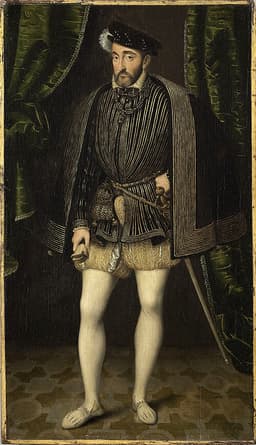
Henry II of France
Emperor · Modern
55.5Total

Matthias
Emperor · Modern
49.7Total
Basic Information
Born
1519
1557
Died
1559
1619
Era
Modern
Modern
Nationality
France
Holy Roman Empire
Occupation
Emperor
Emperor
Civilization
Western
Western
Score Comparison
Military (10%)
45.0
50.0
Political (20%)
68.0
39.4
Influence (20%)
60.0
54.9
Legacy (20%)
48.3
50.0
Leadership (15%)
53.2
67.0
Strategy (15%)
57.5
25.0
TOTAL
55.5
49.7
Henry II of France — Complete Timeline
1557 AD
Battle of St. QuentinWar◆ Major
Henry II's French army was decisively defeated by Spanish forces under Emmanuel Philibert of Savoy at St. Quentin. The defeat forced Henry to negotiate the Treaty of Cateau-Cambr
Italian WarsBattleDefeat
Impact: regionaldestructive
1559 AD
Treaty of Cateau-CambrésisPolitical Action◆ Major
Henry II signed the Treaty of Cateau-Cambr
TreatyItalian WarsPeace
Impact: regional
Death in a jousting accidentOther◆ Major
Henry II was mortally wounded during a jousting tournament held to celebrate the Treaty of Cateau-Cambr
DeathAccidentSuccession Crisis
Impact: nationaltragic
Matthias — Complete Timeline
1606 AD
Peace of ZsitvatorokPolitical Action◆ Major
Matthias, as the representative of the Habsburgs, negotiated the Peace of Zsitvatorok with the Ottoman Empire, ending the Long Turkish War. The treaty was a compromise, with the Habsburgs ceasing to pay tribute to the Ottomans but recognizing Ottoman control over much of Hungary. This peace was a diplomatic achievement for Matthias.
Peace TreatyOttoman EmpireLong Turkish War
Impact: regionalconstructive
1611 AD
Deposition of Rudolf IIPolitical Action◆ Major
Matthias led a revolt of the Habsburg family and the Bohemian estates against his brother Rudolf II, forcing him to cede the crowns of Bohemia, Hungary, and Austria. Matthias was crowned King of Bohemia in 1611 and later became Holy Roman Emperor in 1612. This internal conflict weakened the Habsburg dynasty.
DepositionHabsburg Family FeudPower Struggle
Impact: regionaldestructive
1612 AD
Coronation as Holy Roman EmperorPolitical Action◆ Major
Matthias was crowned Holy Roman Emperor in Frankfurt, succeeding his brother Rudolf II. His reign was marked by attempts to maintain religious peace and centralize authority, but he faced opposition from both Catholic and Protestant factions. His policies ultimately failed to prevent the outbreak of the Thirty Years' War.
CoronationImperial AuthorityReligious Tensions
Impact: global
1618 AD
Defenestration of Prague (1618)Political Action
During Matthias's reign, Protestant nobles in Bohemia threw two Catholic imperial governors out of a window in Prague Castle, an event known as the Second Defenestration of Prague. This act was a direct challenge to Matthias's authority and sparked the Bohemian Revolt, which escalated into the Thirty Years' War. Matthias died shortly after.
Defenestration of PragueThirty Years' WarBohemian Revolt
Impact: globaldestructive
Expert Analysis
Origins
Henry II of France was born in 1519 at the Château de Saint-Germain-en-Laye, the second son of King Francis I and Claude of France. His early years were marked by his father's captivity in Spain after the Battle of Pavia (1525), during which Henry and his brother were held as hostages in Spain from 1526 to 1530. This formative experience instilled a deep resentment toward the Habsburgs. Henry received a solid education in martial arts and statecraft, but was overshadowed by his elder brother Francis, whose death in 1536 made Henry the dauphin. He married Catherine de' Medici in 1533, a union that brought Italian influence to the French court.
Matthias was born in 1557 in Vienna, the third son of Holy Roman Emperor Maximilian II and Maria of Spain. As a younger son, he was not expected to inherit the throne and was given the governorship of the Netherlands in 1577. His rule there was troubled by the Dutch Revolt, and he was dismissed in 1581. He then served as governor of Austria and became involved in the family disputes of the Habsburgs, particularly with his brother Rudolf II, who became emperor in 1576. Matthias's early career was marked by political maneuvering rather than military command.
Rise to Power
Henry II ascended the French throne in 1547 upon the death of his father Francis I. He continued the Italian Wars against the Habsburgs, allying with the Ottoman Empire and supporting Protestant princes in Germany. His key turning point was the capture of Boulogne from the English in 1550. He faced opposition from the powerful Guise family, but maintained control through patronage and centralization. His reign saw the persecution of Protestants, including the Edict of Châteaubriant (1551) and the establishment of the Chambre Ardente.
Matthias rose to power through a revolt against his brother Rudolf II. In 1608, Matthias forced Rudolf to cede Hungary, Austria, and Moravia. In 1611, he deposed Rudolf as King of Bohemia and was crowned Holy Roman Emperor in 1612 after Rudolf's death. His rise was facilitated by the Habsburg family's desire for a more pragmatic ruler, as Rudolf's mental instability had led to political paralysis. Matthias's coronation was a turning point, but it came at the cost of further concessions to the Protestant estates.
Leadership & Governance
Henry II's leadership was characterized by centralization and religious uniformity. He continued the work of his father in strengthening the French monarchy, but his governance was marred by financial strain from the Italian Wars. He created the 'Parlement' of Paris as a judicial body and attempted to reform the tax system. However, his reliance on favorites like Anne de Montmorency and the Guise family led to factionalism. His political score of 68.0 reflects his ability to maintain authority, but his military score of 45.0 underscores his failures in war.
Matthias, with a political score of 39.4, was a weaker ruler. He attempted to maintain the Peace of Augsburg (1555) by balancing Catholic and Protestant interests, but his concessions to Protestants in Bohemia (Letter of Majesty, 1609) backfired, angering Catholics. His leadership score of 67.0 indicates some personal charisma, but his strategic score of 25.0 reveals poor long-term planning. His governance was reactive rather than proactive, leading to the Defenestration of Prague in 1618, which triggered the Thirty Years' War.
Triumph & Tragedy
Henry II's greatest triumph was the Treaty of Cateau-Cambrésis (1559), which ended the Italian Wars and secured peace with Spain. However, the treaty forced France to renounce claims in Italy, leaving only Calais and a few border fortresses. His greatest tragedy was his death in a jousting accident in 1559, when a lance fragment pierced his eye and brain. This event plunged France into a regency under Catherine de' Medici, leading to the French Wars of Religion.
Matthias's triumph was the Peace of Zsitvatorok (1606), which ended the Long Turkish War with the Ottoman Empire on favorable terms for the Habsburgs, recognizing their equal status. His tragedy was the Defenestration of Prague (1618), which occurred during his reign and escalated into the Thirty Years' War, devastating Central Europe. He died in 1619, just as the war began, leaving a legacy of conflict.
Character & Destiny
Henry II was known for his rigid adherence to Catholic orthodoxy and his deep-seated hatred of the Habsburgs. His character was shaped by his captivity in Spain, leading to a vengeful and stubborn disposition. He was influenced strongly by his mistress Diane de Poitiers and his constable Anne de Montmorency. His death in a joust, a sport he loved, was a fittingly ironic end for a king who sought glory but met a senseless accident.
Matthias was pragmatic and willing to compromise, but his indecisiveness and lack of strategic vision led to disaster. He was caught between the militant Catholicism of his family and the rising Protestant demands. His decision to allow the Letter of Majesty in Bohemia was an attempt to placate Protestants but only emboldened them. Historians often see him as a transitional figure whose well-meaning policies inadvertently caused the Thirty Years' War.
Legacy
Henry II's legacy is mixed. He is remembered for the Treaty of Cateau-Cambrésis, which ended a long cycle of wars, but also for the persecution of Huguenots. His death led to the French Wars of Religion, which lasted until 1598. He left a centralized monarchy but a depleted treasury. His influence score of 60.0 reflects his impact on French state-building, but his legacy score of 48.3 is lowered by the wars that followed.
Matthias's legacy is largely negative. He is seen as the emperor whose policies failed to prevent the Thirty Years' War, one of the most destructive conflicts in European history. His legacy score of 50.0 is average, but his influence score of 54.9 acknowledges his role in the Habsburg family's internal dynamics. The Peace of Zsitvatorok is a positive note, but it is overshadowed by the war that followed.
Conclusion
Henry II of France, with a total score of 55.5, had a greater impact than Matthias (49.7) because his reign marked the end of an era (the Italian Wars) and set the stage for France's later dominance under the Bourbons. Matthias's reign was a prelude to catastrophe, but his personal agency was limited by the forces he could not control. Henry II's political and influence scores are higher, and his legacy, though mixed, is more consequential. While Matthias's military score (50.0) slightly exceeds Henry's (45.0), Henry's strategic score (57.5) and leadership (53.2) outpace Matthias's (25.0 and 67.0 respectively). Ultimately, Henry II shaped France's destiny more directly, whereas Matthias was a victim of circumstances.
Rankings
🥇
Henry II of FranceLeader
Mil: 45.0Pol: 68.0Inf: 60.0
55.5
🥈
Matthias
Mil: 50.0Pol: 39.4Inf: 54.9
49.7
+5.8 behind
How This Comparison Works
Algorithm
Each figure is scored on 6 dimensions (0—100 scale) based on structured historical data: Military (10%), Political (20%), Influence (20%), Legacy (20%), Leadership (15%), Strategy (15%). The weighted total produces the final ranking.
Data Sources
Scores are computed from structured sub-indicators in the database. Scale factors adjust for era (Ancient ×0.85, Modern ×1.0) and civilization size (Eastern ×1.05, Other ×0.80) to account for differences in population and military scale.
Maximum 3 Figures
Comparisons are limited to 2—3 figures to ensure readability and statistical meaningfulness.
Error Margins
±5 points per dimension — Sub-scores are derived from historical records with inherent uncertainty. Two figures within 5 points on a dimension should be considered roughly equivalent in that area.
Total Score Accuracy
±3 points overall — The weighted combination of 6 dimensions produces a total score with approximately ±3 points of uncertainty. Differences of less than 3 points are not statistically significant— the figures are effectively tied.
Known Limitations
- Historical records are incomplete and uneven across civilizations
- Figures from oral-tradition societies may be underrepresented
- Occupation labels can misclassify multi-role figures
- Scores measure capability and impact, not moral character
- Quantitative scoring is a comparison tool, not absolute truth
Capability Radar
Military (10%) — Battles & Warfare
Battles
55
20
Win Rate
45
15
Expansion
50
10
Political (20%) — Governance & Reform
Reform
45
30
Diplomacy
55
25
Economy
50
20
Influence (20%) — Cultural & Global Reach
Cultural
45
20
Global
45
50
Legacy (20%) — Historical Impact
Historical
50
60
Longevity
40
55
Leadership (15%) — Power & Stability
Tenure
60
55
Stability
40
15
Strategy (15%) — Tactics & Innovation
Strategy
55
15
Tactics
50
10
Reform
40
10
Similar Comparisons
Comments & Discussion
No comments yet. Be the first to share your thoughts!