Loading...
Hector of Troy vs Zhang Qian
Hector of Troy leads by 2.1 pts · 2 figures compared
…

Hector of Troy
General · Ancient
48.5Total
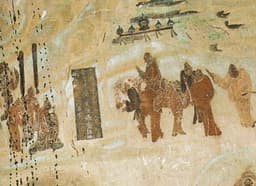
Zhang Qian
Explorer · Ancient
46.4Total
Basic Information
Born
-1210
-164
Died
-1180
-114
Era
Ancient
Ancient
Nationality
Troy
China
Occupation
General
Explorer
Civilization
Western
Eastern
Score Comparison
Military (10%)
20.0
40.3
Political (20%)
35.0
26.4
Influence (20%)
55.0
58.3
Legacy (20%)
55.0
55.0
Leadership (15%)
51.7
40.9
Strategy (15%)
60.0
39.5
TOTAL
48.5
46.4
Hector of Troy — Complete Timeline
1180 BC
Killed Patroclus of PhthiaWar
Hector confronted Patroclus outside the walls of Troy after Apollo had stunned him. Hector struck Patroclus with a spear through the belly, killing him. He then stripped Achilles' armor from Patroclus's body and wore it himself.
Trojan WarCombatKill
Impact: regionaldestructive
Killed by AchillesWar
Achilles, seeking revenge for Patroclus, chased Hector around the walls of Troy three times. Hector finally turned to fight but was killed by a spear thrust to the throat. Achilles dragged his body behind his chariot.
Trojan WarDeathRevenge
Impact: regionaltragic
Led the Trojan assault on the Greek shipsWar◆ Major
Hector led the Trojan army in a massive assault that broke through the Greek wall and reached the ships. He attempted to set fire to the ships, which would have stranded the Greeks in Troy.
Trojan WarAssaultShips
Impact: regional
Refused to retreat behind the wallsPolitical Action◆ Major
Despite his family's pleas, Hector chose to face Achilles alone outside the walls of Troy. He initially ran but later stood his ground, knowing he would likely die, to defend his city and family honor.
Trojan WarDecisionHonor
Impact: regionaltragic
Zhang Qian — Complete Timeline
138 BC
First Mission to the Western RegionsPolitical Action◆ Major
Emperor Wu of Han dispatched Zhang Qian as an envoy to seek an alliance with the Yuezhi against the Xiongnu. Zhang Qian was captured by the Xiongnu and held for ten years, but eventually escaped and continued his journey.
Han DynastyDiplomacyExploration
Impact: regional
128 BC
Reached the Yuezhi and BactriaPolitical Action◆ Major
After escaping Xiongnu captivity, Zhang Qian traveled through Ferghana and Sogdiana to reach the Yuezhi in Bactria. The Yuezhi declined an alliance against the Xiongnu, but Zhang Qian gathered detailed intelligence on Central Asian states.
Han DynastyExplorationCentral Asia
Impact: regional
126 BC
Return to Chang'an and Report to Emperor WuPolitical Action◆ Major
Zhang Qian returned to the Han capital after 13 years, bringing detailed accounts of the Western Regions, including the kingdoms of Dayuan, Kangju, and Daxia. His report provided the first reliable Chinese knowledge of Central Asia and spurred Han expansion.
Han DynastyExplorationDiplomacy
Impact: regionalconstructive
115 BC
Second Mission to the WusunPolitical Action◆ Major
Emperor Wu sent Zhang Qian on a second mission to the Wusun in the Ili Valley to secure an alliance against the Xiongnu. Zhang Qian established diplomatic relations and opened the Silk Road trade routes between China and Central Asia.
Han DynastySilk RoadDiplomacy
Impact: regionalconstructive
Expert Analysis
Origins
Hector of Troy, born around 1250 BCE, was the eldest son of King Priam and Queen Hecuba of Troy. As a prince of a wealthy city-state controlling the Dardanelles, he was raised in a militaristic aristocracy. His education focused on chariot warfare, spear combat, and leadership. Homer depicts him as a family man, devoted to his wife Andromache and son Astyanax.
Zhang Qian was born around 164 BCE in Hanzhong, China, during the Han dynasty. He entered imperial service as a gentleman-of-the-household, likely from a modest official family. His background was administrative rather than military, trained in Confucian classics and diplomatic protocol. His formative experience was being selected by Emperor Wu for a dangerous mission to the Western Regions.
Rise to Power
Hector's rise came through birthright and battlefield performance. As crown prince, he commanded the Trojan army from the start of the Trojan War (c. 1190 BCE). His turning point was leading the assault that broke through the Greek wall and threatened their ships (Iliad Book 12). He killed the Greek hero Patroclus in single combat (Book 16), cementing his reputation as Troy's greatest warrior.
Zhang Qian's rise began in 138 BCE when Emperor Wu appointed him envoy to the Yuezhi. He was captured by Xiongnu nomads and held for ten years, marrying a Xiongnu wife. His escape in 129 BCE demonstrated resourcefulness. He reached the Yuezhi in Bactria but failed to secure an alliance. His 126 BCE return to Chang'an with detailed intelligence impressed the emperor, leading to a second mission (119 BCE) to the Wusun, which established formal diplomatic relations.
Leadership & Governance
Hector led by personal example on the battlefield. He organized Trojan forces in coordinated assaults, delegating commands to allies like Sarpedon and Aeneas. His governance was that of a warrior-prince: he convened councils but ultimately deferred to his father Priam. His leadership style was defensive—protecting Troy rather than expanding. He scored 51.7 in leadership, reflecting his ability to inspire loyalty, but lacked strategic innovation (60.0 strategy).
Zhang Qian's leadership was diplomatic and exploratory. He guided small teams through hostile terrain, negotiating with multiple kingdoms. His governance approach was information-gathering: he documented customs, resources, and military strengths of Central Asian states. He scored 40.9 in leadership, lower due to his subordinate role as envoy rather than ruler. His strategy score of 39.5 reflects his primary focus on exploration over tactical planning.
Triumph & Tragedy
Hector's greatest triumph was killing Patroclus, the closest companion of Achilles. This act temporarily demoralized the Greeks and boosted Trojan morale. His greatest tragedy was his death at Achilles' hands—dragged around Troy behind a chariot. He also failed to heed Polydamas' advice to retreat after Patroclus' death, a strategic error that led to his doom. His refusal to retreat behind walls, while heroic, cost Troy its best defender.
Zhang Qian's triumph was opening the Silk Road. His reports identified trade routes to Ferghana (Dayuan), Bactria, and Parthia, leading to the Han's expansion into Central Asia. His tragedy was failing his primary mission: the Yuezhi refused to ally against the Xiongnu. He also failed to secure the Wusun alliance on his second mission. Yet his exploratory achievements outweighed these diplomatic failures.
Character & Destiny
Hector was characterized by honor and duty. He fought for family and city, not personal glory. His decision to face Achilles alone stemmed from shame at having previously retreated. This sense of honor, while noble, was fatal. Ancient sources praise his humanity—his tender farewell to Andromache—but criticize his tactical inflexibility.
Zhang Qian was patient and adaptable. His ten-year captivity did not break his resolve; he learned Xiongnu language and customs, using them to escape. He was methodical, keeping detailed records. His destiny was to be a pioneer rather than a conqueror. His character—persistent, curious, diplomatic—shaped his role as a bridge between civilizations.
Legacy
Hector's legacy is literary and symbolic. He became the archetype of the noble defender in Western culture, influencing medieval chivalry and modern portrayals of tragic heroes. His story, immortalized in Homer's Iliad, has been retold for 3,000 years. He scored 55.0 in legacy, reflecting cultural impact rather than institutional change.
Zhang Qian's legacy is geopolitical and economic. His explorations directly led to the Silk Road, which connected China to the Mediterranean for over 1,500 years. He established diplomatic protocols that the Han used to manage Central Asian states. His reports shaped Chinese knowledge of the world for centuries. He also scored 55.0 in legacy, but his impact was more tangible—trade routes, alliances, and cultural exchange.
Conclusion
While Hector scores slightly higher overall (48.5 vs 46.4), Zhang Qian's impact is more substantial and enduring. Hector's influence is confined to literature and mythology; his military achievements (20.0) were local and ultimately failed to save Troy. Zhang Qian's explorations (40.3 military, 58.3 influence) transformed global history by creating the Silk Road, enabling the exchange of goods, ideas, and technologies between East and West. Hector's story inspires; Zhang Qian's work changed the world. The greater historical impact belongs to Zhang Qian.
Rankings
🥇
Hector of TroyLeader
Mil: 20.0Pol: 35.0Inf: 55.0
48.5
🥈
Zhang Qian
Mil: 40.3Pol: 26.4Inf: 58.3
46.4
+2.1 behind
How This Comparison Works
Algorithm
Each figure is scored on 6 dimensions (0—100 scale) based on structured historical data: Military (10%), Political (20%), Influence (20%), Legacy (20%), Leadership (15%), Strategy (15%). The weighted total produces the final ranking.
Data Sources
Scores are computed from structured sub-indicators in the database. Scale factors adjust for era (Ancient ×0.85, Modern ×1.0) and civilization size (Eastern ×1.05, Other ×0.80) to account for differences in population and military scale.
Maximum 3 Figures
Comparisons are limited to 2—3 figures to ensure readability and statistical meaningfulness.
Error Margins
±5 points per dimension — Sub-scores are derived from historical records with inherent uncertainty. Two figures within 5 points on a dimension should be considered roughly equivalent in that area.
Total Score Accuracy
±3 points overall — The weighted combination of 6 dimensions produces a total score with approximately ±3 points of uncertainty. Differences of less than 3 points are not statistically significant— the figures are effectively tied.
Known Limitations
- Historical records are incomplete and uneven across civilizations
- Figures from oral-tradition societies may be underrepresented
- Occupation labels can misclassify multi-role figures
- Scores measure capability and impact, not moral character
- Quantitative scoring is a comparison tool, not absolute truth
Capability Radar
Military (10%) — Battles & Warfare
Battles
40
27
Win Rate
35
28
Expansion
10
31
Political (20%) — Governance & Reform
Reform
10
10
Diplomacy
25
85
Economy
15
30
Influence (20%) — Cultural & Global Reach
Cultural
75
70
Global
65
70
Legacy (20%) — Historical Impact
Historical
70
80
Longevity
80
80
Leadership (15%) — Power & Stability
Tenure
20
10
Stability
20
10
Strategy (15%) — Tactics & Innovation
Strategy
45
37
Tactics
55
37
Reform
10
42
Similar Comparisons
Comments & Discussion
No comments yet. Be the first to share your thoughts!