Loading...
Hannibal Barca vs Hector of Troy
Hannibal Barca leads by 8.7 pts · 2 figures compared
…
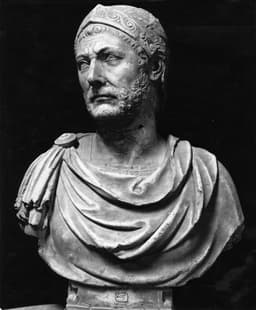
Hannibal Barca
General · Ancient
57.2Total

Hector of Troy
General · Ancient
48.5Total
Basic Information
Born
-247
-1210
Died
-183
-1180
Era
Ancient
Ancient
Nationality
Carthage
Troy
Occupation
General
General
Civilization
Middle Eastern
Western
Score Comparison
Military (10%)
92.0
20.0
Political (20%)
35.0
35.0
Influence (20%)
55.0
55.0
Legacy (20%)
40.0
55.0
Leadership (15%)
68.0
51.7
Strategy (15%)
88.0
60.0
TOTAL
57.2
48.5
Hannibal Barca — Complete Timeline
219 BC
Siege of SaguntumWar◆ Major
Hannibal besieged and captured Saguntum, a Roman ally in Spain. This act violated a treaty with Rome and directly triggered the Second Punic War. The eight-month siege demonstrated Hannibal's determination and military skill, but also his willingness to provoke conflict.
SiegeProvocationWar Start
Impact: regionaldestructive
218 BC
Crossing of the AlpsWar
Hannibal led a Carthaginian army, including war elephants, from Spain across the Alps into Italy. The journey was arduous, with significant losses from terrain, weather, and attacks by mountain tribes. This strategic maneuver surprised the Romans and brought the war to their homeland.
Military CampaignAlpsStrategy
Impact: global
216 BC
Battle of CannaeWar
Hannibal's outnumbered army encircled and annihilated a larger Roman force at Cannae in southern Italy. The Romans suffered up to 70,000 casualties in one day. This battle is considered a masterpiece of tactical encirclement and remains studied in military academies.
BattleTacticsRoman Defeat
Impact: globaldestructive
202 BC
Battle of ZamaWar
Hannibal was defeated by Scipio Africanus at Zama in North Africa. Scipio's tactics neutralized Hannibal's elephants and cavalry, leading to a decisive Roman victory. This battle ended the Second Punic War and forced Carthage to accept harsh peace terms.
BattleDefeatEnd of War
Impact: globaltragic
183 BC
Exile and DeathPolitical Action◆ Major
After the war, Hannibal became a politician in Carthage, but Roman pressure forced him into exile. He fled to the Seleucid court, then to Bithynia. When the Romans demanded his extradition, he committed suicide by poison, ending his life as a fugitive.
ExileSuicideRoman Pursuit
Impact: regionaltragic
Hector of Troy — Complete Timeline
1180 BC
Killed Patroclus of PhthiaWar
Hector confronted Patroclus outside the walls of Troy after Apollo had stunned him. Hector struck Patroclus with a spear through the belly, killing him. He then stripped Achilles' armor from Patroclus's body and wore it himself.
Trojan WarCombatKill
Impact: regionaldestructive
Killed by AchillesWar
Achilles, seeking revenge for Patroclus, chased Hector around the walls of Troy three times. Hector finally turned to fight but was killed by a spear thrust to the throat. Achilles dragged his body behind his chariot.
Trojan WarDeathRevenge
Impact: regionaltragic
Led the Trojan assault on the Greek shipsWar◆ Major
Hector led the Trojan army in a massive assault that broke through the Greek wall and reached the ships. He attempted to set fire to the ships, which would have stranded the Greeks in Troy.
Trojan WarAssaultShips
Impact: regional
Refused to retreat behind the wallsPolitical Action◆ Major
Despite his family's pleas, Hector chose to face Achilles alone outside the walls of Troy. He initially ran but later stood his ground, knowing he would likely die, to defend his city and family honor.
Trojan WarDecisionHonor
Impact: regionaltragic
Expert Analysis
Origins
Hannibal Barca was born in 247 BCE in Carthage (modern-day Tunisia), son of the prominent general Hamilcar Barca. He was raised in a military environment, with his father instilling in him a lifelong hatred of Rome. Hannibal received a thorough education in military tactics and strategy, and he accompanied his father on campaigns in Spain from a young age. His early exposure to warfare and his father's influence shaped his future as a commander.
Hector of Troy, by contrast, is a figure of Greek mythology, believed to have lived around the 12th or 13th century BCE. He was the eldest son of King Priam and Queen Hecuba of Troy. As a prince, Hector was trained in the arts of war from boyhood. His upbringing emphasized duty, honor, and protection of his family and city. While Hannibal's origins are historical, Hector's are legendary, but both emerged from elite backgrounds with clear expectations of leadership.
Rise to Power
Hannibal rose to prominence at a young age. In 221 BCE, at 26, he was elected commander-in-chief of the Carthaginian army in Spain by the army and the Carthaginian government. He immediately set about consolidating Carthaginian control in Spain, and in 219 BCE he besieged Saguntum, a Roman ally, triggering the Second Punic War. His daring crossing of the Alps in 218 BCE with war elephants and a multi-ethnic army brought him into Italy, where he won a series of victories against Rome. His greatest triumph came at Cannae in 216 BCE, where he annihilated a Roman army of over 80,000 men, a victory that remains studied in military academies.
Hector's rise is less documented. He appears in Homer's Iliad as the foremost Trojan warrior. His leadership was recognized by his father and the Trojan council. He led the Trojan army in major offensives, including the assault on the Greek ships in 1184 BCE (traditional date of the Trojan War). His pivotal moment came when he killed Patroclus, Achilles' close companion, after Apollo stunned the Greek hero. This act directly led to his confrontation with Achilles and his own death.
Leadership & Governance
Hannibal's leadership was characterized by strategic brilliance and adaptability. He commanded a diverse army of Carthaginians, Numidians, Iberians, and Gauls, and he maintained their loyalty through shared hardships and rewards. His governance was limited to military command; he never ruled Carthage. Politically, he scored a low 35.0, reflecting his inability to secure lasting support from Carthage's oligarchic government. His strategy score of 88.0 highlights his tactical genius, especially in using terrain and deception.
Hector's leadership was more about inspiration and defense. He was a prince who led from the front, and his men respected his courage. He governed Troy alongside his father and brothers, but his role was primarily military. His political score of 35.0 matches Hannibal's, as he had limited political power. His strategy score of 60.0 indicates competent but not exceptional tactical ability. Hector's leadership was more about personal example than strategic innovation.
Triumph & Tragedy
Hannibal's greatest triumph was the Battle of Cannae, where his outnumbered army encircled and destroyed a Roman force of up to 70,000 casualties. He also achieved a strategic victory by maintaining a presence in Italy for over a decade. However, his greatest failure was the Battle of Zama in 202 BCE, where he was decisively defeated by Scipio Africanus. Scipio's tactics neutralized Hannibal's elephants and cavalry, leading to Carthage's surrender. Hannibal also failed to capture Rome itself and could not secure sufficient reinforcements from Carthage.
Hector's triumph was leading the Trojan assault that broke through the Greek wall and reached the ships, nearly winning the war. He also killed Patroclus, a major Greek hero. His tragedy was his death at the hands of Achilles, who dragged his body around Troy. Hector's refusal to retreat behind the walls, despite his family's pleas, led to his death. His failure was his inability to defend Troy, which fell shortly after.
Character & Destiny
Hannibal was cunning, patient, and ruthless. He was known for his strategic patience and ability to adapt. His character shaped his destiny: his hatred of Rome drove him to invade Italy, but his inability to secure political support led to his downfall. After the war, he was forced into exile and eventually poisoned himself to avoid capture. Historical assessments note his military genius but his political naivete.
Hector was honorable, dutiful, and brave, but also impulsive. His sense of honor compelled him to face Achilles, even knowing he would die. His character made him a tragic hero, but his death sealed Troy's fate. He is remembered as a model of noble warrior ethos, but his strategy was often reactive.
Legacy
Hannibal's legacy is immense in military history. His tactics at Cannae are studied to this day. He scored 55.0 in influence and 40.0 in legacy, reflecting his impact on warfare but limited lasting political influence. He is remembered as one of the greatest generals of antiquity, and his crossing of the Alps is legendary. His total score of 57.2 reflects a high military but low political impact.
Hector's legacy is more cultural. He scored 55.0 in both influence and legacy, tied with Hannibal in influence. He is a symbol of Trojan heroism and appears in literature from Homer to modern works. His legacy is tied to the myth of Troy, which has endured for millennia. However, his military score of 20.0 is low, as his achievements are largely legendary and not backed by historical data.
Conclusion
Hannibal Barca had a greater impact than Hector of Troy. Hannibal's military score of 92.0 dwarfs Hector's 20.0, and his strategic innovations changed warfare. While Hector's cultural legacy is powerful, Hannibal's real-world influence on military history is more concrete. Hannibal's total score of 57.2 exceeds Hector's 48.5 by 8.7 points, and his historical reality gives him an edge over Hector's mythological status. Therefore, Hannibal is the more impactful figure.
Rankings
🥇
Hannibal BarcaLeader
Mil: 92.0Pol: 35.0Inf: 55.0
57.2
🥈
Hector of Troy
Mil: 20.0Pol: 35.0Inf: 55.0
48.5
+8.7 behind
How This Comparison Works
Algorithm
Each figure is scored on 6 dimensions (0—100 scale) based on structured historical data: Military (10%), Political (20%), Influence (20%), Legacy (20%), Leadership (15%), Strategy (15%). The weighted total produces the final ranking.
Data Sources
Scores are computed from structured sub-indicators in the database. Scale factors adjust for era (Ancient ×0.85, Modern ×1.0) and civilization size (Eastern ×1.05, Other ×0.80) to account for differences in population and military scale.
Maximum 3 Figures
Comparisons are limited to 2—3 figures to ensure readability and statistical meaningfulness.
Error Margins
±5 points per dimension — Sub-scores are derived from historical records with inherent uncertainty. Two figures within 5 points on a dimension should be considered roughly equivalent in that area.
Total Score Accuracy
±3 points overall — The weighted combination of 6 dimensions produces a total score with approximately ±3 points of uncertainty. Differences of less than 3 points are not statistically significant— the figures are effectively tied.
Known Limitations
- Historical records are incomplete and uneven across civilizations
- Figures from oral-tradition societies may be underrepresented
- Occupation labels can misclassify multi-role figures
- Scores measure capability and impact, not moral character
- Quantitative scoring is a comparison tool, not absolute truth
Capability Radar
Military (10%) — Battles & Warfare
Battles
95
40
Win Rate
92
35
Expansion
85
10
Political (20%) — Governance & Reform
Reform
30
10
Diplomacy
60
25
Economy
35
15
Influence (20%) — Cultural & Global Reach
Cultural
85
75
Global
85
65
Legacy (20%) — Historical Impact
Historical
95
70
Longevity
90
80
Leadership (15%) — Power & Stability
Tenure
40
20
Stability
25
20
Strategy (15%) — Tactics & Innovation
Strategy
95
45
Tactics
99
55
Reform
70
10
Similar Comparisons
Comments & Discussion
No comments yet. Be the first to share your thoughts!