Loading...
Hamoud bin Mohammed vs Julius Caesar
Julius Caesar leads by 27.1 pts · 2 figures compared
…
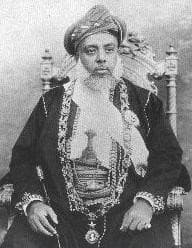
Hamoud bin Mohammed
Emperor · Modern
55.7Total

Julius Caesar
General · Ancient
82.8Total
Basic Information
Born
1853
-100
Died
1902
-44
Era
Modern
Ancient
Nationality
Zanzibar
Roman Republic
Occupation
Emperor
General
Civilization
Other
Western
Score Comparison
Military (10%)
43.3
88.0
Political (20%)
62.7
78.0
Influence (20%)
54.9
85.0
Legacy (20%)
46.7
82.0
Leadership (15%)
74.0
80.0
Strategy (15%)
54.3
85.0
TOTAL
55.7
82.8
Hamoud bin Mohammed — Complete Timeline
1896 AD
British Recognition as SultanPolitical Action◆ Major
After the Anglo-Zanzibar War, the British installed Hamoud bin Mohammed as sultan. He was chosen for his pro-British stance and willingness to cooperate with British anti-slavery policies, marking Zanzibar's transition to a British protectorate.
British ProtectorateInstallationColonial Rule
1897 AD
Abolition of Slavery in ZanzibarReform
Hamoud bin Mohammed issued a decree abolishing the legal status of slavery in Zanzibar. This ended the island's role as a major slave trade hub, freeing approximately 60,000 enslaved people and compensating slave owners.
AbolitionSlaveryHuman Rights
Impact: regionalprogressive
Enactment of the Slavery Abolition DecreeReform◆ Major
Hamoud bin Mohammed signed the Slavery Abolition Decree on April 5, 1897, which freed all slaves in Zanzibar and Pemba. The decree included provisions for former slaves to become tenants or wage laborers on plantations.
Abolition DecreeEmancipationSocial Reform
Impact: regionalprogressive
Julius Caesar — Complete Timeline
58 BC
Gallic WarsWar◆ Major
Caesar, as proconsul of Gaul, launched a series of campaigns that conquered all of Gaul (modern France, Belgium, and parts of Switzerland). He fought numerous battles, including against the Helvetii, the Belgae, and the Gallic chieftain Vercingetorix. The wars brought immense wealth and a loyal army to Caesar.
Gallic WarsConquestRoman Expansion
Impact: regional
49 BC
Crossing the RubiconPolitical Action◆ Major
Caesar led Legio XIII across the Rubicon River into Italy, defying the Roman Senate's order to disband his army. This act triggered a civil war against Pompey and the Optimates, ultimately leading to Caesar's dictatorship and the end of the Roman Republic.
Roman Civil WarEnd of RepublicPower Struggle
Impact: global
48 BC
Battle of PharsalusWar◆ Major
Caesar's outnumbered army defeated the larger forces of Pompey the Great at Pharsalus in Greece. Caesar's tactical use of a reserve line to counter Pompey's cavalry charge proved decisive. Pompey fled to Egypt, where he was assassinated, leaving Caesar as the undisputed master of the Roman world.
Roman Civil WarBattleDecisive Victory
Impact: regional
44 BC
Appointment as Dictator for LifePolitical Action◆ Major
The Roman Senate appointed Caesar dictator perpetuo (dictator for life), granting him unprecedented personal power. This move concentrated military, legislative, and judicial authority in one person, effectively ending the Roman Republic's traditional system of checks and balances and alarming many senators.
DictatorshipEnd of RepublicPower Consolidation
Impact: regionaldestructive
Assassination on the Ides of MarchPolitical Action◆ Major
A group of Roman senators, led by Marcus Junius Brutus and Gaius Cassius Longinus, stabbed Caesar to death at a meeting of the Senate in the Theatre of Pompey. The assassination was intended to restore the Republic, but instead triggered another civil war that led to the rise of the Roman Empire.
AssassinationRoman PoliticsEnd of Republic
Impact: globaldestructive
Expert Analysis
hamoud-bin-mohammed-vs-julius-caesar
# The Conqueror and the Abolitionist: Two Paths to Power
On the Ides of March, 44 BCE, a blood-soaked Julius Caesar crumpled at the base of Pompey’s Theatre, stabbed twenty-three times by senators who feared his ambition. Half a world away and nineteen centuries later, in the summer of 1896, Hamoud bin Mohammed stood on the palace balcony in Stone Town, Zanzibar, watching the Royal Navy bombard his predecessor’s fortress into rubble. One man seized history by the throat; the other was carried into power on the tides of empire. What separates a legend from a footnote? The answer lies not merely in what they achieved, but in the worlds that shaped them.
Origins
Caesar was born into the twilight of the Roman Republic, a world of iron discipline and ruthless ambition. His patrician family, the Julii, claimed descent from the goddess Venus, but their political fortunes had waned. Young Gaius grew up in a Rome where senatorial backstabbing was an art form and military glory the surest path to immortality. His uncle Marius had been a populist reformer; his rival Sulla a conservative dictator. From boyhood, Caesar understood that in Rome, power flowed from the sword and the crowd.
Hamoud bin Mohammed was born in 1853 on the spice island of Zanzibar, a sultanate that had grown wealthy on cloves, ivory, and human flesh. His world was the Indian Ocean trade network, where Omani Arab sultans ruled over a Swahili-speaking populace, Indian merchants financed caravans, and European consuls schemed for influence. Zanzibar was a crossroads, but by Hamoud’s youth, it was a crossroads dominated by British gunboats. He learned diplomacy as a survival skill, watching his cousins bargain with the British for scraps of sovereignty.
Rise to Power
Caesar’s ascent was a masterpiece of calculated risk. He borrowed fortunes to bribe his way into the consulship, formed the First Triumvirate with Pompey and Crassus, then spent eight years conquering Gaul—slaughtering a million people and enslaving another million in the process. His Commentaries turned butchery into propaganda. When the Senate ordered him to disband his army, Caesar crossed the Rubicon River in 49 BCE, uttering *“Alea iacta est”*—the die is cast. Civil war followed. He defeated Pompey at Pharsalus, chased his enemies to Egypt, and returned to Rome as dictator.
Hamoud’s rise was quieter but no less dramatic. The Anglo-Zanzibar War of 1896 lasted barely forty minutes—the shortest war in history. When the pro-British sultan died, his nephew Khalid barghash seized power without British approval. The Royal Navy responded by shelling the palace. Khalid fled, and the British installed Hamoud, a known Anglophile, as sultan. His coronation came at gunpoint. He understood that his authority rested not on legions but on London’s approval.
Leadership & Governance
Caesar governed as a revolutionary in conservative clothing. He reformed the calendar, granted citizenship to provincials, started public works projects, and packed the Senate with his supporters. But his military genius was his greatest asset. At Alesia, he besieged a Gallic stronghold while simultaneously fighting off a relief army—a feat of tactical brilliance that ended Celtic resistance. Yet his political wisdom faltered. He accepted the title *dictator perpetuo*—dictator for life—and placed his image on coins, acts that screamed “king” to a Republic that had murdered kings for centuries.
Hamoud governed as a reformer under constraint. His defining act came in 1897, when he issued the Slavery Abolition Decree on April 5, ending the legal status of slavery in Zanzibar and Pemba. The decree freed thousands, but it was no act of pure benevolence. Britain had been pressuring Zanzibar for decades; the Royal Navy already patrolled the coast intercepting slave ships. Hamoud’s decree simply formalized what British power had already made inevitable. His political skill lay in making the decree his own, preserving a semblance of sovereignty while yielding to reality.
Triumph & Tragedy
Caesar’s triumph was absolute. He conquered Gaul, defeated his rivals, and reshaped the Mediterranean world. His tragedy was that he could not stop. He pardoned his enemies, but they plotted anyway. He tried to rule as a father of the state, but he had destroyed the state’s traditions. The Ides of March was both murder and suicide—a man who could not see that the Republic he saved was the Republic he had killed.
Hamoud’s triumph was moral. By abolishing slavery, he ended an institution that had defined Zanzibar for centuries. His tragedy was that he had no choice. He was a sultan who ruled at British pleasure, a reformer whose reforms were dictated from Whitehall. When he died in 1902, his son succeeded him peacefully—a sign of stability, but also of Zanzibar’s quiet absorption into the British sphere.
Character & Destiny
Caesar was audacity incarnate. He pardoned enemies, seduced queens, and gambled everything on his own genius. His personality drove him to conquer where others would have compromised, and to dominate where others would have shared power. That same personality made him impossible to tolerate. The senators who killed him were not evil; they were terrified of a man who had become larger than the state.
Hamoud was prudence personified. He navigated between British demands and local traditions, accepting the role of a constitutional monarch before the concept existed. His personality was shaped by necessity—a weak state, a dominant empire, a world where survival meant accommodation. He did not change history; he managed it.
Legacy
Caesar’s legacy is the Roman Empire itself. His adopted son Octavian became Augustus, the first emperor. For centuries, European rulers styled themselves “Caesar”—Kaiser, Tsar, Qaysar. His reforms outlived him, his writings shaped Latin literature, and his assassination became the most famous political murder in history. His score of 83.3 reflects a man who changed the world, for better and worse.
Hamoud’s legacy is quieter but real. The abolition decree made Zanzibar a symbol of emancipation in East Africa. His reign stabilized a sultanate that might have collapsed into chaos. But his score of 65.4 tells the truth: he was a figure of transition, not transformation. He is remembered in Zanzibar as a reformer, but his name does not echo through the centuries.
Conclusion
Caesar and Hamoud never could have traded places. The Roman would have found Zanzibar suffocating—too small, too constrained, too dependent. The sultan would have found Rome terrifying—too violent, too unstable, too free. Their differences are not merely of scale but of kind. Caesar was a force of nature, a man who broke the world and rebuilt it in his image. Hamoud was a steward, a man who preserved what he could while the world changed around him. History remembers both, but it remembers them differently. One gave his name to emperors; the other gave his people freedom. Which is greater depends on what you value—the storm that reshapes the landscape, or the hand that steadies the ship through the storm.
Rankings
🥇
Julius CaesarLeader
Mil: 88.0Pol: 78.0Inf: 85.0
82.8
🥈
Hamoud bin Mohammed
Mil: 43.3Pol: 62.7Inf: 54.9
55.7
+27.1 behind
How This Comparison Works
Algorithm
Each figure is scored on 6 dimensions (0—100 scale) based on structured historical data: Military (10%), Political (20%), Influence (20%), Legacy (20%), Leadership (15%), Strategy (15%). The weighted total produces the final ranking.
Data Sources
Scores are computed from structured sub-indicators in the database. Scale factors adjust for era (Ancient ×0.85, Modern ×1.0) and civilization size (Eastern ×1.05, Other ×0.80) to account for differences in population and military scale.
Maximum 3 Figures
Comparisons are limited to 2—3 figures to ensure readability and statistical meaningfulness.
Error Margins
±5 points per dimension — Sub-scores are derived from historical records with inherent uncertainty. Two figures within 5 points on a dimension should be considered roughly equivalent in that area.
Total Score Accuracy
±3 points overall — The weighted combination of 6 dimensions produces a total score with approximately ±3 points of uncertainty. Differences of less than 3 points are not statistically significant— the figures are effectively tied.
Known Limitations
- Historical records are incomplete and uneven across civilizations
- Figures from oral-tradition societies may be underrepresented
- Occupation labels can misclassify multi-role figures
- Scores measure capability and impact, not moral character
- Quantitative scoring is a comparison tool, not absolute truth
Capability Radar
Military (10%) — Battles & Warfare
Battles
5
95
Win Rate
5
92
Expansion
5
97
Political (20%) — Governance & Reform
Reform
70
90
Diplomacy
40
85
Economy
30
82
Influence (20%) — Cultural & Global Reach
Cultural
30
88
Global
40
94
Legacy (20%) — Historical Impact
Historical
50
95
Longevity
40
96
Leadership (15%) — Power & Stability
Tenure
40
75
Stability
30
60
Strategy (15%) — Tactics & Innovation
Strategy
5
94
Tactics
5
96
Reform
5
88
Similar Comparisons
Comments & Discussion
No comments yet. Be the first to share your thoughts!