Loading...
Hafez al-Assad vs Pietro Badoglio
Pietro Badoglio leads by 0.4 pts · 2 figures compared
…
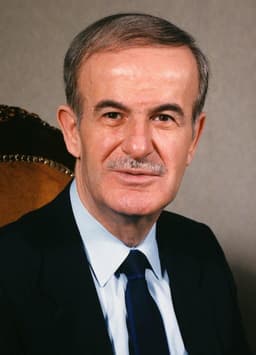
Hafez al-Assad
General · Modern
54.4Total

Pietro Badoglio
General · Modern
54.8Total
Basic Information
Born
1930
1871
Died
—
1956
Era
Modern
Modern
Nationality
Syria
Italy
Occupation
General
General
Civilization
Middle Eastern
Western
Score Comparison
Military (10%)
20.0
50.0
Political (20%)
45.0
61.3
Influence (20%)
61.0
54.9
Legacy (20%)
54.0
47.5
Leadership (15%)
72.0
62.0
Strategy (15%)
60.7
57.5
TOTAL
54.4
54.8
Hafez al-Assad — Complete Timeline
1970 AD
Seized power in the Corrective MovementPolitical Action
Hafez al-Assad, then Minister of Defense, launched a bloodless intra-party coup known as the Corrective Movement on November 13, 1970. He ousted the civilian leadership of the Ba'ath Party, assumed the presidency, and established an authoritarian regime dominated by the Alawite minority.
Coup d'étatBa'ath PartyAlawite Rule
Impact: nationaldestructive
1973 AD
Launched the Yom Kippur WarWar◆ Major
Assad coordinated with Egypt's Anwar Sadat to launch a surprise attack on Israel on October 6, 1973. Syrian forces advanced into the Golan Heights but were repelled by Israeli counterattacks. The war ended with a ceasefire, and Syria failed to regain the Golan Heights.
Arab-Israeli WarGolan HeightsMilitary Campaign
Impact: regional
1976 AD
Intervened in the Lebanese Civil WarWar◆ Major
Assad sent Syrian troops into Lebanon to intervene in the civil war, initially against Palestinian and leftist forces. The Syrian military remained in Lebanon for 29 years, exerting political and military control. The intervention solidified Syria's dominance over Lebanese affairs.
LebanonMilitary InterventionHegemony
Impact: regionaldestructive
1982 AD
Crushed the Muslim Brotherhood uprising in HamaWar◆ Major
Assad ordered the Syrian army to besiege and bombard the city of Hama to suppress an Islamist uprising led by the Muslim Brotherhood. Over several weeks, between 10,000 and 40,000 civilians were killed, and large parts of the city were destroyed. The massacre ended armed opposition for decades.
MassacreRepressionMuslim Brotherhood
Impact: nationaldestructive
Pietro Badoglio — Complete Timeline
1916 AD
Commanded the Capture of Mount SabotinoWar◆ Major
Badoglio, as a general, commanded the Italian capture of Mount Sabotino during the Sixth Battle of the Isonzo. The victory was a significant tactical success, but Badoglio's later role in the disastrous Battle of Caporetto overshadowed it.
World War IBattleItaly
Impact: regional
1917 AD
Battle of CaporettoWar◆ Major
Badoglio commanded the Italian Second Army during the Battle of Caporetto, where Austro-German forces broke through Italian lines. His failure to prepare defenses led to a catastrophic defeat, with over 300,000 Italian casualties and a retreat to the Piave River.
World War IDefeatCaporetto
Impact: regionaltragic
1943 AD
Appointed Prime Minister after Mussolini's FallPolitical Action
After the Grand Council of Fascism deposed Mussolini, King Victor Emmanuel III appointed Badoglio as Prime Minister. Badoglio secretly negotiated an armistice with the Allies, which was announced on September 8, 1943, leading to German occupation of Italy.
World War IIArmisticeItaly
Impact: global
Signed the Armistice of CassibilePolitical Action
Badoglio signed the Armistice of Cassibile with the Allies on September 3, 1943, ending Italy's war with the Allies. The armistice was kept secret until September 8, causing chaos as German forces swiftly occupied northern and central Italy.
World War IIArmisticeItaly
Impact: global
Expert Analysis
Origins
Hafez al-Assad was born on October 6, 1930, in Qardaha, a village in northwestern Syria, to a poor Alawite family. His father, Ali Sulayman, was a local notable. Assad excelled in school and joined the Ba'ath Party in 1946. He attended the Homs Military Academy, graduating as a pilot in 1955. His early military career included training in the Soviet Union.
Pietro Badoglio was born on September 28, 1871, in Grazzano Monferrato, Italy, to a landowning family. He entered the Royal Military Academy of Turin in 1890 and served in the Italian colonial wars in Libya and Ethiopia. Badoglio rose through the ranks, becoming a general by 1915. He commanded troops in World War I, earning a reputation for tactical competence.
Rise to Power
Assad's rise began within the Ba'ath Party. As Minister of Defense, he launched the Corrective Movement on November 13, 1970, a bloodless intra-party coup that ousted the civilian leadership. He assumed the presidency in 1971, consolidating power through the Alawite-dominated military and security apparatus. He eliminated rivals, including General Muhammad Umran, and centralized control.
Badoglio's rise was tied to his military career. He became Chief of the General Staff in 1925 and was appointed Marshal of Italy in 1926. He served as Governor-General of Libya (1929-1934) and Viceroy of Ethiopia after the conquest in 1936. He resigned in 1940 due to disagreements with Mussolini over Greece. After Mussolini's fall on July 25, 1943, King Victor Emmanuel III appointed Badoglio Prime Minister. He secretly negotiated the Armistice of Cassibile, signed on September 3, 1943.
Leadership & Governance
Assad ruled Syria with an iron fist. He centralized power in the presidency and the Ba'ath Party. He implemented socialist economic policies, including land reform and nationalization, but later encouraged limited private investment. His governance relied on the mukhabarat (security services) to suppress dissent. He crushed the Muslim Brotherhood uprising in Hama in 1982, killing tens of thousands. He also intervened in Lebanon's civil war in 1976, maintaining Syrian influence.
Badoglio's leadership was transitional. As Prime Minister, he faced the chaotic aftermath of Mussolini's fall. He publicly declared Italy would continue the war while secretly negotiating peace. He signed the armistice but failed to prepare the military for the German reaction. When Germany invaded Italy on September 8, 1943, the government fled to Brindisi, leaving troops without orders. His governance was marked by indecisiveness and poor coordination with the Allies.
Triumph & Tragedy
Assad's greatest success was stabilizing Syria under his authoritarian rule. He maintained power for 30 years, navigating regional conflicts like the Yom Kippur War (1973). He also secured Syrian influence in Lebanon. However, his failure was the brutal suppression of Hama, which tarnished his legacy. Additionally, his economic policies led to stagnation, and his neglect of succession planning left a fragile state.
Badoglio's triumph was negotiating the armistice that ended Italy's war with the Allies. However, his tragedy was the disaster of September 8, 1943, when the military collapsed. He also bore responsibility for the Italian defeat at Caporetto in 1917, where his Second Army was routed. His legacy is mixed: seen as a pragmatist who ended the war, but also as a symbol of military incompetence.
Character & Destiny
Assad was calculating and ruthless. He meticulously built a personality cult and eliminated threats. His character shaped Syria's destiny as a police state. His distrust of democracy and reliance on force ensured his survival but stunted development. Political score: 45.0, reflecting his skill in maintaining power.
Badoglio was cautious and indecisive. He lacked political vision, acting as a caretaker. His military experience did not translate into effective leadership. His character led to the chaotic armistice implementation. Military score: 50.0, but leadership score: 62.0, indicating some competence.
Legacy
Assad's legacy is enduring: his son Bashar al-Assad succeeded him, and his authoritarian model persists. Syria remains a Ba'athist state with a powerful security apparatus. His influence score: 61.0, legacy: 54.0. However, his rule laid the groundwork for the devastating civil war.
Badoglio's legacy is more ambiguous. He is remembered for signing the armistice, but also for Caporetto. Italy's post-war republic rejected the monarchy he served. His influence score: 54.9, legacy: 47.5. He is not celebrated in Italy.
Conclusion
While Badoglio's total score (54.8) slightly edges Assad's (54.4), Assad's impact is greater. Assad shaped Syria for three decades, influencing the Middle East. Badoglio's role was brief and largely negative. Assad's leadership score (72.0) and influence (61.0) outweigh Badoglio's. Therefore, Hafez al-Assad had a deeper and more lasting impact on history.
Rankings
🥇
Pietro BadoglioLeader
Mil: 50.0Pol: 61.3Inf: 54.9
54.8
🥈
Hafez al-Assad
Mil: 20.0Pol: 45.0Inf: 61.0
54.4
+0.4 behind
How This Comparison Works
Algorithm
Each figure is scored on 6 dimensions (0—100 scale) based on structured historical data: Military (10%), Political (20%), Influence (20%), Legacy (20%), Leadership (15%), Strategy (15%). The weighted total produces the final ranking.
Data Sources
Scores are computed from structured sub-indicators in the database. Scale factors adjust for era (Ancient ×0.85, Modern ×1.0) and civilization size (Eastern ×1.05, Other ×0.80) to account for differences in population and military scale.
Maximum 3 Figures
Comparisons are limited to 2—3 figures to ensure readability and statistical meaningfulness.
Error Margins
±5 points per dimension — Sub-scores are derived from historical records with inherent uncertainty. Two figures within 5 points on a dimension should be considered roughly equivalent in that area.
Total Score Accuracy
±3 points overall — The weighted combination of 6 dimensions produces a total score with approximately ±3 points of uncertainty. Differences of less than 3 points are not statistically significant— the figures are effectively tied.
Known Limitations
- Historical records are incomplete and uneven across civilizations
- Figures from oral-tradition societies may be underrepresented
- Occupation labels can misclassify multi-role figures
- Scores measure capability and impact, not moral character
- Quantitative scoring is a comparison tool, not absolute truth
Capability Radar
Military (10%) — Battles & Warfare
Battles
45
55
Win Rate
40
45
Expansion
30
30
Political (20%) — Governance & Reform
Reform
50
35
Diplomacy
70
50
Economy
45
30
Influence (20%) — Cultural & Global Reach
Cultural
40
20
Global
55
40
Legacy (20%) — Historical Impact
Historical
60
45
Longevity
55
30
Leadership (15%) — Power & Stability
Tenure
85
60
Stability
40
25
Strategy (15%) — Tactics & Innovation
Strategy
60
55
Tactics
55
50
Reform
65
40
Similar Comparisons
Comments & Discussion
No comments yet. Be the first to share your thoughts!