Loading...
Guled Abdi vs William III
William III leads by 19.9 pts · 2 figures compared
…
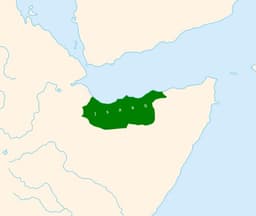
Guled Abdi
Emperor · Modern
44.7Total

William III
Emperor · Modern
64.6Total
Basic Information
Born
1750
1650
Died
1808
1702
Era
Modern
Modern
Nationality
Somalia
England
Occupation
Emperor
Emperor
Civilization
Other
Western
Score Comparison
Military (10%)
50.0
61.7
Political (20%)
35.1
82.0
Influence (20%)
48.6
55.0
Legacy (20%)
39.2
55.0
Leadership (15%)
58.8
80.0
Strategy (15%)
36.8
66.3
TOTAL
44.7
64.6
Guled Abdi — Complete Timeline
1750 AD
Foundation of the Isaaq SultanatePolitical Action◆ Major
Guled Abdi established the Isaaq Sultanate, becoming its first sultan. This event created a centralized political entity for the Isaaq clan in the Horn of Africa, consolidating their territory and influence in the region.
FoundingSultanateIsaaq
Impact: regionalconstructive
1760 AD
Consolidation of Isaaq TerritoryWar
Guled Abdi led military campaigns to expand and secure the Isaaq Sultanate's borders, subjugating rival clans and establishing control over key trade routes in the region. This solidified the sultanate's power base.
ExpansionMilitary CampaignIsaaq
Impact: regional
William III — Complete Timeline
1688 AD
Glorious RevolutionPolitical Action
William III, Stadtholder of the Dutch Republic, invaded England at the invitation of Protestant nobles. King James II fled, and William and his wife Mary II were declared joint monarchs, establishing parliamentary supremacy and Protestant succession.
Constitutional ChangeInvasionMonarchy
Impact: nationalconstructive
1690 AD
Battle of the BoyneWar◆ Major
William III personally led Williamite forces to victory over the Jacobite army of James II at the River Boyne in Ireland. The battle secured Protestant dominance in Ireland and William's hold on the English throne.
Jacobite WarIrelandProtestant-Catholic Conflict
Impact: regional
1697 AD
Treaty of RyswickPolitical Action◆ Major
William III negotiated the Treaty of Ryswick ending the Nine Years' War with France. Louis XIV recognized William as King of England and agreed to cease supporting James II's claims, temporarily stabilizing European borders.
DiplomacyPeace TreatyFrance
Impact: regionalconstructive
1702 AD
Death from a riding accidentOther◆ Major
William III died from pneumonia after breaking his collarbone in a riding accident at Hampton Court Palace. His death ended the Stuart line's direct rule and passed the throne to Queen Anne, leading to the Act of Union 1707.
DeathSuccessionStuart Dynasty
Impact: nationaltragic
Expert Analysis
Origins
Guled Abdi (born c. 1740s) was the first Sultan of the Isaaq Sultanate, a Somali clan confederation in the Horn of Africa. Little is documented about his early life, but he emerged from the Eidagale clan, a leading Isaaq lineage. His rise came through lineage and military prowess, unifying the Isaaq clans under a central authority for the first time.
William III (born 1650) was the son of William II, Prince of Orange, and Mary, daughter of King Charles I of England. Born into the Dutch House of Orange, he became Stadtholder of the Dutch Republic in 1672. His early life was marked by political turmoil and the French invasion of the Netherlands (1672), which shaped his lifelong opposition to Louis XIV.
Rise to Power
Guled Abdi rose to power by consolidating the Isaaq clans, who had previously been fragmented. He founded the Isaaq Sultanate around 1749, establishing a hereditary monarchy. His authority was based on military strength and control over trade routes, particularly the port of Berbera. He subjugated rival clans like the Gadabuursi and Issa, expanding his territory.
William III's rise came through the Glorious Revolution of 1688. Invited by Protestant nobles to replace the Catholic James II, William landed in England with a Dutch army. James fled, and William and his wife Mary were crowned co-monarchs in 1689. This invasion was a turning point, ensuring Protestant succession and limiting royal power via the Bill of Rights.
Leadership & Governance
Guled Abdi ruled as a traditional Somali sultan, relying on clan elders and a council (shir). His governance was decentralized, with local autonomy for sub-clans. He focused on maintaining order, collecting tribute, and defending trade. His leadership style was paternalistic but lacked formal institutions, scoring 58.8 in leadership and 36.8 in strategy.
William III was a pragmatic constitutional monarch. He worked closely with Parliament, accepting the Bill of Rights (1689) that curtailed royal prerogatives. He prioritized war with France, leading the Nine Years' War (1688–1697) and the War of Spanish Succession (1701–1714). His political score of 82.0 reflects his skill in navigating English and Dutch politics. He was an excellent strategist (66.3), personally leading campaigns like the Battle of the Boyne (1690).
Triumph & Tragedy
Guled Abdi's greatest triumph was founding the Isaaq Sultanate, which lasted until 1884 and provided stability for the Isaaq clans. However, his failure to create a strong centralized state meant the sultanate was vulnerable to internal divisions and later European colonization. He scored 39.2 in legacy, reflecting limited long-term impact.
William III's triumph was securing Protestant rule in England and defeating James II at the Boyne. He also negotiated the Treaty of Ryswick (1697), gaining recognition from France. His tragedy was his inability to fully curb French power; the War of Spanish Succession continued after his death. He died from a riding accident in 1702, leaving no direct heir, ending the Stuart line. His legacy score of 55.0 reflects his role in shaping British constitutional monarchy.
Character & Destiny
Guled Abdi was a unifier and warrior, but his lack of administrative innovation limited his dynasty's durability. His character was typical of a clan leader: focused on immediate power and kinship ties. This ultimately led to the sultanate's decline after his death.
William III was reserved, determined, and astute. His Calvinist faith drove his anti-French and anti-Catholic policies. His character shaped his destiny: he sacrificed personal popularity for political stability. His decision to invade England was risky but succeeded due to careful planning.
Legacy
Guled Abdi's Isaaq Sultanate is remembered as a precursor to modern Somali clan structures, but it was eclipsed by colonial rule. His impact is localized and limited compared to William III.
William III's legacy is profound: he solidified parliamentary sovereignty, Protestant succession, and the British involvement in European wars. The Bill of Rights influenced the US Constitution. His reign marked the transition to constitutional monarchy.
Conclusion
William III clearly had greater impact, with a total score of 64.6 versus Guled Abdi's 44.7. William's political and leadership scores (82.0 and 80.0) dwarf Guled's (35.1 and 58.8). While Guled founded a sultanate, William reshaped English governance and European power dynamics. His influence endures in modern constitutional systems, whereas Guled's achievement remains regionally confined.
Rankings
🥇
William IIILeader
Mil: 61.7Pol: 82.0Inf: 55.0
64.6
🥈
Guled Abdi
Mil: 50.0Pol: 35.1Inf: 48.6
44.7
+19.9 behind
How This Comparison Works
Algorithm
Each figure is scored on 6 dimensions (0—100 scale) based on structured historical data: Military (10%), Political (20%), Influence (20%), Legacy (20%), Leadership (15%), Strategy (15%). The weighted total produces the final ranking.
Data Sources
Scores are computed from structured sub-indicators in the database. Scale factors adjust for era (Ancient ×0.85, Modern ×1.0) and civilization size (Eastern ×1.05, Other ×0.80) to account for differences in population and military scale.
Maximum 3 Figures
Comparisons are limited to 2—3 figures to ensure readability and statistical meaningfulness.
Error Margins
±5 points per dimension — Sub-scores are derived from historical records with inherent uncertainty. Two figures within 5 points on a dimension should be considered roughly equivalent in that area.
Total Score Accuracy
±3 points overall — The weighted combination of 6 dimensions produces a total score with approximately ±3 points of uncertainty. Differences of less than 3 points are not statistically significant— the figures are effectively tied.
Known Limitations
- Historical records are incomplete and uneven across civilizations
- Figures from oral-tradition societies may be underrepresented
- Occupation labels can misclassify multi-role figures
- Scores measure capability and impact, not moral character
- Quantitative scoring is a comparison tool, not absolute truth
Capability Radar
Military (10%) — Battles & Warfare
Battles
15
75
Win Rate
20
70
Expansion
25
60
Political (20%) — Governance & Reform
Reform
25
80
Diplomacy
30
85
Economy
20
70
Influence (20%) — Cultural & Global Reach
Cultural
20
60
Global
10
70
Legacy (20%) — Historical Impact
Historical
25
80
Longevity
20
75
Leadership (15%) — Power & Stability
Tenure
30
70
Stability
25
65
Strategy (15%) — Tactics & Innovation
Strategy
20
78
Tactics
15
72
Reform
10
65
Similar Comparisons
Comments & Discussion
No comments yet. Be the first to share your thoughts!