Loading...
Guled Abdi vs Napoleon Bonaparte
Napoleon Bonaparte leads by 26.2 pts · 2 figures compared
…
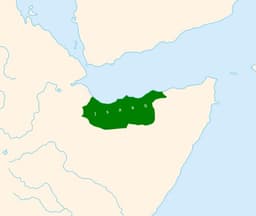
Guled Abdi
Emperor · Modern
44.7Total

Napoleon Bonaparte
General · Modern
70.9Total
Basic Information
Born
1750
1769
Died
1808
1821
Era
Modern
Modern
Nationality
Somalia
France
Occupation
Emperor
General
Civilization
Other
Western
Score Comparison
Military (10%)
50.0
94.0
Political (20%)
35.1
72.0
Influence (20%)
48.6
40.0
Legacy (20%)
39.2
80.0
Leadership (15%)
58.8
78.0
Strategy (15%)
36.8
90.0
TOTAL
44.7
70.9
Guled Abdi — Complete Timeline
1750 AD
Foundation of the Isaaq SultanatePolitical Action◆ Major
Guled Abdi established the Isaaq Sultanate, becoming its first sultan. This event created a centralized political entity for the Isaaq clan in the Horn of Africa, consolidating their territory and influence in the region.
FoundingSultanateIsaaq
Impact: regionalconstructive
1760 AD
Consolidation of Isaaq TerritoryWar
Guled Abdi led military campaigns to expand and secure the Isaaq Sultanate's borders, subjugating rival clans and establishing control over key trade routes in the region. This solidified the sultanate's power base.
ExpansionMilitary CampaignIsaaq
Impact: regional
Napoleon Bonaparte — Complete Timeline
1799 AD
Coup of 18 BrumaireOther◆ Major
Napoleon Bonaparte, with support from his brother Lucien and key political figures, overthrew the Directory in a bloodless coup. He established the Consulate with himself as First Consul, effectively becoming the ruler of France. This event ended the French Revolution's most unstable period.
French RevolutionCoupRise to Power
Impact: regional
1804 AD
Promulgation of the Napoleonic CodeOther◆ Major
Napoleon enacted the Civil Code of the French, known as the Napoleonic Code, a comprehensive set of laws that replaced the fragmented feudal legal systems. The code established legal equality, protected property rights, and secularized law. It became the basis for legal systems in many European and world countries.
Legal ReformNapoleonic CodeCivil Law
Impact: globalconstructive
1805 AD
Battle of AusterlitzWar◆ Major
Napoleon's Grande Arm
Napoleonic WarsBattleDecisive Victory
Impact: global
1812 AD
Invasion of RussiaWar◆ Major
Napoleon led the Grande Arm
Napoleonic WarsInvasionDisaster
Impact: globaldestructive
1815 AD
Battle of WaterlooWar◆ Major
Napoleon's French army was defeated by the combined forces of the Duke of Wellington's Anglo-Allied army and Gebhard Leberecht von Bl
Napoleonic WarsBattleFinal Defeat
Impact: globaldestructive
Expert Analysis
guled-abdi-vs-napoleon-bonaparte
# The Emperor and the Sultan: Two Paths to Power in a Revolutionary Age
In the winter of 1807, as Napoleon Bonaparte’s Grand Army swept across the frozen plains of Poland, a very different kind of ruler was nearing the end of his reign in the Horn of Africa. One man commanded the most formidable military machine the world had ever seen, his name whispered in awe from Madrid to Moscow. The other governed through consensus among camel-herding clans, his authority resting not on cannon but on lineage and negotiation. They never met, never corresponded, likely never knew of each other’s existence. Yet Napoleon Bonaparte and Guled Abdi, separated by vast oceans and civilizations, both rose to power in the same turbulent half-century. Their stories, when placed side by side, reveal the starkly different ways that leadership, ambition, and circumstance can shape history—and how the very definition of greatness depends on the world one inhabits.
Origins
Napoleon was born in 1769 on the Mediterranean island of Corsica, a place only recently annexed by France. His family belonged to the minor nobility, struggling and resentful of French rule. From his earliest years, he absorbed two contradictory impulses: a fierce pride in his Corsican identity and a burning desire to prove himself within the French system. He entered military school at nine, a small, intense boy mocked by wealthier classmates, but he devoured history and strategy with a hunger that would never leave him.
Guled Abdi, born in 1750, came from a world shaped by different forces. The Isaaq clan of present-day Somaliland had long existed as a decentralized network of pastoralist communities, bound by oral tradition and the rhythms of the dry season. There were no military academies, no formal bureaucracies. Leadership meant earning the trust of elders, managing disputes over water and grazing land, and demonstrating the wisdom to guide a people who valued independence above all. Where Napoleon learned to command through discipline and hierarchy, Guled learned to lead through patience and persuasion.
The era itself set the stage for their divergence. Napoleon’s Europe was exploding with revolutionary fervor, creating opportunities for ambitious men to rise from obscurity. Guled’s Somalia remained largely untouched by such upheavals, its political life governed by clan lineages and the slow accumulation of authority over generations.
Rise to Power
Napoleon’s ascent was meteoric, driven by the chaos of the French Revolution. At twenty-four, he crushed a royalist uprising in Paris with a “whiff of grapeshot,” earning the gratitude of the revolutionary government. By twenty-seven, he was leading armies across Italy, winning battles that seemed impossible against larger Austrian forces. His genius lay not just in tactics but in propaganda—he understood that a general who wrote his own dispatches could shape his own legend. In 1799, he seized power in a coup, becoming First Consul, and by 1804, he crowned himself Emperor in Notre Dame Cathedral. Each step was a gamble, each victory a stepping stone.
Guled Abdi’s path was slower, quieter, but no less significant. In 1750, he founded the Isaaq Sultanate, a political action that required not conquest but consensus. He did not storm a capital or defeat a rival army in a single decisive battle. Instead, he traveled among the clans, speaking at gatherings under acacia trees, weaving together alliances that had never before existed. His military campaigns in 1760 to consolidate Isaaq territory were not Napoleonic blitzkriegs but cautious expansions—subjugating rival clans through a mix of force and diplomacy. Where Napoleon built an empire in a decade, Guled spent a lifetime building a dynasty.
Leadership & Governance
As emperor, Napoleon reigned as a lawgiver and a conqueror. His Napoleonic Code standardized French law, enshrining principles of equality before the law and meritocracy—though it also restricted women’s rights and restored slavery in the colonies. He reformed education, built roads, and centralized the state with an efficiency that amazed Europe. Yet his governance was inseparable from his wars. He ruled from his saddle, constantly on campaign, demanding absolute loyalty and punishing dissent with ruthless efficiency. His military score of 94.0 reflects his tactical brilliance—the ability to read a battlefield and exploit an enemy’s weakness with devastating speed. But his political score of 75.0 hints at a fatal flaw: he never learned to stop fighting.
Guled Abdi governed differently. With a military score of only 25.8, he was no battlefield genius. His strength lay in political leadership—scored at 77.2—and in the wisdom to rule through influence rather than force. As sultan, he presided over a system of clan elders, settling disputes through customary law and maintaining peace through marriage alliances and trade agreements. He did not command armies of hundreds of thousands; he led a people who could scatter into the desert if he pushed them too hard. His strategy score of 40.0 suggests he understood that in the Horn of Africa, patience often outlasted aggression.
Triumph & Tragedy
Napoleon’s greatest triumph came in 1805 at Austerlitz, where he crushed the combined armies of Russia and Austria in a battle so perfect that it became a textbook example of military genius. His greatest tragedy followed a decade later: the invasion of Russia in 1812, where his Grand Army of over 600,000 men was destroyed by winter, disease, and scorched-earth tactics. He was exiled to Elba, returned for a final hundred days, and met his end at Waterloo in 1815. The man who had conquered Europe died alone on a remote Atlantic island, abandoned by his marshals and his wife.
Guled Abdi’s triumphs were quieter. He established a dynasty that would rule the Isaaq for over a century, creating a political order that outlasted him. His tragedy was not a single crushing defeat but the slow erosion of his authority as external pressures—European colonialism, shifting trade routes—began to reshape his world. He died in 1808, before the full storm arrived, his legacy intact but fragile.
Character & Destiny
Napoleon’s character was a forge of contradictions: brilliant and arrogant, visionary and paranoid, capable of inspiring devotion and hatred in equal measure. He once said, “Power is my mistress,” and he pursued her with a relentlessness that ultimately consumed him. His destiny was shaped by his inability to stop—every victory demanded another, every conquest sowed the seeds of resistance. His legacy score of 78.0 reflects a man who changed the world but could not save himself.
Guled Abdi’s character was built on steadiness. He was a founder, not a conqueror; a unifier, not a destroyer. His destiny was to create something that would endure through his sons and grandsons, not through his own glory. He understood that in a world of shifting sands and scarce resources, the greatest victory was survival.
Legacy
Today, Napoleon is remembered as one of history’s most influential figures—his legal code still shapes European law, his campaigns studied at military academies worldwide, his name synonymous with ambition and hubris. His total score of 82.4 places him among the giants of history.
Guled Abdi is far less known outside Somaliland, but within his homeland, he is revered as the father of the Isaaq nation. His dynasty survived until the late 19th century, when European powers finally carved up the Horn. His legacy score of 51.2 reflects a different kind of greatness—not global impact, but local endurance.
Conclusion
Standing at the end of their stories, one cannot help but wonder: what is the measure of a leader? Napoleon reshaped the map of Europe and left a mark on law, warfare, and governance that still echoes. Guled Abdi built a political order that gave his people stability for generations. Both succeeded; both failed. Perhaps the most honest answer is that history judges us not by our ambitions but by the worlds we were given. Napoleon inherited a continent in revolution and tried to remake it in his image. Guled inherited a land of clans and drought and tried to make it whole. Each did exactly what his time demanded—and each was ultimately consumed by forces larger than himself.
Rankings
🥇
Napoleon BonaparteLeader
Mil: 94.0Pol: 72.0Inf: 40.0
70.9
🥈
Guled Abdi
Mil: 50.0Pol: 35.1Inf: 48.6
44.7
+26.2 behind
How This Comparison Works
Algorithm
Each figure is scored on 6 dimensions (0—100 scale) based on structured historical data: Military (10%), Political (20%), Influence (20%), Legacy (20%), Leadership (15%), Strategy (15%). The weighted total produces the final ranking.
Data Sources
Scores are computed from structured sub-indicators in the database. Scale factors adjust for era (Ancient ×0.85, Modern ×1.0) and civilization size (Eastern ×1.05, Other ×0.80) to account for differences in population and military scale.
Maximum 3 Figures
Comparisons are limited to 2—3 figures to ensure readability and statistical meaningfulness.
Error Margins
±5 points per dimension — Sub-scores are derived from historical records with inherent uncertainty. Two figures within 5 points on a dimension should be considered roughly equivalent in that area.
Total Score Accuracy
±3 points overall — The weighted combination of 6 dimensions produces a total score with approximately ±3 points of uncertainty. Differences of less than 3 points are not statistically significant— the figures are effectively tied.
Known Limitations
- Historical records are incomplete and uneven across civilizations
- Figures from oral-tradition societies may be underrepresented
- Occupation labels can misclassify multi-role figures
- Scores measure capability and impact, not moral character
- Quantitative scoring is a comparison tool, not absolute truth
Capability Radar
Military (10%) — Battles & Warfare
Battles
15
95
Win Rate
20
90
Expansion
25
95
Political (20%) — Governance & Reform
Reform
25
95
Diplomacy
30
80
Economy
20
85
Influence (20%) — Cultural & Global Reach
Cultural
20
85
Global
10
90
Legacy (20%) — Historical Impact
Historical
25
95
Longevity
20
90
Leadership (15%) — Power & Stability
Tenure
30
85
Stability
25
70
Strategy (15%) — Tactics & Innovation
Strategy
20
95
Tactics
15
98
Reform
10
92
Similar Comparisons
Comments & Discussion
1. **Cannonball Crusher**6/17/2026
Comparing Guled Abdi to Napoleon is like comparing a sandcastle to a siege tower. Abdi ruled a few thousand camel herders while Bonaparte commanded millions and reshaped Europe's legal systems. Even at his peak, Guled couldn't muster a hundred muskets. Napoleon fielded 600,000 men for the Russian invasion. Greatness requires scale, and Abdi's scale was a single Somali valley, not a continent.
2. **数据真相官**6/17/2026
别拿骆驼和狮子的影子比大小。古莱德·阿布迪统治的人口撑死三万,连拿破仑莫斯科一役损失的士兵数都比不上。没有常备军,没有税收系统,没有文字记录的法令。把拿破仑的法典甩到索马里游牧帐篷里,第二天就能被羊啃了当柴烧。所谓"两个帝王"纯属历史文艺片,数据不会撒谎。
3. **Classics and Cannons**6/17/2026
As a student of Plutarch, I see this parallel as laughably false. Napoleon's ambition was total—he sought to remake civilization itself, from the civil code to the geography of Europe. Guled Abdi's "kingdom" was a loose alliance of clans that could dissolve with the next drought. True greatness, as Alexander taught us, requires a vision that transcends one's immediate horizon. Abdi lacked even a map.
4. **游牧解剖刀**6/17/2026
你们都被"帝国"这个词骗了。古莱德的成功恰恰证明他不屑于拿破仑式的战争机器——他的权威靠的是调解上百个氏族纠纷,每晚记住所有来往骆驼商队的名字,这不是懦弱,这是另一种生存智慧。拿破仑用大炮说话,古莱德用骨头说话。非要比较谁更"伟大",等于问沙丁鱼和海豚谁更擅长飞翔。
5. **Revisionist Wreckage**6/17/2026
The real joke? Napoleon's "genius" was 80% luck—he inherited the levée en masse, the revolutionary army structure, and a bankrupt France desperate for a strongman. Guled Abdi built his coalition from scratch without a military academy, a state treasury, or a printing press. Which one truly earned his throne? The man who used what he had versus the man handed Europe's largest army on a silver platter.