Loading...
This comparison has not been analyzed yet.
One-time AI generation (~1 minute). Scores and timeline are already available below.
Guled Abdi vs Narendra Singh of Patiala
Narendra Singh of Patiala leads by 6.0 pts · 2 figures compared
…
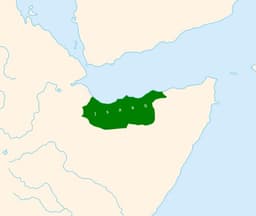
Guled Abdi
Emperor · Modern
44.7Total

Narendra Singh of Patiala
Emperor · Modern
50.7Total
Basic Information
Born
1750
1823
Died
1808
1862
Era
Modern
Modern
Nationality
Somalia
India
Occupation
Emperor
Emperor
Civilization
Other
Indian
Score Comparison
Military (10%)
50.0
21.2
Political (20%)
35.1
68.0
Influence (20%)
48.6
50.2
Legacy (20%)
39.2
38.3
Leadership (15%)
58.8
72.0
Strategy (15%)
36.8
54.8
TOTAL
44.7
50.7
Guled Abdi — Complete Timeline
1750 AD
Foundation of the Isaaq SultanatePolitical Action◆ Major
Guled Abdi established the Isaaq Sultanate, becoming its first sultan. This event created a centralized political entity for the Isaaq clan in the Horn of Africa, consolidating their territory and influence in the region.
FoundingSultanateIsaaq
Impact: regionalconstructive
1760 AD
Consolidation of Isaaq TerritoryWar
Guled Abdi led military campaigns to expand and secure the Isaaq Sultanate's borders, subjugating rival clans and establishing control over key trade routes in the region. This solidified the sultanate's power base.
ExpansionMilitary CampaignIsaaq
Impact: regional
Narendra Singh of Patiala — Complete Timeline
1850 AD
Construction of the Moti Bagh PalaceCultural◆ Major
Narendra Singh commissioned the construction of the Moti Bagh Palace in Patiala, a large palace complex that blended Sikh and Mughal architectural styles. The palace became the main royal residence and a symbol of Patiala's wealth and power.
ArchitectureRoyal ResidencePatronage
Impact: regionalconstructive
1855 AD
Administrative and judicial reforms in PatialaReform
Narendra Singh implemented administrative and judicial reforms in Patiala, including the establishment of a modern court system and the codification of laws. These reforms aimed to improve governance and reduce corruption in the state.
AdministrationJudicial ReformGovernance
Impact: regionalconstructive
1857 AD
Support for the British during the Indian Rebellion of 1857War◆ Major
Narendra Singh provided military and financial support to the British East India Company during the Indian Rebellion of 1857. He sent troops and resources to help suppress the uprising in the Patiala region, strengthening his alliance with the British.
Indian RebellionBritish AllianceMilitary Support
Impact: regional
This comparison has not been analyzed yet.
One-time AI generation (~1 minute). Scores and timeline are already available below.
Rankings
🥇
Narendra Singh of PatialaLeader
Mil: 21.2Pol: 68.0Inf: 50.2
50.7
🥈
Guled Abdi
Mil: 50.0Pol: 35.1Inf: 48.6
44.7
+6.0 behind
How This Comparison Works
Algorithm
Each figure is scored on 6 dimensions (0—100 scale) based on structured historical data: Military (10%), Political (20%), Influence (20%), Legacy (20%), Leadership (15%), Strategy (15%). The weighted total produces the final ranking.
Data Sources
Scores are computed from structured sub-indicators in the database. Scale factors adjust for era (Ancient ×0.85, Modern ×1.0) and civilization size (Eastern ×1.05, Other ×0.80) to account for differences in population and military scale.
Maximum 3 Figures
Comparisons are limited to 2—3 figures to ensure readability and statistical meaningfulness.
Error Margins
±5 points per dimension — Sub-scores are derived from historical records with inherent uncertainty. Two figures within 5 points on a dimension should be considered roughly equivalent in that area.
Total Score Accuracy
±3 points overall — The weighted combination of 6 dimensions produces a total score with approximately ±3 points of uncertainty. Differences of less than 3 points are not statistically significant— the figures are effectively tied.
Known Limitations
- Historical records are incomplete and uneven across civilizations
- Figures from oral-tradition societies may be underrepresented
- Occupation labels can misclassify multi-role figures
- Scores measure capability and impact, not moral character
- Quantitative scoring is a comparison tool, not absolute truth
Capability Radar
Military (10%) — Battles & Warfare
Battles
15
15
Win Rate
20
10
Expansion
25
5
Political (20%) — Governance & Reform
Reform
25
30
Diplomacy
30
50
Economy
20
40
Influence (20%) — Cultural & Global Reach
Cultural
20
20
Global
10
10
Legacy (20%) — Historical Impact
Historical
25
20
Longevity
20
10
Leadership (15%) — Power & Stability
Tenure
30
60
Stability
25
50
Strategy (15%) — Tactics & Innovation
Strategy
20
10
Tactics
15
10
Reform
10
5
Similar Comparisons
Comments & Discussion
No comments yet. Be the first to share your thoughts!