Loading...
Guadalupe Victoria vs Jorge Pacheco Areco
Guadalupe Victoria leads by 10.1 pts · 2 figures compared
…
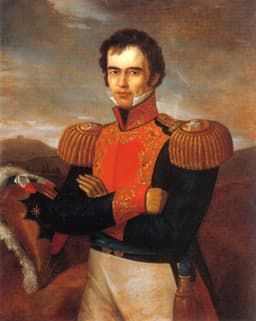
Guadalupe Victoria
Politician · Modern
53.3Total

Jorge Pacheco Areco
Politician · Modern
43.2Total
Basic Information
Born
1786
1920
Died
1843
—
Era
Modern
Modern
Nationality
Mexico
Uruguay
Occupation
Politician
Politician
Civilization
Western
Western
Score Comparison
Military (10%)
25.9
49.4
Political (20%)
68.0
32.2
Influence (20%)
56.4
47.1
Legacy (20%)
49.2
38.3
Leadership (15%)
74.0
51.9
Strategy (15%)
30.3
43.0
TOTAL
53.3
43.2
Guadalupe Victoria — Complete Timeline
1812 AD
Victoria's role in the Mexican War of IndependenceWar◆ Major
Guadalupe Victoria joined the insurgent forces under Jos
War of IndependenceGuerrilla WarfareInsurgency
Impact: national
1824 AD
Guadalupe Victoria becomes first President of MexicoPolitical Action◆ Major
Guadalupe Victoria was elected as the first president of the newly established Federal Republic of Mexico. His presidency (1824-1829) marked the consolidation of Mexican independence and the establishment of republican institutions.
Mexican IndependenceFirst PresidentRepublic
Impact: nationalconstructive
1827 AD
Victoria's presidency and the expulsion of the SpanishPolitical Action◆ Major
During Victoria's presidency, the Mexican government ordered the expulsion of all Spanish residents from Mexico. This action aimed to remove remaining colonial influence but caused economic disruption and social tension.
ExpulsionAnti-SpanishNationalism
Impact: nationaldestructive
1829 AD
Victoria's peaceful transfer of powerPolitical Action◆ Major
Guadalupe Victoria completed his four-year term and peacefully handed over the presidency to Vicente Guerrero. This was the first peaceful transfer of executive power in Mexican history, setting a precedent for republican governance.
Peaceful TransitionDemocracyPresidency
Impact: nationalconstructive
Jorge Pacheco Areco — Complete Timeline
1967 AD
Elected President of UruguayPolitical Action◆ Major
Jorge Pacheco Areco was elected president of Uruguay in the 1966 general election, taking office in 1967. He succeeded the National Council of Government and was a member of the Colorado Party.
ElectionColorado PartyPresidential System
Impact: national
1968 AD
Froze Prices and WagesReform
Pacheco Areco implemented a price and wage freeze to combat inflation. The policy temporarily stabilized prices but led to labor unrest and strikes, which were met with government repression.
Economic PolicyInflationLabor Conflict
Impact: nationaldestructive
Declared State of EmergencyPolitical Action◆ Major
Pacheco Areco declared a state of emergency in June 1968, suspending civil liberties and imposing censorship on the press. The measure was aimed at curbing strikes and leftist activism, but it also suppressed political opposition.
State of EmergencyAuthoritarianismCensorship
Impact: nationaldestructive
Banned the TupamarosPolitical Action◆ Major
Pacheco Areco banned the Tupamaros (National Liberation Movement) as an illegal organization. The group had engaged in bank robberies and kidnappings, and the ban escalated the conflict between the government and leftist guerrillas.
CounterinsurgencyTupamarosPolitical Violence
Impact: nationaldestructive
Expert Analysis
Origins
Guadalupe Victoria, born José Miguel Ramón Adaucto Fernández y Félix in 1786 in Tamazula, New Spain (now Mexico), was of humble origins. He studied law at the Colegio de San Ildefonso but left to join the independence movement in 1812. Victoria adopted his nom de guerre early, symbolizing his commitment to victory. His formative experiences were shaped by the brutal guerrilla warfare against Spanish royalists.
Jorge Pacheco Areco, born in 1920 in Montevideo, Uruguay, came from a political family—his father was a prominent Blanco Party figure. He attended the University of the Republic, studying law, but never practiced. Instead, he entered journalism and politics, serving as a diplomat and later as vice president before assuming the presidency in 1967 upon the death of his predecessor.
Rise to Power
Victoria rose by joining the insurgent forces under José María Morelos in 1812. He became a key guerrilla leader in the region of Veracruz, known for his tenacity. After the war, he served in the provisional government and was elected first president of the Federal Republic of Mexico in 1824, taking office in 1825. His rise was a product of his military service and political maneuvering among factions.
Pacheco Areco's rise was more conventional. He served as a deputy, senator, and diplomat. In 1966, he was elected vice president on a ticket with General Óscar Gestido. When Gestido died in 1967, Pacheco became president. His rise was sudden and unexpected, thrusting him into power during a time of economic crisis and social unrest.
Leadership & Governance
Victoria's leadership focused on consolidating the new republic. He established diplomatic relations with Britain and the United States, and oversaw the adoption of the 1824 Constitution. He governed with a moderate liberal approach, balancing federalist and centralist factions. His major act was the expulsion of Spanish residents in 1827, a populist move to weaken remaining royalist influence. Victoria's political score is 68.0, reflecting his ability to navigate early republican politics.
Pacheco Areco's governance was authoritarian. In June 1968, he declared a state of emergency, suspending civil liberties and imposing press censorship. He banned the Tupamaros guerrilla group and froze wages and prices to combat inflation. His leadership score of 51.9 is lower than Victoria's 74.0, indicating a more repressive style. His policies temporarily stabilized the economy but sparked labor unrest and strikes.
Triumph & Tragedy
Victoria's triumph was completing his four-year term and peacefully handing power to Vicente Guerrero in 1829—the first peaceful transfer of power in Mexican history. This set a precedent for democratic transition. His tragedy was the expulsion of the Spanish, which damaged the economy and alienated many skilled residents. Additionally, his presidency saw ongoing factional strife that would later lead to instability.
Pacheco Areco's triumph was his short-term economic stabilization: inflation dropped from 136% in 1968 to 20% by 1970. His tragedy was the erosion of democracy. His state of emergency lasted for years, and his crackdown on the Tupamaros escalated into a full-blown conflict that eventually led to the 1973 coup and dictatorship. His legacy score is 38.3, reflecting the authoritarian turn.
Character & Destiny
Victoria was pragmatic and resilient. He adopted a symbolic name to inspire followers and showed flexibility in alliances. His character favored institutional stability, as seen in his peaceful transition. However, he lacked the strategic vision to prevent future conflicts. His strategy score is 30.3, indicating limited long-term planning.
Pacheco Areco was hardline and uncompromising. He believed in strong executive power to maintain order. His decision to rule by decree reflected a distrust of democratic processes. This character trait led to his downfall: his repression fueled the very violence he sought to suppress. His strategy score of 43.0 is higher than Victoria's, but his political score of 32.2 is much lower, showing poor political acumen.
Legacy
Victoria is remembered as the first president of Mexico, a founding father. His peaceful transfer of power is a cornerstone of Mexican democratic tradition. However, his expulsion of the Spanish is criticized. His overall legacy score of 49.2 reflects mixed views: he is honored but not as celebrated as Morelos or Hidalgo.
Pacheco Areco's legacy is negative. He is seen as the president who paved the way for the 1973 coup. His state of emergency and censorship are remembered as the beginning of Uruguay's dark period. His influence score of 47.1 is similar to Victoria's 56.4, but his legacy is tarnished. Uruguay's return to democracy in 1985 was a repudiation of his methods.
Conclusion
Guadalupe Victoria had a greater impact on history than Jorge Pacheco Areco. Victoria's role in founding the Mexican republic and establishing democratic norms is foundational. Despite his flaws, he contributed to nation-building. Pacheco Areco, by contrast, undermined democracy in Uruguay. His policies led directly to authoritarianism. The score gap of 10.1 points reflects this: Victoria's total score of 53.3 versus Pacheco's 43.2. Victoria's political and leadership scores are significantly higher (68.0 vs 32.2 and 74.0 vs 51.9). While neither was a strategic genius, Victoria's positive contributions to democratic institutions outweigh Pacheco's negative legacy. The first president of Mexico shaped a nation's trajectory; the hardline Uruguayan president set his country back decades.
Rankings
🥇
Guadalupe VictoriaLeader
Mil: 25.9Pol: 68.0Inf: 56.4
53.3
🥈
Jorge Pacheco Areco
Mil: 49.4Pol: 32.2Inf: 47.1
43.2
+10.1 behind
How This Comparison Works
Algorithm
Each figure is scored on 6 dimensions (0—100 scale) based on structured historical data: Military (10%), Political (20%), Influence (20%), Legacy (20%), Leadership (15%), Strategy (15%). The weighted total produces the final ranking.
Data Sources
Scores are computed from structured sub-indicators in the database. Scale factors adjust for era (Ancient ×0.85, Modern ×1.0) and civilization size (Eastern ×1.05, Other ×0.80) to account for differences in population and military scale.
Maximum 3 Figures
Comparisons are limited to 2—3 figures to ensure readability and statistical meaningfulness.
Error Margins
±5 points per dimension — Sub-scores are derived from historical records with inherent uncertainty. Two figures within 5 points on a dimension should be considered roughly equivalent in that area.
Total Score Accuracy
±3 points overall — The weighted combination of 6 dimensions produces a total score with approximately ±3 points of uncertainty. Differences of less than 3 points are not statistically significant— the figures are effectively tied.
Known Limitations
- Historical records are incomplete and uneven across civilizations
- Figures from oral-tradition societies may be underrepresented
- Occupation labels can misclassify multi-role figures
- Scores measure capability and impact, not moral character
- Quantitative scoring is a comparison tool, not absolute truth
Capability Radar
Military (10%) — Battles & Warfare
Battles
35
26
Win Rate
40
33
Expansion
15
37
Political (20%) — Governance & Reform
Reform
50
20
Diplomacy
45
25
Economy
40
20
Influence (20%) — Cultural & Global Reach
Cultural
40
10
Global
30
10
Legacy (20%) — Historical Impact
Historical
50
20
Longevity
45
10
Leadership (15%) — Power & Stability
Tenure
55
30
Stability
35
15
Strategy (15%) — Tactics & Innovation
Strategy
35
40
Tactics
30
42
Reform
20
42
Similar Comparisons
Comments & Discussion
No comments yet. Be the first to share your thoughts!