Loading...
Goodluck Jonathan vs Napoleon Bonaparte
Napoleon Bonaparte leads by 16.8 pts · 2 figures compared
…
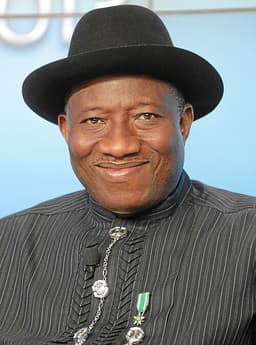
Goodluck Jonathan
Politician · Modern
54.1Total

Napoleon Bonaparte
General · Modern
70.9Total
Basic Information
Born
1957
1769
Died
—
1821
Era
Modern
Modern
Nationality
Nigeria
France
Occupation
Politician
General
Civilization
Other
Western
Score Comparison
Military (10%)
26.9
94.0
Political (20%)
68.0
72.0
Influence (20%)
56.4
40.0
Legacy (20%)
49.2
80.0
Leadership (15%)
72.0
78.0
Strategy (15%)
40.5
90.0
TOTAL
54.1
70.9
Goodluck Jonathan — Complete Timeline
2010 AD
Election as President of NigeriaPolitical Action◆ Major
Goodluck Jonathan became president following the death of President Umaru Yar'Adua. He was later elected in his own right in the 2011 presidential election, winning a majority of votes.
ElectionSuccessionPresidency
Impact: national
2012 AD
Subsidy removal protestsPolitical Action◆ Major
Jonathan's government attempted to remove fuel subsidies, leading to nationwide protests known as the 'Occupy Nigeria' movement. The protests forced the government to partially reverse the policy, highlighting public discontent.
ProtestsSubsidyEconomic Policy
Impact: nationaldestructive
2015 AD
2015 presidential election defeatPolitical Action
Jonathan lost the 2015 presidential election to Muhammadu Buhari. In a historic move, he conceded defeat before the official results were announced, preventing post-election violence and setting a precedent for peaceful democratic transitions in Nigeria.
ElectionConcessionDemocracy
Impact: nationalconstructive
Napoleon Bonaparte — Complete Timeline
1799 AD
Coup of 18 BrumaireOther◆ Major
Napoleon Bonaparte, with support from his brother Lucien and key political figures, overthrew the Directory in a bloodless coup. He established the Consulate with himself as First Consul, effectively becoming the ruler of France. This event ended the French Revolution's most unstable period.
French RevolutionCoupRise to Power
Impact: regional
1804 AD
Promulgation of the Napoleonic CodeOther◆ Major
Napoleon enacted the Civil Code of the French, known as the Napoleonic Code, a comprehensive set of laws that replaced the fragmented feudal legal systems. The code established legal equality, protected property rights, and secularized law. It became the basis for legal systems in many European and world countries.
Legal ReformNapoleonic CodeCivil Law
Impact: globalconstructive
1805 AD
Battle of AusterlitzWar◆ Major
Napoleon's Grande Arm
Napoleonic WarsBattleDecisive Victory
Impact: global
1812 AD
Invasion of RussiaWar◆ Major
Napoleon led the Grande Arm
Napoleonic WarsInvasionDisaster
Impact: globaldestructive
1815 AD
Battle of WaterlooWar◆ Major
Napoleon's French army was defeated by the combined forces of the Duke of Wellington's Anglo-Allied army and Gebhard Leberecht von Bl
Napoleonic WarsBattleFinal Defeat
Impact: globaldestructive
Expert Analysis
goodluck-jonathan-vs-napoleon-bonaparte
# The Conqueror and the Conceder
On a June evening in 1815, Napoleon Bonaparte watched his empire crumble in the muddy fields of Waterloo. He had once marched from Cairo to Moscow, redrawing the map of Europe with the stroke of a pen and the roar of cannon. Nearly two centuries later, in March 2015, Goodluck Jonathan sat in Nigeria’s presidential villa, facing a different kind of defeat. His opponent, Muhammadu Buhari, had won the election. Jonathan picked up the phone and called him. "I promised them free and fair elections," he said later. "I had to keep my word." One man fought until his last soldier fell; the other surrendered power before the final vote was counted. What drove these two leaders to such opposite ends of the same story?
Origins
Napoleon was born in 1769 on the island of Corsica, a rocky Mediterranean outpost that France had only recently annexed. His family was minor nobility, poor and resentful of French rule. As a boy, he spoke Italian-accented French and was mocked by classmates at military school. The French Revolution, which erupted when he was twenty, shattered the old order and opened paths that had been closed to a Corsican outsider. He seized them.
Goodluck Jonathan was born in 1957 in Otuoke, a small fishing village in the Niger Delta. His father was a canoe carver; his mother sold cassava. He grew up without running water or electricity, walking miles to school barefoot. The Biafran War, which ravaged his region when he was a child, taught him the cost of division. Where Napoleon was forged by revolution and ambition, Jonathan was shaped by poverty and survival. The world they inherited could not have been more different—and neither could the tools they used to navigate it.
Rise to Power
Napoleon rose through the ranks of a revolutionary army desperate for talent. At twenty-four, he crushed a royalist uprising in Paris with a "whiff of grapeshot." At twenty-six, he conquered Italy. By thirty, he had made himself First Consul of France. His path was a ladder of victories, each one higher than the last. He understood that in the chaos of revolution, the boldest man wins.
Jonathan’s rise was quieter but no less remarkable. He entered politics in the 1990s, a time when Nigeria was ruled by military dictators. He became deputy governor of Bayelsa State, then governor, then vice president. In 2010, President Umaru Yar’Adua died after a long illness, and Jonathan succeeded him. He was not elected; he inherited the office. The following year, he won his own mandate. Unlike Napoleon, who stormed the gates of power, Jonathan slipped through them.
Leadership & Governance
Napoleon governed with the same energy he brought to war. He centralized the state, streamlined the bureaucracy, and imposed the Napoleonic Code—a legal system that enshrined equality before the law, property rights, and secular governance. It remains the basis of law in much of Europe and beyond. He built roads, schools, and banks. He also silenced dissent, censored the press, and crowned himself emperor. His genius was organizational: he turned a revolution into a machine.
Jonathan governed a fragile democracy. His greatest test came in 2012, when his government tried to remove fuel subsidies. Prices doubled overnight. The "Occupy Nigeria" protests erupted across the country, paralyzing the economy. Jonathan backed down. It was not a Napoleonic moment—he did not crush the protests with force—but it reflected a deeper reality: in a diverse, fractious democracy, survival often means compromise, not conquest.
Triumph & Tragedy
Napoleon’s triumph was Austerlitz in 1805, where he shattered the armies of Austria and Russia. His tragedy was the invasion of Russia in 1812. He marched six hundred thousand men into the snow; fewer than a hundred thousand came back. He never recovered.
Jonathan’s triumph was his concession. In 2015, when the election results showed he had lost, he did not dispute them. He did not call on the army. He did not declare a state of emergency. He called Buhari and congratulated him. For a continent where many leaders cling to power until they are dragged out, this was extraordinary. His tragedy was the Boko Haram insurgency, which grew during his presidency. In 2014, the group kidnapped 276 schoolgirls from Chibok. Jonathan’s response was slow and ineffective. The world watched, and judged.
Character & Destiny
Napoleon believed he was destiny’s instrument. "I am not a man," he once said. "I am a thing." He saw himself as history’s agent, entitled to reshape the world. This conviction gave him courage but also blindness. He could not imagine defeat, so he could not prepare for it.
Jonathan was the opposite. He never seemed to believe he was destined for greatness. He was a professor of zoology who stumbled into politics. When he lost, he accepted it. "Nobody’s ambition is worth the blood of any Nigerian," he said. His character was not heroic in the Napoleonic sense. It was something rarer: humble.
Legacy
Napoleon’s legacy is written in stone and law. The Napoleonic Code, the metric system, the modern French state—these endure. But so does the memory of millions dead in his wars. He is remembered as both a genius and a tyrant.
Jonathan’s legacy is less tangible. He did not build an empire or reform a legal system. But he did something that few leaders in his position have done: he left. In 2019, when Kenya’s Raila Odinga lost an election, he went to court. When Ivory Coast’s Laurent Gbagbo lost, he started a civil war. Jonathan set a precedent. His concession did not end Nigeria’s problems—corruption, inequality, and insecurity remain—but it proved that democracy could work in a country where it had often failed.
Conclusion
Napoleon and Jonathan are not rivals. They are opposites, separated by time, place, and the nature of power itself. Napoleon ruled when the world belonged to conquerors; Jonathan governed when it belonged to voters. One expanded his empire until it collapsed; the other shrank his power until it vanished. Both faced the same question: What do you do when you lose? Napoleon answered by fighting until he had nothing left to fight with. Jonathan answered by picking up the phone. In the end, history remembers both—but for very different reasons.
Rankings
🥇
Napoleon BonaparteLeader
Mil: 94.0Pol: 72.0Inf: 40.0
70.9
🥈
Goodluck Jonathan
Mil: 26.9Pol: 68.0Inf: 56.4
54.1
+16.8 behind
How This Comparison Works
Algorithm
Each figure is scored on 6 dimensions (0—100 scale) based on structured historical data: Military (10%), Political (20%), Influence (20%), Legacy (20%), Leadership (15%), Strategy (15%). The weighted total produces the final ranking.
Data Sources
Scores are computed from structured sub-indicators in the database. Scale factors adjust for era (Ancient ×0.85, Modern ×1.0) and civilization size (Eastern ×1.05, Other ×0.80) to account for differences in population and military scale.
Maximum 3 Figures
Comparisons are limited to 2—3 figures to ensure readability and statistical meaningfulness.
Error Margins
±5 points per dimension — Sub-scores are derived from historical records with inherent uncertainty. Two figures within 5 points on a dimension should be considered roughly equivalent in that area.
Total Score Accuracy
±3 points overall — The weighted combination of 6 dimensions produces a total score with approximately ±3 points of uncertainty. Differences of less than 3 points are not statistically significant— the figures are effectively tied.
Known Limitations
- Historical records are incomplete and uneven across civilizations
- Figures from oral-tradition societies may be underrepresented
- Occupation labels can misclassify multi-role figures
- Scores measure capability and impact, not moral character
- Quantitative scoring is a comparison tool, not absolute truth
Capability Radar
Military (10%) — Battles & Warfare
Battles
19
95
Win Rate
24
90
Expansion
27
95
Political (20%) — Governance & Reform
Reform
40
95
Diplomacy
65
80
Economy
45
85
Influence (20%) — Cultural & Global Reach
Cultural
30
85
Global
50
90
Legacy (20%) — Historical Impact
Historical
55
95
Longevity
40
90
Leadership (15%) — Power & Stability
Tenure
60
85
Stability
50
70
Strategy (15%) — Tactics & Innovation
Strategy
31
95
Tactics
35
98
Reform
36
92
Similar Comparisons
Comments & Discussion
No comments yet. Be the first to share your thoughts!