Loading...
Gojong of Korea vs Napoleon Bonaparte
Napoleon Bonaparte leads by 15.4 pts · 2 figures compared
…
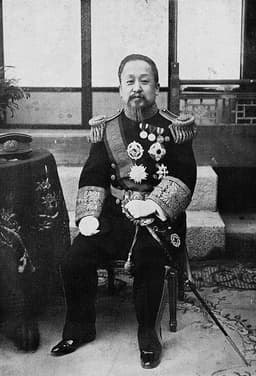
Gojong of Korea
Emperor · Modern
55.5Total

Napoleon Bonaparte
General · Modern
70.9Total
Basic Information
Born
1852
1769
Died
1919
1821
Era
Modern
Modern
Nationality
Korea
France
Occupation
Emperor
General
Civilization
Eastern
Western
Score Comparison
Military (10%)
43.3
94.0
Political (20%)
68.0
72.0
Influence (20%)
60.0
40.0
Legacy (20%)
50.0
80.0
Leadership (15%)
53.2
78.0
Strategy (15%)
54.6
90.0
TOTAL
55.5
70.9
Gojong of Korea — Complete Timeline
1897 AD
Proclamation of the Korean EmpirePolitical Action
Gojong declared Korea an empire, assuming the title of Emperor. This was an attempt to assert Korea's sovereignty and equal status with China and Japan, and to modernize the state. The move was partly a response to the assassination of his wife, Empress Myeongseong.
Korean EmpireSovereigntyModernization
Impact: nationalconstructive
1905 AD
Signing of the Japan-Korea Treaty of 1905Political Action
Under Japanese pressure, Gojong's government signed the Eulsa Treaty, making Korea a Japanese protectorate. Gojong did not sign the treaty himself and later attempted to appeal to international powers, but the treaty stripped Korea of its diplomatic sovereignty.
TreatyJapanese ProtectorateLoss of Sovereignty
Impact: nationaltragic
1907 AD
Forced Abdication by JapanPolitical Action◆ Major
Japanese authorities forced Gojong to abdicate in favor of his son, Sunjong, after Gojong sent a secret envoy to the Hague Peace Conference to protest Japanese control. The abdication was part of Japan's consolidation of power over Korea.
AbdicationJapanese ImperialismHague Secret Envoy Affair
Impact: nationaltragic
1919 AD
Death and Funeral of GojongOther
Gojong died suddenly, with rumors of poisoning by Japanese agents. His funeral on March 1, 1919, became a catalyst for the March First Movement, a massive nationwide protest against Japanese rule. The movement was brutally suppressed but galvanized Korean independence efforts.
DeathMarch First MovementKorean Independence
Impact: nationaltragic
Napoleon Bonaparte — Complete Timeline
1799 AD
Coup of 18 BrumaireOther◆ Major
Napoleon Bonaparte, with support from his brother Lucien and key political figures, overthrew the Directory in a bloodless coup. He established the Consulate with himself as First Consul, effectively becoming the ruler of France. This event ended the French Revolution's most unstable period.
French RevolutionCoupRise to Power
Impact: regional
1804 AD
Promulgation of the Napoleonic CodeOther◆ Major
Napoleon enacted the Civil Code of the French, known as the Napoleonic Code, a comprehensive set of laws that replaced the fragmented feudal legal systems. The code established legal equality, protected property rights, and secularized law. It became the basis for legal systems in many European and world countries.
Legal ReformNapoleonic CodeCivil Law
Impact: globalconstructive
1805 AD
Battle of AusterlitzWar◆ Major
Napoleon's Grande Arm
Napoleonic WarsBattleDecisive Victory
Impact: global
1812 AD
Invasion of RussiaWar◆ Major
Napoleon led the Grande Arm
Napoleonic WarsInvasionDisaster
Impact: globaldestructive
1815 AD
Battle of WaterlooWar◆ Major
Napoleon's French army was defeated by the combined forces of the Duke of Wellington's Anglo-Allied army and Gebhard Leberecht von Bl
Napoleonic WarsBattleFinal Defeat
Impact: globaldestructive
Expert Analysis
gojong-of-korea-vs-napoleon-bonaparte
# The Emperor and the Eagle: Two Paths Through the Storm of Modernity
In the winter of 1907, as the snow fell on Seoul, a Korean emperor sat alone in his palace, stripped of power, awaiting the inevitable Japanese order to abdicate. Half a world away, on a remote island in the South Atlantic, another emperor had died decades earlier, his bones resting in a forgotten grave. Napoleon Bonaparte and Gojong of Korea never met, never corresponded, and ruled worlds apart. Yet both faced the same fundamental challenge of the modern era: how to preserve sovereignty in an age of empires. One conquered Europe; the other lost his kingdom. The difference was not merely in their talents, but in the very nature of the worlds they inhabited.
Origins
Napoleon was born in 1769 on Corsica, an island recently annexed by France, to a minor noble family of Italian descent. He grew up speaking Corsican Italian, learning French as a foreign language. His world was one of revolution and opportunity—the old order of kings and aristocrats was collapsing across Europe, and a young man with ambition and talent could rise faster than ever before. The French Revolution had thrown open doors that had been locked for centuries.
Gojong, by contrast, was born in 1852 into the 500-year-old Joseon dynasty, a kingdom that had deliberately isolated itself from the outside world. He became king at age twelve, ruling through a regency while Confucian scholars debated ritual and protocol. His Korea was a "hermit kingdom," its borders closed, its society rigidly hierarchical, its worldview shaped by Chinese civilization. The storm of Western imperialism was already breaking on Asia's shores, but in Seoul, the court believed the old ways could still hold.
Rise to Power
Napoleon's ascent was meteoric. At twenty-four, he was a captain; at twenty-six, a general. In 1796, he took command of a starving, ragged army in Italy and within months had defeated the Austrian Empire, turning a revolutionary crisis into a national triumph. By 1799, at age thirty, he seized power in a coup. His rise was built on military genius—a strategic mind rated 93 out of 100—and an ability to read the chaos of his time and ride it like a wave.
Gojong's path was slower and more constrained. He assumed full rule in 1873, at age twenty-one, after a decade of regency. His power came not from conquest but from inheritance—and from the careful navigation of court factions. Unlike Napoleon, who could create his own legitimacy through victory, Gojong had to negotiate with entrenched aristocratic families, Confucian scholars, and eventually, foreign powers who saw Korea as a prize to be divided. His political score of 85 reflects a man who understood the game of survival, even as the rules kept changing.
Leadership & Governance
Napoleon governed as he conquered: with energy, clarity, and ruthless efficiency. He centralized the French state, created the Bank of France, and most enduringly, codified the Napoleonic Code—a legal system that swept away feudal privileges and established principles of equality before the law. His leadership score of 80 and political score of 75 reflect a man who could inspire armies but struggled to build lasting institutions. He was a master of war, with a military score of 94, but his political wisdom was often undermined by his own ambition.
Gojong's governance was a desperate balancing act. He attempted modernization—building telegraph lines, sending students abroad, establishing a Western-style military—but always under the shadow of China, Russia, Japan, and the Western powers. In 1897, he proclaimed the Korean Empire, declaring himself Emperor rather than King, a direct challenge to China's traditional suzerainty. It was a brilliant political move, asserting Korea's equal status among nations. But his military score of 59.7 and strategy of 30 tell the story: he lacked the force to back his claims. His modernization was too little, too late, and too dependent on foreign advisors who served their own nations' interests.
Triumph & Tragedy
Napoleon's greatest moment came in 1805 at Austerlitz, where he destroyed the combined armies of Russia and Austria, cementing his control of Europe. His worst came in 1812, when he invaded Russia, lost his Grand Army to winter and guerrilla warfare, and set the stage for his downfall. Waterloo in 1815 was the final act—a battle he could have won, but for a series of misjudgments and a Prussian army arriving at the wrong moment.
Gojong's triumph was the Korean Empire itself—a brief, shining moment from 1897 to 1905 when Korea stood as a sovereign, modernizing nation. His tragedy was the Eulsa Treaty of 1905, signed under Japanese duress, which made Korea a protectorate. He never signed it—the treaty was forced on his ministers—but he could not stop it. In 1907, after sending a secret envoy to the Hague Peace Conference to protest Japanese rule, he was forced to abdicate. His death in 1919, under suspicious circumstances—rumors of Japanese poisoning persist—became the spark for the March 1st Movement, Korea's greatest uprising against colonial rule.
Character & Destiny
Napoleon was a man of boundless ambition, convinced of his own destiny. "I am not a man," he once said, "but a thing." He saw himself as an instrument of history, and in many ways he was. His personality—impulsive, brilliant, arrogant—drove him to conquer Europe but also to overreach. He could not stop, could not consolidate, could not share power. His fall was built into his character.
Gojong was a different kind of ruler: cautious, patient, and ultimately tragic. He understood that Korea could not match the military power of Japan or the Western empires. His strategy was survival through diplomacy, delay, and appeals to international law. But the world of the early twentieth century had no room for such subtlety. Japan's military score of 90-plus, backed by modern industry and a ruthless leadership, overwhelmed Gojong's world of Confucian courtiers and outdated armies. His personality—resilient but not aggressive—was suited to preservation, not conquest. In the end, neither was enough.
Legacy
Napoleon's legacy is stamped across Europe: the Napoleonic Code, the modern state system, the very idea of a meritocratic military. His scores of 82 for influence and 78 for legacy reflect a man who shaped the modern world even in defeat. He is remembered as both tyrant and reformer, a figure of awe and caution.
Gojong's legacy is more complex. His influence score of 75.7 and legacy of 69.5 understate his importance to Korean identity. He is remembered as the last emperor of a sovereign Korea, the man who tried to save his nation through modernization, and whose death ignited the independence movement. In South Korea today, he is revered as a symbol of resistance, a king who fought with the only weapons he had—diplomacy, symbolism, and the quiet dignity of a lost cause.
Conclusion
Napoleon and Gojong stand on opposite sides of a historical divide. Napoleon lived in a world where military genius could still reshape continents; Gojong lived in one where the age of small kingdoms was ending, swallowed by industrial empires. Napoleon's tragedy was his own hubris; Gojong's was his nation's weakness. One fell from a height, the other was crushed by forces he could not control. Their stories remind us that history rewards not just talent, but timing. And that for every Napoleon who burns across the sky, there is a Gojong who watches the fire consume his world.
Rankings
🥇
Napoleon BonaparteLeader
Mil: 94.0Pol: 72.0Inf: 40.0
70.9
🥈
Gojong of Korea
Mil: 43.3Pol: 68.0Inf: 60.0
55.5
+15.4 behind
How This Comparison Works
Algorithm
Each figure is scored on 6 dimensions (0—100 scale) based on structured historical data: Military (10%), Political (20%), Influence (20%), Legacy (20%), Leadership (15%), Strategy (15%). The weighted total produces the final ranking.
Data Sources
Scores are computed from structured sub-indicators in the database. Scale factors adjust for era (Ancient ×0.85, Modern ×1.0) and civilization size (Eastern ×1.05, Other ×0.80) to account for differences in population and military scale.
Maximum 3 Figures
Comparisons are limited to 2—3 figures to ensure readability and statistical meaningfulness.
Error Margins
±5 points per dimension — Sub-scores are derived from historical records with inherent uncertainty. Two figures within 5 points on a dimension should be considered roughly equivalent in that area.
Total Score Accuracy
±3 points overall — The weighted combination of 6 dimensions produces a total score with approximately ±3 points of uncertainty. Differences of less than 3 points are not statistically significant— the figures are effectively tied.
Known Limitations
- Historical records are incomplete and uneven across civilizations
- Figures from oral-tradition societies may be underrepresented
- Occupation labels can misclassify multi-role figures
- Scores measure capability and impact, not moral character
- Quantitative scoring is a comparison tool, not absolute truth
Capability Radar
Military (10%) — Battles & Warfare
Battles
5
95
Win Rate
5
90
Expansion
5
95
Political (20%) — Governance & Reform
Reform
40
95
Diplomacy
30
80
Economy
30
85
Influence (20%) — Cultural & Global Reach
Cultural
50
85
Global
40
90
Legacy (20%) — Historical Impact
Historical
60
95
Longevity
40
90
Leadership (15%) — Power & Stability
Tenure
60
85
Stability
20
70
Strategy (15%) — Tactics & Innovation
Strategy
5
95
Tactics
5
98
Reform
10
92
Similar Comparisons
Comments & Discussion
CorsicanCannon6/17/2026
Napoleon? Please. He had a revolution to ride, a bankrupt monarchy to topple, and a continent ripe for conquest. Gojong had a peninsula surrounded by sharks — Japan, China, Russia — while his own court was paralyzed by ritual. One man rewrote the map of Europe; the other watched his kingdom vanish into an empire he never even saw coming. Different leagues entirely.
落魄老王6/17/2026
拿皇是法兰西的创业猛人,自己开公司、拉队伍、打天下;高宗是李氏朝鲜的末代董事,祖传老店非要他守,结果被日本强行收购。一个白手起家封神,一个接盘背锅出局。说俩人处境类似?那是小瞧了失败的难度。你让拿破仑坐拥五百年祖产被吞掉,他未必干得比高宗体面。
古典考据派6/17/2026
拿坡仑生于科西嘉被法吞之年,十八岁前法语都说不好,却以炮兵起家翻覆欧陆;李㷩十二岁登基,身边全是朱子注疏、礼部废话,连自家军队的饷银都发不齐。单说一个事实:1796年拿坡仑在意大利打赢洛迪桥战役时,朝鲜还在送《燕行录》给清廷缴贡。两个人的起跑线都不在一个时代。
DataSkeptic6/17/2026
The comparison is romantic but hollow. One man commanded armies of 600,000 across an entire continent; the other ruled a population smaller than modern-day Paris and saw his military crushed in 1904 by Japan without any European ally lifting a finger. Napoleon lost at Waterloo; Gojong lost before the first shot was fired — his navy was irrelevant, his treasury empty, his army decades behind. Apples and supernovas.
HeritageWarden6/17/2026
I reject the premise that Gojong was simply a weaker version of Napoleon. Gojong attempted modernization — built Korea’s first electric tram, telegraph system, and even a Western-style palace. But his hands were tied by a Confucian bureaucracy that saw a newspaper as a threat to cosmic order. Napoleon could shoot the bureaucracy; Gojong had to negotiate with it while Japan aimed a gun at his temple. Two different traps.