Loading...
Gitanas Nauseda vs Punsalmaagiin Ochirbat
Gitanas Nauseda leads by 0.3 pts · 2 figures compared
…
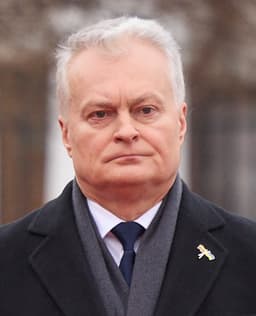
Gitanas Nauseda
Politician · Modern
46.5Total

Punsalmaagiin Ochirbat
Politician · Modern
46.2Total
Basic Information
Born
1964
1942
Died
—
—
Era
Modern
Modern
Nationality
Lithuania
Mongolia
Occupation
Politician
Politician
Civilization
Western
Eastern
Score Comparison
Military (10%)
13.5
10.6
Political (20%)
68.0
53.8
Influence (20%)
51.0
52.5
Legacy (20%)
37.5
45.0
Leadership (15%)
64.0
68.0
Strategy (15%)
31.8
25.2
TOTAL
46.5
46.2
Gitanas Nauseda — Complete Timeline
2019 AD
Elected President of LithuaniaPolitical Action◆ Major
Nauseda won the Lithuanian presidential election as an independent candidate, defeating Ingrida
ElectionPresidentIndependent
Impact: nationalconstructive
2020 AD
Strong Stance on Belarus and RussiaPolitical Action◆ Major
Nauseda condemned the Belarusian government's crackdown on protesters after the disputed 2020 election. He supported EU sanctions against Belarus and provided support to Belarusian opposition figures.
BelarusHuman RightsForeign Policy
Impact: regionalconstructive
2022 AD
Support for Ukraine During Russian InvasionPolitical Action◆ Major
Nauseda was a vocal supporter of Ukraine after Russia's full-scale invasion. He advocated for NATO's eastern flank reinforcement and Lithuania provided military aid to Ukraine.
UkraineNATOSecurity
Impact: globalconstructive
2024 AD
Re-elected President of LithuaniaPolitical Action◆ Major
Nauseda won re-election in the 2024 Lithuanian presidential election, defeating Prime Minister Ingrida
ElectionRe-electionPresident
Impact: nationalconstructive
Punsalmaagiin Ochirbat — Complete Timeline
1990 AD
Election as First President of MongoliaPolitical Action
Punsalmaagiin Ochirbat was elected as the first president of Mongolia following the peaceful democratic revolution. His election marked the end of communist rule and the transition to a multi-party democracy.
Democratic RevolutionPresidencyMongolia
Impact: nationalprogressive
1991 AD
Economic Reforms and PrivatizationReform◆ Major
Ochirbat initiated economic reforms, including privatization of state-owned enterprises and transition to a market economy. These reforms faced challenges but laid the foundation for Mongolia's economic development.
Economic ReformPrivatizationMarket Economy
Impact: nationalconstructive
1992 AD
Adoption of New ConstitutionPolitical Action◆ Major
Under Ochirbat's presidency, Mongolia adopted a new constitution that established a parliamentary system and guaranteed human rights. This constitution replaced the communist-era constitution and solidified democratic reforms.
ConstitutionDemocratic ReformsHuman Rights
Impact: nationalprogressive
Expert Analysis
Origins
**Gitanas Nauseda** was born in 1964 in Klaipėda, Lithuania, then part of the Soviet Union. He studied economics at Vilnius University, earning a degree in 1987. His early career focused on academia and banking; he worked as a research assistant and later became a professor at Vilnius University. Nauseda also served as an economic advisor to the Lithuanian parliament and the prime minister, shaping his technocratic approach.
**Punsalmaagiin Ochirbat** was born in 1942 in Töv Province, Mongolia. He graduated from the Moscow State University of Geology and Mining in 1965, specializing in mining engineering. Ochirbat began his career as a geologist and rose through the ranks of the Mongolian People's Revolutionary Party (MPRP). He served in various governmental roles, including Minister of Geology and Mining, before becoming the Chairman of the Presidium of the People's Great Khural in 1990.
Rise to Power
Nauseda entered politics later in life. He ran for president in 2019 as an independent, positioning himself as a centrist and outsider. In the first round, he placed second behind Ingrida Šimonytė, but in the runoff on May 26, 2019, he won with 66.7% of the vote. His campaign focused on reducing income inequality, supporting families, and maintaining a strong foreign policy stance.
Ochirbat became the first President of Mongolia in 1990 following the peaceful democratic revolution. He was elected by the People's Great Khural in a compromise between the ruling MPRP and the opposition. In 1993, he was directly elected in Mongolia's first direct presidential election, winning 57.8% of the vote. His rise was tied to the collapse of communism and Mongolia's transition to democracy.
Leadership & Governance
Nauseda's leadership style is cautious and consensus-oriented. He has focused on economic stability, social welfare, and foreign policy. He took a strong stance against Belarus after the 2020 election, supporting EU sanctions. He also advocated for NATO's eastern flank reinforcement after Russia's 2022 invasion of Ukraine, pushing for increased defense spending. Domestically, he proposed a tax reform to reduce inequality, but faced parliamentary opposition.
Ochirbat led Mongolia through a turbulent transition from communism to democracy. He oversaw the adoption of a new constitution in 1992, establishing a parliamentary system with a strong presidency. He initiated economic reforms, including privatization and market liberalization. However, these reforms led to social hardships, including unemployment and inflation. Ochirbat's leadership was marked by his commitment to non-violent change and his efforts to balance reform with stability.
Triumph & Tragedy
Nauseda's greatest success is his consistent re-election in 2024, indicating public approval. He has maintained Lithuania's strong pro-Western stance and support for Ukraine, enhancing Lithuania's international standing. His failure includes limited domestic reforms; income inequality remains high, and his tax proposals stalled. He scored 64.0 in leadership but only 31.8 in strategy, reflecting his cautious approach.
Ochirbat's triumph is overseeing Mongolia's peaceful democratic transition and the adoption of a liberal constitution. He is credited with preventing civil war during the 1990 protests. His tragedy lies in the economic pain of reforms: GDP fell sharply in the early 1990s, and living standards declined. Ochirbat scored 68.0 in leadership, the highest among the two, but only 25.2 in strategy, indicating difficulties in economic management.
Character & Destiny
Nauseda is described as pragmatic, reserved, and detail-oriented. His background as an economist influences his cautious decision-making. He avoids populism and seeks broad consensus. His character has led to steady but incremental progress, avoiding major crises but also limiting transformative change.
Ochirbat was seen as a moderate reformer who prioritized national unity. He was willing to compromise with the opposition, which helped avoid violence. However, his conciliatory nature sometimes led to indecisiveness. His destiny was to be a transitional figure, guiding Mongolia through a peaceful revolution but struggling with the economic aftermath.
Legacy
Nauseda's legacy is still forming, but he will likely be remembered for strengthening Lithuania's role in NATO and the EU, and for his firm stance against authoritarian neighbors. His domestic impact is less clear, as structural reforms remain incomplete. He scores 51.0 in influence and 37.5 in legacy.
Ochirbat's legacy is that of a founding father of Mongolian democracy. The 1992 constitution remains in place, and his role in the peaceful transition is celebrated. However, his economic policies are criticized for causing hardship. He scores 52.5 in influence and 45.0 in legacy, slightly higher than Nauseda in these categories.
Conclusion
While Nauseda has a higher total score (46.5 vs 46.2), the difference is negligible. Ochirbat's historical impact is more profound: he led Mongolia's transition from communism to democracy, established a lasting constitution, and set the country on a democratic path. Nauseda, though effective, operates within an established democratic framework. Ochirbat's actions had a foundational effect, while Nauseda's are incremental. Therefore, Punsalmaagiin Ochirbat had greater impact, despite the marginal score difference.
Rankings
🥇
Gitanas NausedaLeader
Mil: 13.5Pol: 68.0Inf: 51.0
46.5
🥈
Punsalmaagiin Ochirbat
Mil: 10.6Pol: 53.8Inf: 52.5
46.2
+0.3 behind
How This Comparison Works
Algorithm
Each figure is scored on 6 dimensions (0—100 scale) based on structured historical data: Military (10%), Political (20%), Influence (20%), Legacy (20%), Leadership (15%), Strategy (15%). The weighted total produces the final ranking.
Data Sources
Scores are computed from structured sub-indicators in the database. Scale factors adjust for era (Ancient ×0.85, Modern ×1.0) and civilization size (Eastern ×1.05, Other ×0.80) to account for differences in population and military scale.
Maximum 3 Figures
Comparisons are limited to 2—3 figures to ensure readability and statistical meaningfulness.
Error Margins
±5 points per dimension — Sub-scores are derived from historical records with inherent uncertainty. Two figures within 5 points on a dimension should be considered roughly equivalent in that area.
Total Score Accuracy
±3 points overall — The weighted combination of 6 dimensions produces a total score with approximately ±3 points of uncertainty. Differences of less than 3 points are not statistically significant— the figures are effectively tied.
Known Limitations
- Historical records are incomplete and uneven across civilizations
- Figures from oral-tradition societies may be underrepresented
- Occupation labels can misclassify multi-role figures
- Scores measure capability and impact, not moral character
- Quantitative scoring is a comparison tool, not absolute truth
Capability Radar
Military (10%) — Battles & Warfare
Battles
21
14
Win Rate
26
18
Expansion
25
23
Political (20%) — Governance & Reform
Reform
40
70
Diplomacy
55
60
Economy
50
45
Influence (20%) — Cultural & Global Reach
Cultural
20
30
Global
25
25
Legacy (20%) — Historical Impact
Historical
20
40
Longevity
15
30
Leadership (15%) — Power & Stability
Tenure
30
55
Stability
45
50
Strategy (15%) — Tactics & Innovation
Strategy
34
21
Tactics
33
28
Reform
35
31
Similar Comparisons
Comments & Discussion
No comments yet. Be the first to share your thoughts!