Loading...
This comparison has not been analyzed yet.
One-time AI generation (~1 minute). Scores and timeline are already available below.
Ghiyath al-Din Tughluq vs Munjong of Joseon
Ghiyath al-Din Tughluq leads by 17.6 pts · 2 figures compared
…
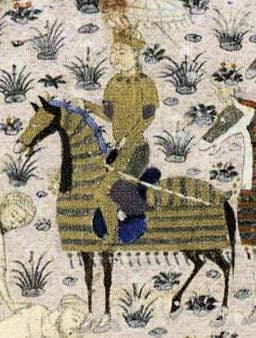
Ghiyath al-Din Tughluq
Emperor · Medieval
59.7Total

Munjong of Joseon
Emperor · Medieval
42.1Total
Basic Information
Born
1300
1414
Died
1325
1452
Era
Medieval
Medieval
Nationality
India
Korea
Occupation
Emperor
Emperor
Civilization
Indian
Eastern
Score Comparison
Military (10%)
61.7
50.8
Political (20%)
68.0
26.4
Influence (20%)
56.4
47.9
Legacy (20%)
48.3
37.5
Leadership (15%)
74.0
44.5
Strategy (15%)
60.7
50.0
TOTAL
59.7
42.1
Ghiyath al-Din Tughluq — Complete Timeline
1320 AD
Founding of the Tughluq DynastyPolitical Action
Ghiyath al-Din Tughluq, then governor of Dipalpur, led a revolt against the Khilji sultan Khusrau Khan. He defeated Khusrau Khan at the Battle of Saraswati and captured Delhi, proclaiming himself sultan. This established the Tughluq dynasty.
Dynasty FoundingRevoltDelhi Sultanate
Impact: nationalconstructive
1321 AD
Construction of Tughlaqabad FortCultural
Ghiyath al-Din Tughluq founded the city of Tughlaqabad near Delhi and built a massive fort there. The fort was designed to be impregnable, with thick walls and a strategic location. It served as his capital and a symbol of his power.
Fort BuildingUrban PlanningArchitecture
constructive
1323 AD
Conquest of WarangalWar◆ Major
Ghiyath al-Din Tughluq led a campaign against the Kakatiya kingdom of Warangal. He defeated the Kakatiya ruler Prataparudra II and annexed the region to the Delhi Sultanate. This extended Tughluq control into the Deccan.
Deccan CampaignKakatiya WarTerritorial Expansion
Impact: regionaldestructive
1325 AD
Death in a Pavilion CollapseOther◆ Major
Ghiyath al-Din Tughluq was killed when a wooden pavilion collapsed on him during a victory parade near Tughlaqabad. The structure was reportedly built hastily. His son Muhammad bin Tughluq succeeded him amid suspicions of foul play.
Accidental DeathSuccessionConspiracy
Impact: nationaltragic
Munjong of Joseon — Complete Timeline
1450 AD
Accession to the ThronePolitical Action◆ Major
Munjong ascended the throne after the death of his father, King Sejong the Great. He inherited a stable and prosperous kingdom but faced challenges from powerful aristocratic families.
SuccessionRoyal AccessionSejong Legacy
Impact: national
1451 AD
Promotion of Confucian ScholarshipCultural
Munjong continued Sejong's patronage of Confucian learning, supporting the compilation of historical texts and the expansion of the Jiphyeonjeon (Hall of Worthies). He emphasized education and civil service.
ConfucianismScholarshipCultural Patronage
Impact: nationalconstructive
1452 AD
Early Death and Political InstabilityPolitical Action◆ Major
Munjong died suddenly after only two years of reign, possibly from illness. His death left his young son Danjong as king, leading to a power vacuum and the eventual usurpation by Sejo.
DeathSuccession CrisisPolitical Instability
Impact: nationaltragic
This comparison has not been analyzed yet.
One-time AI generation (~1 minute). Scores and timeline are already available below.
Rankings
🥇
Ghiyath al-Din TughluqLeader
Mil: 61.7Pol: 68.0Inf: 56.4
59.7
🥈
Munjong of Joseon
Mil: 50.8Pol: 26.4Inf: 47.9
42.1
+17.6 behind
How This Comparison Works
Algorithm
Each figure is scored on 6 dimensions (0—100 scale) based on structured historical data: Military (10%), Political (20%), Influence (20%), Legacy (20%), Leadership (15%), Strategy (15%). The weighted total produces the final ranking.
Data Sources
Scores are computed from structured sub-indicators in the database. Scale factors adjust for era (Ancient ×0.85, Modern ×1.0) and civilization size (Eastern ×1.05, Other ×0.80) to account for differences in population and military scale.
Maximum 3 Figures
Comparisons are limited to 2—3 figures to ensure readability and statistical meaningfulness.
Error Margins
±5 points per dimension — Sub-scores are derived from historical records with inherent uncertainty. Two figures within 5 points on a dimension should be considered roughly equivalent in that area.
Total Score Accuracy
±3 points overall — The weighted combination of 6 dimensions produces a total score with approximately ±3 points of uncertainty. Differences of less than 3 points are not statistically significant— the figures are effectively tied.
Known Limitations
- Historical records are incomplete and uneven across civilizations
- Figures from oral-tradition societies may be underrepresented
- Occupation labels can misclassify multi-role figures
- Scores measure capability and impact, not moral character
- Quantitative scoring is a comparison tool, not absolute truth
Capability Radar
Military (10%) — Battles & Warfare
Battles
65
43
Win Rate
70
47
Expansion
70
52
Political (20%) — Governance & Reform
Reform
55
20
Diplomacy
50
15
Economy
50
15
Influence (20%) — Cultural & Global Reach
Cultural
40
20
Global
30
5
Legacy (20%) — Historical Impact
Historical
50
15
Longevity
40
10
Leadership (15%) — Power & Stability
Tenure
60
10
Stability
45
10
Strategy (15%) — Tactics & Innovation
Strategy
65
53
Tactics
60
58
Reform
55
59
Similar Comparisons
Comments & Discussion
No comments yet. Be the first to share your thoughts!