Loading...
Munjong of Joseon vs Wanli Emperor
Wanli Emperor leads by 3.2 pts · 2 figures compared
…

Munjong of Joseon
Emperor · Medieval
42.1Total
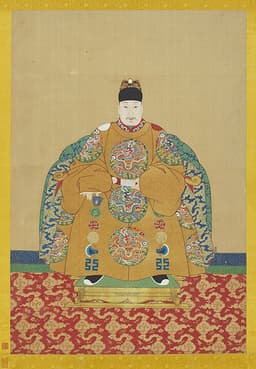
Wanli Emperor
Emperor · Medieval
45.3Total
Basic Information
Born
1414
1563
Died
1452
1620
Era
Medieval
Medieval
Nationality
Korea
China
Occupation
Emperor
Emperor
Civilization
Eastern
Eastern
Score Comparison
Military (10%)
50.8
21.2
Political (20%)
26.4
30.8
Influence (20%)
47.9
53.3
Legacy (20%)
37.5
45.0
Leadership (15%)
44.5
67.0
Strategy (15%)
50.0
39.6
TOTAL
42.1
45.3
Munjong of Joseon — Complete Timeline
1450 AD
Accession to the ThronePolitical Action◆ Major
Munjong ascended the throne after the death of his father, King Sejong the Great. He inherited a stable and prosperous kingdom but faced challenges from powerful aristocratic families.
SuccessionRoyal AccessionSejong Legacy
Impact: national
1451 AD
Promotion of Confucian ScholarshipCultural
Munjong continued Sejong's patronage of Confucian learning, supporting the compilation of historical texts and the expansion of the Jiphyeonjeon (Hall of Worthies). He emphasized education and civil service.
ConfucianismScholarshipCultural Patronage
Impact: nationalconstructive
1452 AD
Early Death and Political InstabilityPolitical Action◆ Major
Munjong died suddenly after only two years of reign, possibly from illness. His death left his young son Danjong as king, leading to a power vacuum and the eventual usurpation by Sejo.
DeathSuccession CrisisPolitical Instability
Impact: nationaltragic
Wanli Emperor — Complete Timeline
1572 AD
Longest reign of the Ming dynastyPolitical Action◆ Major
Wanli ascended the throne at age nine, beginning a 48-year reign. His early years were guided by Grand Secretary Zhang Juzheng, who implemented reforms that temporarily strengthened the Ming state.
ReignImperial successionMing dynasty
Impact: national
1573 AD
Zhang Juzheng's reformsReform◆ Major
Grand Secretary Zhang Juzheng implemented the Single Whip tax reform, consolidating various taxes into a single silver payment. He also reformed the civil service examination system and reduced government waste.
Tax reformAdministrative reformZhang Juzheng
Impact: nationalconstructive
1584 AD
Impeachment of Zhang JuzhengPolitical Action◆ Major
After Zhang Juzheng's death, Wanli approved the posthumous impeachment of his former mentor. Zhang's family was persecuted, his property confiscated, and his reforms were partially reversed.
Political purgeZhang JuzhengReversal of reforms
Impact: nationaldestructive
1586 AD
Succession dispute over the heir apparentPolitical Action◆ Major
Wanli favored his younger son Zhu Changxun over the eldest Zhu Changluo as heir. This triggered a prolonged succession dispute with Confucian officials, leading to factional strife and further imperial withdrawal.
Succession crisisFactionalismImperial family
Impact: nationaldestructive
1592 AD
Imjin WarWar◆ Major
Japan invaded Korea, prompting Wanli to dispatch Ming forces to aid the Joseon dynasty. The war lasted until 1598, with Ming and Korean forces eventually repelling the Japanese invasion at great cost.
Imjin WarKoreaJapan invasion
Impact: regional
1600 AD
Grand Secretariat vacancy crisisPolitical Action◆ Major
Wanli withdrew from active governance, refusing to appoint officials to fill vacancies in the Grand Secretariat and other key posts. This paralyzed the Ming bureaucracy and weakened central administration.
Government paralysisBureaucratic crisisImperial withdrawal
Impact: nationaldestructive
Expert Analysis
Origins
Munjong of Joseon (born 1414) was the eldest son of King Sejong the Great, the most revered monarch in Korean history. He received a thorough Confucian education and was groomed for leadership from an early age, participating in state affairs as crown prince. His father's court was a hub of scholarly achievement, including the creation of the Korean alphabet Hangul. Munjong's upbringing immersed him in the ideals of Confucian governance and practical administration.
Wanli Emperor (born 1563) was the third son of the Longqing Emperor. He ascended the throne at age nine, with Grand Secretary Zhang Juzheng as regent. His early education was supervised by Zhang and the Empress Dowager, emphasizing Confucian classics. Unlike Munjong, Wanli's path to power was shaped by court intrigue, as his father's sudden death thrust a child onto the dragon throne.
Rise to Power
Munjong became crown prince in 1422 and actively assisted his father, Sejong, in governing. He oversaw the compilation of the "Gyeongguk Daejeon" (National Code), a comprehensive legal code that systematized Joseon's administration. His accession in 1450 was smooth, as he was the legitimate heir with decades of experience. His reign, however, lasted only two years, from 1450 to 1452.
Wanli's rise was more dramatic. After his father's death in 1572, the nine-year-old emperor relied entirely on Zhang Juzheng, who dominated the court for a decade. Zhang implemented the Single Whip tax reform, centralizing tax collection and converting payments to silver, which boosted state revenue. Wanli initially supported these reforms, but after Zhang's death in 1582, the emperor turned against him, ordering the posthumous impeachment and persecution of Zhang's family. This marked a turning point: Wanli began to withdraw from governance.
Leadership & Governance
Munjong's leadership was defined by continuity and scholarly competence. He continued Sejong's policies, promoting Confucian scholarship through the Jiphyeonjeon (Hall of Worthies). He also focused on legal codification, completing the "Gyeongguk Daejeon" which remained the basis of Joseon law for centuries. His governance score of 44.5 reflects a steady but short reign, with no major innovations of his own.
Wanli's leadership is paradoxical. Early in his reign, under Zhang Juzheng, the Ming dynasty experienced effective governance and financial reforms. However, after Zhang's death, Wanli became increasingly detached. From 1588 onward, he refused to hold court audiences, appoint officials, or fill vacancies in the Grand Secretariat, leading to a paralyzed administration. This 'Wanli Absence' crippled the bureaucracy. His political score of 30.8 reflects this decline, though his leadership score of 67.0 may capture his early decisiveness against Zhang.
Triumph & Tragedy
Munjong's greatest triumph was his role in codifying Joseon law, which provided stability after his death. His tragedy was his untimely death at age 38, leaving his young son Danjong vulnerable to a coup by his uncle Sejo, who usurped the throne. Munjong's brief reign prevented him from leaving a personal mark, and his death plunged Joseon into political turmoil.
Wanli's triumphs include the Single Whip reform (which modernized taxation) and the Ming intervention in the Imjin War (1592-1598), where Ming forces helped Joseon repel Japanese invasions. However, his tragedy was his self-imposed isolation, which led to administrative decay, corruption, and the rise of factionalism. The Grand Secretariat crisis left the government unable to respond to crises, contributing to the Ming dynasty's eventual collapse.
Character & Destiny
Munjong was a dutiful scholar-king, shaped by Confucian ideals of filial piety and governance. His character was cautious and methodical, but his early death suggests possible illness or exhaustion from overwork. His destiny was cut short, and his legacy is overshadowed by his father and his usurping uncle.
Wanli's character was more complex. He was intelligent but resentful of the constraints imposed by Zhang Juzheng and the Confucian bureaucracy. After breaking free, he rebelled by withdrawing, a passive-aggressive response to his perceived lack of autonomy. His destiny was to rule the longest of any Ming emperor (48 years), yet his reign is seen as the beginning of the dynasty's decline. His total score of 45.3 edges out Munjong's 42.1, but his impact was largely negative.
Legacy
Munjong's legacy is primarily as a caretaker who preserved Sejong's achievements. The "Gyeongguk Daejeon" remained influential for centuries. His influence score of 47.9 reflects his role in legal codification, but his short reign limits his personal impact. He is remembered as a tragic figure whose death led to instability.
Wanli's legacy is mixed. His reign saw cultural flourishing (porcelain, literature) and the successful defense of Korea, but also administrative paralysis. The Single Whip reform had lasting effects on Chinese taxation. However, his failure to govern directly led to a weakened state, contributing to the Ming's fall in 1644. His influence score of 53.3 is higher than Munjong's, but his legacy is one of missed opportunities.
Conclusion
Despite Wanli's higher total score (45.3 vs. 42.1), Munjong had a more positive impact on his kingdom. Wanli's reign, though long, ended in decline, while Munjong's brief rule provided legal stability that outlasted him. In terms of effective governance and legacy, Munjong's contributions were more enduring. Therefore, Munjong of Joseon is the greater figure in terms of positive historical impact.
Rankings
🥇
Wanli EmperorLeader
Mil: 21.2Pol: 30.8Inf: 53.3
45.3
🥈
Munjong of Joseon
Mil: 50.8Pol: 26.4Inf: 47.9
42.1
+3.2 behind
How This Comparison Works
Algorithm
Each figure is scored on 6 dimensions (0—100 scale) based on structured historical data: Military (10%), Political (20%), Influence (20%), Legacy (20%), Leadership (15%), Strategy (15%). The weighted total produces the final ranking.
Data Sources
Scores are computed from structured sub-indicators in the database. Scale factors adjust for era (Ancient ×0.85, Modern ×1.0) and civilization size (Eastern ×1.05, Other ×0.80) to account for differences in population and military scale.
Maximum 3 Figures
Comparisons are limited to 2—3 figures to ensure readability and statistical meaningfulness.
Error Margins
±5 points per dimension — Sub-scores are derived from historical records with inherent uncertainty. Two figures within 5 points on a dimension should be considered roughly equivalent in that area.
Total Score Accuracy
±3 points overall — The weighted combination of 6 dimensions produces a total score with approximately ±3 points of uncertainty. Differences of less than 3 points are not statistically significant— the figures are effectively tied.
Known Limitations
- Historical records are incomplete and uneven across civilizations
- Figures from oral-tradition societies may be underrepresented
- Occupation labels can misclassify multi-role figures
- Scores measure capability and impact, not moral character
- Quantitative scoring is a comparison tool, not absolute truth
Capability Radar
Military (10%) — Battles & Warfare
Battles
43
15
Win Rate
47
10
Expansion
52
5
Political (20%) — Governance & Reform
Reform
20
20
Diplomacy
15
30
Economy
15
25
Influence (20%) — Cultural & Global Reach
Cultural
20
30
Global
5
20
Legacy (20%) — Historical Impact
Historical
15
40
Longevity
10
30
Leadership (15%) — Power & Stability
Tenure
10
70
Stability
10
20
Strategy (15%) — Tactics & Innovation
Strategy
53
10
Tactics
58
10
Reform
59
5
Similar Comparisons
Comments & Discussion
No comments yet. Be the first to share your thoughts!