Loading...
Ghiyath al-Din Tughluq vs Julius Caesar
Julius Caesar leads by 23.1 pts · 2 figures compared
…
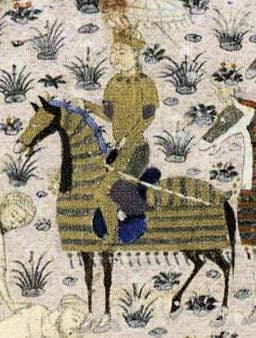
Ghiyath al-Din Tughluq
Emperor · Medieval
59.7Total

Julius Caesar
General · Ancient
82.8Total
Basic Information
Born
1300
-100
Died
1325
-44
Era
Medieval
Ancient
Nationality
India
Roman Republic
Occupation
Emperor
General
Civilization
Indian
Western
Score Comparison
Military (10%)
61.7
88.0
Political (20%)
68.0
78.0
Influence (20%)
56.4
85.0
Legacy (20%)
48.3
82.0
Leadership (15%)
74.0
80.0
Strategy (15%)
60.7
85.0
TOTAL
59.7
82.8
Ghiyath al-Din Tughluq — Complete Timeline
1320 AD
Founding of the Tughluq DynastyPolitical Action
Ghiyath al-Din Tughluq, then governor of Dipalpur, led a revolt against the Khilji sultan Khusrau Khan. He defeated Khusrau Khan at the Battle of Saraswati and captured Delhi, proclaiming himself sultan. This established the Tughluq dynasty.
Dynasty FoundingRevoltDelhi Sultanate
Impact: nationalconstructive
1321 AD
Construction of Tughlaqabad FortCultural
Ghiyath al-Din Tughluq founded the city of Tughlaqabad near Delhi and built a massive fort there. The fort was designed to be impregnable, with thick walls and a strategic location. It served as his capital and a symbol of his power.
Fort BuildingUrban PlanningArchitecture
constructive
1323 AD
Conquest of WarangalWar◆ Major
Ghiyath al-Din Tughluq led a campaign against the Kakatiya kingdom of Warangal. He defeated the Kakatiya ruler Prataparudra II and annexed the region to the Delhi Sultanate. This extended Tughluq control into the Deccan.
Deccan CampaignKakatiya WarTerritorial Expansion
Impact: regionaldestructive
1325 AD
Death in a Pavilion CollapseOther◆ Major
Ghiyath al-Din Tughluq was killed when a wooden pavilion collapsed on him during a victory parade near Tughlaqabad. The structure was reportedly built hastily. His son Muhammad bin Tughluq succeeded him amid suspicions of foul play.
Accidental DeathSuccessionConspiracy
Impact: nationaltragic
Julius Caesar — Complete Timeline
58 BC
Gallic WarsWar◆ Major
Caesar, as proconsul of Gaul, launched a series of campaigns that conquered all of Gaul (modern France, Belgium, and parts of Switzerland). He fought numerous battles, including against the Helvetii, the Belgae, and the Gallic chieftain Vercingetorix. The wars brought immense wealth and a loyal army to Caesar.
Gallic WarsConquestRoman Expansion
Impact: regional
49 BC
Crossing the RubiconPolitical Action◆ Major
Caesar led Legio XIII across the Rubicon River into Italy, defying the Roman Senate's order to disband his army. This act triggered a civil war against Pompey and the Optimates, ultimately leading to Caesar's dictatorship and the end of the Roman Republic.
Roman Civil WarEnd of RepublicPower Struggle
Impact: global
48 BC
Battle of PharsalusWar◆ Major
Caesar's outnumbered army defeated the larger forces of Pompey the Great at Pharsalus in Greece. Caesar's tactical use of a reserve line to counter Pompey's cavalry charge proved decisive. Pompey fled to Egypt, where he was assassinated, leaving Caesar as the undisputed master of the Roman world.
Roman Civil WarBattleDecisive Victory
Impact: regional
44 BC
Appointment as Dictator for LifePolitical Action◆ Major
The Roman Senate appointed Caesar dictator perpetuo (dictator for life), granting him unprecedented personal power. This move concentrated military, legislative, and judicial authority in one person, effectively ending the Roman Republic's traditional system of checks and balances and alarming many senators.
DictatorshipEnd of RepublicPower Consolidation
Impact: regionaldestructive
Assassination on the Ides of MarchPolitical Action◆ Major
A group of Roman senators, led by Marcus Junius Brutus and Gaius Cassius Longinus, stabbed Caesar to death at a meeting of the Senate in the Theatre of Pompey. The assassination was intended to restore the Republic, but instead triggered another civil war that led to the rise of the Roman Empire.
AssassinationRoman PoliticsEnd of Republic
Impact: globaldestructive
Expert Analysis
ghiyath-al-din-tughluq-vs-julius-caesar
# The General and the Sultan: Two Paths to Power, Two Legacies of Dust
On a March morning in 44 BCE, the Roman Senate gathered in the Theatre of Pompey. Sixty conspirators, their daggers hidden beneath togas, surrounded Gaius Julius Caesar. They struck twenty-three times. The dictator fell at the base of a statue of his former rival, Pompey the Great, blood pooling on the marble floor. The man who had conquered Gaul, crossed the Rubicon, and reshaped the ancient world died not on a battlefield but in a chamber of betrayal—a death that would launch a civil war and birth an empire.
Two centuries later and half a world away, another ruler met his end in a way that seemed almost absurd by comparison. In 1325, Ghiyath al-Din Tughluq, founder of the Tughluq dynasty of the Delhi Sultanate, was parading in triumph near his newly built fortress of Tughlaqabad. A wooden pavilion, hastily constructed to honor the occasion, collapsed upon him. The emperor was crushed to death, not by an enemy blade but by the very celebration of his own victory. One man was murdered by his peers; the other was killed by a mistake in carpentry. Both had risen from nothing. Both had seized power through blood and ambition. Yet their stories could not have diverged more sharply. What drove these two figures—separated by centuries, continents, and civilizations—to such different fates? The answer lies not in fortune alone, but in the raw material of character, the crucible of their times, and the choices that carved their paths.
Origins
Caesar was born into the chaos of the late Roman Republic, a world of senatorial intrigue, civil wars, and the slow decay of republican institutions. His family, the Julii, claimed descent from the goddess Venus, but they were old patricians in a system that increasingly favored new money and military strongmen. Caesar’s father died when he was sixteen, leaving him to navigate a treacherous political landscape. His mother, Aurelia, a woman of formidable intelligence, taught him to read men as carefully as he read the stars. The young Caesar learned early that in Rome, survival meant mastering the art of the deal, the speech, and the sword.
Ghiyath al-Din Tughluq, born around 1300, emerged from a very different world. The Delhi Sultanate, a Muslim empire ruling over a Hindu-majority India, was a patchwork of warring factions, slave dynasties, and fragile alliances. Tughluq’s father was a Turkic slave soldier, a *mamluk* who had risen through the ranks to become governor of Dipalpur in Punjab. The son inherited not a divine lineage but a practical education in frontier warfare, irrigation projects, and the delicate art of balancing Hindu chieftains against Muslim nobles. Where Caesar learned rhetoric in the forums of Rome, Tughluq learned to read the monsoon rains and the shifting loyalties of his father’s cavalry.
Rise to Power
Caesar’s ascent was a masterpiece of calculated risk. He fled Rome during Sulla’s proscriptions, served as a military tribune in Asia, and was captured by pirates—whom he later crucified after raising his own ransom money. He climbed the *cursus honorum*—quaestor, aedile, praetor—spending fortunes on games and bribes, building a network of debt and loyalty that would later prove decisive. The turning point came in 58 BCE, when he secured the governorship of Gaul. Over eight years, he conquered a territory larger than Italy itself, writing his own propaganda in the *Commentaries*, and forged an army that loved him more than it loved Rome. When the Senate ordered him to disband, he crossed the Rubicon in 49 BCE, a river that separated lawful command from treason. “The die is cast,” he said—and the Republic died with it.
Tughluq’s rise was more direct, less theatrical. In 1320, the Khilji sultan Khusrau Khan, a convert from Hinduism, had seized the throne and alienated the Turkic nobility. Tughluq, then governor of Dipalpur, saw his moment. He raised a revolt, marched on Delhi, and defeated Khusrau Khan in battle. The chroniclers record that Tughluq was a reluctant emperor, crowned only after the nobles insisted. But this was a ritual of modesty, not a sign of weakness. He immediately set about consolidating power: building the massive Tughlaqabad Fort—a fortress of cyclopean stone designed to intimidate as much as defend—and launching campaigns to reassert Delhi’s authority over rebellious provinces. In 1323, he conquered the Kakatiya kingdom of Warangal, a victory that filled his treasury and extended his reach deep into the Deccan.
Leadership & Governance
Caesar ruled as a dictator, first for ten years, then for life. He reformed the calendar, gave land to veterans, granted citizenship to provincials, and centralized power in his own hands. His military genius was unmatched: at Alesia, he surrounded a Gallic army while simultaneously besieging a relief force, a feat of logistics and tactics that still astounds. Yet his political wisdom was flawed. He pardoned his enemies, including Brutus and Cassius, but failed to secure their loyalty. He accepted divine honors and the title *dictator perpetuo*, but never created a stable system of succession. As the historian Suetonius wrote, “He thought the Senate was full of friends, but they were full of daggers.”
Tughluq’s governance was more pragmatic, less grandiose. He restored order after the chaos of Khusrau Khan, repaired irrigation canals, and patronized scholars and poets. His military score of 57.1 and strategy of 59.5 suggest a competent but not brilliant commander; his conquest of Warangal was a solid achievement, not a dazzling campaign. His political score of 52.9 reflects a ruler who maintained stability but did not transform his realm. He was, above all, a consolidator, not a visionary. His leadership score of 80.3, however, hints at something deeper: he was respected, perhaps even loved, by his men. The Tughlaqabad Fort, with its sloping walls and massive gates, still stands as a testament to his determination—a fortress that outlasted its builder.
Triumph & Tragedy
Caesar’s greatest triumph was the conquest of Gaul. His greatest tragedy was his failure to understand that the Republic, however corrupt, still held the hearts of its elite. He could forgive his enemies, but they could not forgive him for making them powerless. The Ides of March was not just a murder; it was a political suicide note.
Tughluq’s triumph was the founding of a dynasty that would rule for nearly a century. His tragedy was a death so anticlimactic that it borders on the comic. The pavilion collapse at Tughlaqabad in 1325—during a victory parade, no less—killed him instantly. His son, Muhammad bin Tughluq, would inherit the throne and become one of the most brilliant and disastrous rulers in Indian history, a man whose schemes bankrupted the sultanate. Ghiyath al-Din’s legacy, then, was not his own rule, but the chaos he inadvertently unleashed.
Character & Destiny
Caesar was a gambler who played for the highest stakes. He was generous, cunning, and ruthless by turns. His character drove him to take risks that others would not, and his destiny was to die by the very ambition that made him great. Tughluq was a builder, a stabilizer, a man who valued order over glory. His destiny was to be remembered not for his achievements, but for the strange, almost absurd manner of his death.
Legacy
Caesar’s legacy is the Roman Empire. His name became a title—*Kaiser*, *Tsar*—and his reforms shaped Western governance for two millennia. He is remembered as a military genius, a political revolutionary, and a cautionary tale about the price of ambition.
Tughluq’s legacy is the Tughlaq dynasty, which ruled until 1414, and the Tughlaqabad Fort, now a crumbling ruin on the outskirts of Delhi. He is a footnote in the history of the Delhi Sultanate, a competent ruler overshadowed by his brilliant son and the subsequent chaos of Timur’s invasion. His scores—total 64.4 against Caesar’s 83.3—reflect a life that was solid but not spectacular.
Conclusion
Two men, separated by time and terrain, both rose from the periphery to seize power. Caesar changed the world; Tughluq held it steady for a moment. One died by the hands of his peers, the other by a fallen roof. In the end, both were victims of the same truth: history remembers not the steady hand, but the bold one. Yet there is a quiet dignity in Tughluq’s story—a reminder that not every ruler needs to reshape the world. Some are content to build a fort, defeat a kingdom, and pass the crown to a son. The fort still stands, even if the emperor is dust. And that, perhaps, is enough.
Rankings
🥇
Julius CaesarLeader
Mil: 88.0Pol: 78.0Inf: 85.0
82.8
🥈
Ghiyath al-Din Tughluq
Mil: 61.7Pol: 68.0Inf: 56.4
59.7
+23.1 behind
How This Comparison Works
Algorithm
Each figure is scored on 6 dimensions (0—100 scale) based on structured historical data: Military (10%), Political (20%), Influence (20%), Legacy (20%), Leadership (15%), Strategy (15%). The weighted total produces the final ranking.
Data Sources
Scores are computed from structured sub-indicators in the database. Scale factors adjust for era (Ancient ×0.85, Modern ×1.0) and civilization size (Eastern ×1.05, Other ×0.80) to account for differences in population and military scale.
Maximum 3 Figures
Comparisons are limited to 2—3 figures to ensure readability and statistical meaningfulness.
Error Margins
±5 points per dimension — Sub-scores are derived from historical records with inherent uncertainty. Two figures within 5 points on a dimension should be considered roughly equivalent in that area.
Total Score Accuracy
±3 points overall — The weighted combination of 6 dimensions produces a total score with approximately ±3 points of uncertainty. Differences of less than 3 points are not statistically significant— the figures are effectively tied.
Known Limitations
- Historical records are incomplete and uneven across civilizations
- Figures from oral-tradition societies may be underrepresented
- Occupation labels can misclassify multi-role figures
- Scores measure capability and impact, not moral character
- Quantitative scoring is a comparison tool, not absolute truth
Capability Radar
Military (10%) — Battles & Warfare
Battles
65
95
Win Rate
70
92
Expansion
70
97
Political (20%) — Governance & Reform
Reform
55
90
Diplomacy
50
85
Economy
50
82
Influence (20%) — Cultural & Global Reach
Cultural
40
88
Global
30
94
Legacy (20%) — Historical Impact
Historical
50
95
Longevity
40
96
Leadership (15%) — Power & Stability
Tenure
60
75
Stability
45
60
Strategy (15%) — Tactics & Innovation
Strategy
65
94
Tactics
60
96
Reform
55
88
Similar Comparisons
Comments & Discussion
TogaTracker6/17/2026
Caesar wasn't "murdered by his peers"—he was assassinated by a senatorial clique terrified of a monarch they themselves enabled. Tughluq's death is actually more honest: pure chance, no grand betrayal. History buffs romanticize the Ides of March, but a collapsed pavilion tells you more about human frailty than any senatorial conspiracy ever could. Caesar built an empire; Tughluq built a faulty roof.
算账先生6/17/2026
拿恺撒和突格鲁克比?恺撒是被元老院捅死的,突格鲁克是被自己庆祝胜利的棚子砸死的,这能一样吗?数字不会骗人:恺撒打了八场高卢战役,征服了三百多个部落;突格鲁克最大的“功绩”就是修建了一个后来被遗弃的堡垒。一个终结了罗马共和国,一个连自己的安保木工都没管好。别美化巧合,尊重数据。
LatinRoots6/17/2026
Both men understood power's theatricality. Caesar's toga was bloodied for maximum political effect; Tughluq's timber canopy collapsed in a clumsy farce. But consider: Caesar wrote his own commentaries, controlling the narrative for millennia. Tughluq left us no memoirs, just a heap of splintered wood. One died scripting history, the other as an architectural footnote. The classics scholar knows: history belongs to those who write their own lines.
拆台匠6/17/2026
什么“两个传奇”?这完全是不对称比较。恺撒的对手是庞培和克拉苏这种级别的博弈者;突格鲁克的主要对手是蒙古入侵和饥荒。你告诉我,一个在元老院操纵政变的人,跟一个被自己庆祝建筑砸死的苏丹,有什么棋局可对?恺撒死时留下了奥古斯都和帝国制度;突格鲁克死时留下了内乱和烂尾楼。这不是悲剧对比,这是把悲剧和闹剧放在一起比。