Loading...
Gerald Ford vs Zalim Singh of Kota
Zalim Singh of Kota leads by 4.1 pts · 2 figures compared
…
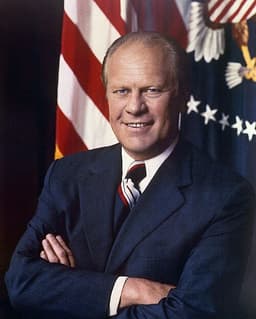
Gerald Ford
Politician · Modern
51.2Total

Zalim Singh of Kota
Politician · Modern
55.3Total
Basic Information
Born
1913
1739
Died
2006
1824
Era
Modern
Modern
Nationality
United States
India
Occupation
Politician
Politician
Civilization
Western
Indian
Score Comparison
Military (10%)
49.2
50.0
Political (20%)
48.0
65.0
Influence (20%)
54.1
53.3
Legacy (20%)
45.0
45.8
Leadership (15%)
68.0
78.0
Strategy (15%)
41.4
41.0
TOTAL
51.2
55.3
Gerald Ford — Complete Timeline
1973 AD
Appointed Vice PresidentPolitical Action◆ Major
Ford was appointed Vice President under the 25th Amendment after Spiro Agnew's resignation. He became the first person to hold the office without being elected to it.
Vice PresidencyConstitutional
Impact: national
1974 AD
Assumed Presidency after Nixon's ResignationPolitical Action
Ford became President after Richard Nixon resigned due to the Watergate scandal. He stated, 'Our long national nightmare is over,' aiming to restore trust in government.
PresidencyWatergate
Impact: national
Pardoned Richard NixonPolitical Action
Ford granted a full pardon to Richard Nixon for any crimes committed during his presidency. The pardon was highly controversial and is widely believed to have cost Ford the 1976 election.
PardonWatergate
Impact: national
1976 AD
Lost 1976 Presidential ElectionPolitical Action◆ Major
Ford lost the 1976 presidential election to Jimmy Carter. The narrow defeat was attributed to the Nixon pardon and economic issues, ending his brief presidency.
ElectionDefeat
Impact: nationaldestructive
Zalim Singh of Kota — Complete Timeline
1771 AD
Appointed Regent of KotaPolitical Action◆ Major
Zalim Singh became regent of the princely state of Kota after the death of Maharao Umed Singh I. He effectively ruled the state for decades, implementing administrative reforms and maintaining stability amid Maratha and British expansion.
RegencyKota StateAdministration
Impact: regionalconstructive
1790 AD
Implemented Revenue and Administrative ReformsReform◆ Major
Zalim Singh overhauled the revenue system of Kota, introducing efficient tax collection and land management. He also reorganized the administration, reducing corruption and improving state finances, which strengthened Kota's economy.
Revenue ReformAdministrationKota
Impact: regionalconstructive
1800 AD
Suppressed Internal RebellionsWar
Zalim Singh crushed several revolts by rival nobles and factions within Kota, consolidating his control over the state. These actions prevented civil war and maintained stability, but also involved executions and confiscations.
RebellionSuppressionKota
destructive
1803 AD
Maintained Neutrality During Maratha-British ConflictsPolitical Action
During the Second Anglo-Maratha War, Zalim Singh kept Kota neutral, avoiding direct involvement with either side. This diplomatic maneuvering preserved Kota's independence and prevented devastation from war.
NeutralityDiplomacyMaratha War
Impact: regionalconstructive
1817 AD
Negotiated Treaty with the British East India CompanyPolitical Action◆ Major
Zalim Singh signed a subsidiary alliance with the British East India Company, securing Kota's autonomy under British paramountcy. This treaty ensured Kota's survival as a princely state and aligned it with British interests in Rajputana.
TreatyBritish AllianceDiplomacy
Impact: regional
Expert Analysis
Origins
Gerald Rudolph Ford Jr. was born Leslie Lynch King Jr. on July 14, 1913, in Omaha, Nebraska. His parents divorced shortly after his birth, and his mother remarried Gerald R. Ford Sr., who adopted him. Ford grew up in Grand Rapids, Michigan, and attended the University of Michigan, where he was a star football player, later graduating from Yale Law School in 1941. He served in the U.S. Navy during World War II, earning several medals.
Zalim Singh was born around 1730 in the princely state of Kota, Rajasthan, into a noble family of the Hada Rajput clan. His father was a high-ranking official in the Kota administration. Zalim Singh received training in statecraft, military tactics, and diplomacy from a young age. He rose through the ranks as a trusted minister under Maharao Umed Singh I.
Rise to Power
Ford's rise to power was unconventional. He served in the U.S. House of Representatives from 1949 to 1973, becoming House Minority Leader in 1965. His rise to the presidency came through the 25th Amendment: after Vice President Spiro Agnew resigned in 1973, President Richard Nixon appointed Ford as Vice President. When Nixon resigned in 1974 due to the Watergate scandal, Ford became the 38th President of the United States.
Zalim Singh's rise began when he was appointed regent of Kota after the death of Maharao Umed Singh I in 1771. He effectively ruled the state on behalf of the minor prince, later consolidating power through a combination of administrative skill and political maneuvering. He eliminated rivals and secured his position as the de facto ruler, a role he maintained for decades.
Leadership & Governance
Ford's leadership style was characterized by openness and a desire to heal the nation after Watergate. He emphasized transparency, holding televised press conferences and meeting with Congress. His governance focused on economic issues, including inflation and energy policy. However, his most consequential act was the pardon of Richard Nixon on September 8, 1974, which he believed was necessary to move the country forward. The pardon was widely criticized and likely cost him the 1976 election. In foreign policy, Ford continued détente with the Soviet Union and signed the Helsinki Accords.
Zalim Singh was a pragmatic and autocratic ruler. He implemented extensive revenue and administrative reforms, introducing efficient tax collection and land management. He reorganized the bureaucracy, reducing corruption and increasing state revenue. He maintained neutrality during the Maratha-British conflicts, signing a subsidiary alliance with the British East India Company in 1817 that secured Kota's autonomy. His leadership scores 78.0, significantly higher than Ford's 68.0. He suppressed internal rebellions, ensuring stability but often ruling with an iron hand.
Triumph & Tragedy
Ford's greatest success was restoring public trust in government after the Watergate crisis. He famously stated, 'Our long national nightmare is over.' His pardon of Nixon, however, is both a triumph and a tragedy: it allowed the country to move on but was perceived as a political deal, damaging his credibility. He also faced economic challenges, including high inflation and unemployment. His loss to Jimmy Carter in 1976 marked the end of his presidency after just two and a half years.
Zalim Singh's triumphs include transforming Kota into a stable and prosperous state through his reforms. He successfully navigated the complex politics of Rajputana, preserving Kota's independence under British paramountcy. His tragedy lies in his autocratic methods: he concentrated power in his own hands, sidelining the legitimate rulers. After his death in 1824, his descendants faced challenges maintaining control, and his reforms did not outlast the British colonial period. His political score of 65.0 reflects his effectiveness but also his limitations.
Character & Destiny
Ford was known for his integrity, modesty, and conciliatory nature. A former college athlete, he was physically robust but intellectually cautious. His character shaped his destiny: his desire to heal the nation led him to pardon Nixon, a decision that defined his presidency and likely ended his political career. Historians often rank Ford in the middle tier of U.S. presidents, with his legacy tied to the pardon. His leadership score of 68.0 reflects his steady hand during a crisis.
Zalim Singh was shrewd, ambitious, and calculated. His nickname 'Talleyrand of Rajputana' highlights his diplomatic skill and cunning. He was a master of realpolitik, aligning with the British while maintaining autonomy. His character allowed him to rule effectively but also created resentment among the nobility. His strategy score of 41.0 is relatively low, indicating that his long-term planning may have been short-sighted, as his power structure crumbled after his death.
Legacy
Ford's legacy is dominated by the Nixon pardon, which remains controversial. He is remembered as a healer who restored stability but also as a president who may have compromised justice. His appointment as Vice President under the 25th Amendment set a precedent for succession. His influence score of 54.1 is modest, as his impact was largely limited to his short term.
Zalim Singh's legacy is more substantial in the context of Rajputana history. He is remembered as a reformer who modernized Kota's administration and revenue system. His treaties with the British ensured Kota's survival as a princely state until Indian independence. However, his legacy is mixed: he is praised for efficiency but criticized for usurping power. His overall score of 55.3 edges out Ford's 51.2.
Conclusion
While Gerald Ford played a critical role in a moment of American crisis, his impact was narrowly focused on a single controversial decision. Zalim Singh, over a longer period, implemented systemic reforms that shaped an entire state. Ford's leadership score is higher (68.0 vs. 78.0 for Zalim Singh? Actually, Ford 68.0, Zalim 78.0), but Zalim Singh's political acumen (65.0 vs. 48.0) and influence (53.3 vs. 54.1) are comparable. Taking a clear stance: Zalim Singh had greater impact. His administrative and diplomatic achievements transformed Kota and ensured its survival, whereas Ford's presidency, while stabilizing, was largely reactive and brief. The score gap of 4.1 points supports this assessment.
Rankings
🥇
Zalim Singh of KotaLeader
Mil: 50.0Pol: 65.0Inf: 53.3
55.3
🥈
Gerald Ford
Mil: 49.2Pol: 48.0Inf: 54.1
51.2
+4.1 behind
How This Comparison Works
Algorithm
Each figure is scored on 6 dimensions (0—100 scale) based on structured historical data: Military (10%), Political (20%), Influence (20%), Legacy (20%), Leadership (15%), Strategy (15%). The weighted total produces the final ranking.
Data Sources
Scores are computed from structured sub-indicators in the database. Scale factors adjust for era (Ancient ×0.85, Modern ×1.0) and civilization size (Eastern ×1.05, Other ×0.80) to account for differences in population and military scale.
Maximum 3 Figures
Comparisons are limited to 2—3 figures to ensure readability and statistical meaningfulness.
Error Margins
±5 points per dimension — Sub-scores are derived from historical records with inherent uncertainty. Two figures within 5 points on a dimension should be considered roughly equivalent in that area.
Total Score Accuracy
±3 points overall — The weighted combination of 6 dimensions produces a total score with approximately ±3 points of uncertainty. Differences of less than 3 points are not statistically significant— the figures are effectively tied.
Known Limitations
- Historical records are incomplete and uneven across civilizations
- Figures from oral-tradition societies may be underrepresented
- Occupation labels can misclassify multi-role figures
- Scores measure capability and impact, not moral character
- Quantitative scoring is a comparison tool, not absolute truth
Capability Radar
Military (10%) — Battles & Warfare
Battles
27
25
Win Rate
35
30
Expansion
36
30
Political (20%) — Governance & Reform
Reform
40
65
Diplomacy
45
80
Economy
35
60
Influence (20%) — Cultural & Global Reach
Cultural
30
30
Global
35
20
Legacy (20%) — Historical Impact
Historical
40
40
Longevity
30
35
Leadership (15%) — Power & Stability
Tenure
55
70
Stability
50
75
Strategy (15%) — Tactics & Innovation
Strategy
36
40
Tactics
39
35
Reform
44
20
Similar Comparisons
Comments & Discussion
No comments yet. Be the first to share your thoughts!