Loading...
Gerald Ford vs Mohammed bin Nayef
Gerald Ford leads by 1.6 pts · 2 figures compared
…
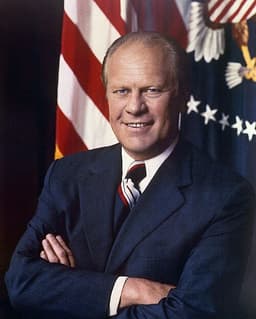
Gerald Ford
Politician · Modern
51.2Total

Mohammed bin Nayef
Politician · Modern
49.6Total
Basic Information
Born
1913
1959
Died
2006
—
Era
Modern
Modern
Nationality
United States
Saudi Arabia
Occupation
Politician
Politician
Civilization
Western
Middle Eastern
Score Comparison
Military (10%)
49.2
10.0
Political (20%)
48.0
68.0
Influence (20%)
54.1
53.3
Legacy (20%)
45.0
41.7
Leadership (15%)
68.0
72.0
Strategy (15%)
41.4
38.6
TOTAL
51.2
49.6
Gerald Ford — Complete Timeline
1973 AD
Appointed Vice PresidentPolitical Action◆ Major
Ford was appointed Vice President under the 25th Amendment after Spiro Agnew's resignation. He became the first person to hold the office without being elected to it.
Vice PresidencyConstitutional
Impact: national
1974 AD
Assumed Presidency after Nixon's ResignationPolitical Action
Ford became President after Richard Nixon resigned due to the Watergate scandal. He stated, 'Our long national nightmare is over,' aiming to restore trust in government.
PresidencyWatergate
Impact: national
Pardoned Richard NixonPolitical Action
Ford granted a full pardon to Richard Nixon for any crimes committed during his presidency. The pardon was highly controversial and is widely believed to have cost Ford the 1976 election.
PardonWatergate
Impact: national
1976 AD
Lost 1976 Presidential ElectionPolitical Action◆ Major
Ford lost the 1976 presidential election to Jimmy Carter. The narrow defeat was attributed to the Nixon pardon and economic issues, ending his brief presidency.
ElectionDefeat
Impact: nationaldestructive
Mohammed bin Nayef — Complete Timeline
2003 AD
Counter-Terrorism LeadershipWar◆ Major
As Minister of Interior, Mohammed bin Nayef led Saudi Arabia's counter-terrorism efforts, overseeing the dismantling of al-Qaeda cells and the rehabilitation of extremists. He survived an assassination attempt by a suicide bomber in 2009.
TerrorismSecurityRehabilitation
Impact: national
2015 AD
Appointment as Crown PrincePolitical Action◆ Major
Mohammed bin Nayef was appointed Crown Prince of Saudi Arabia by King Salman, becoming the first grandson of King Abdulaziz to hold the position. He was also Minister of Interior, known for his role in counter-terrorism.
SuccessionRoyal Family
Impact: national
2017 AD
Removal from Crown Prince PositionPolitical Action
King Salman removed Mohammed bin Nayef from the position of Crown Prince and replaced him with Mohammed bin Salman. This was part of a major reshuffle that consolidated power in the hands of the younger prince.
SuccessionPower Struggle
Impact: national
Expert Analysis
Origins
Gerald Rudolph Ford Jr. was born on July 14, 1913, in Omaha, Nebraska, as Leslie Lynch King Jr. His parents divorced shortly after his birth, and his mother remarried Gerald R. Ford Sr., who adopted him. Ford grew up in Grand Rapids, Michigan, in a stable middle-class household. He excelled in sports, particularly football, and attended the University of Michigan, where he played on the national championship teams. After graduating, he worked as an assistant football coach while attending Yale Law School, earning his law degree in 1941. He served in the U.S. Navy during World War II, reaching the rank of lieutenant commander.
Mohammed bin Nayef bin Abdulaziz Al Saud was born on August 30, 1959, in Jeddah, Saudi Arabia, into the House of Saud. He is the son of Prince Nayef bin Abdulaziz, a long-serving interior minister and later crown prince. Mohammed grew up in the royal court, deeply immersed in the intricacies of Saudi politics and security. He received his early education in Saudi Arabia and later studied at the University of Portland in the United States, earning a bachelor's degree in political science. His formative years were shaped by the tribal and familial dynamics of the Saudi monarchy, as well as the rising threat of Islamist extremism.
Rise to Power
Ford's rise was gradual and institutional. He was elected to the U.S. House of Representatives in 1948, representing Michigan's 5th district, and served for 25 years, rising to become House Minority Leader in 1965. His big break came in 1973 when Vice President Spiro Agnew resigned amid a corruption scandal. President Richard Nixon appointed Ford as Vice President under the 25th Amendment, making Ford the first person to assume the vice presidency without being elected. When Nixon resigned on August 9, 1974, due to the Watergate scandal, Ford became President. His ascent was marked by constitutional procedure and bipartisan respect.
Mohammed bin Nayef's rise was tied to his family's control of the security apparatus. He joined the Ministry of Interior in 1985, working under his father, Prince Nayef. In 2012, after his father's death, he became Minister of Interior, overseeing Saudi Arabia's internal security and counter-terrorism efforts. He gained prominence for his role in dismantling al-Qaeda cells after the 2003 Riyadh bombings. In 2015, King Salman appointed him Crown Prince, making him the first grandson of King Abdulaziz to hold that position. However, his tenure was short-lived: in 2017, King Salman removed him and replaced him with his nephew, Mohammed bin Salman.
Leadership & Governance
Ford's leadership style was conciliatory and bipartisan. He aimed to heal the nation after Watergate, famously stating, "Our long national nightmare is over." His governance focused on restoring trust in government. He granted a full pardon to Nixon on September 8, 1974, which he believed was necessary to move forward but which proved deeply unpopular. He also faced economic challenges, including inflation and unemployment, with policies that included tax cuts and deregulation. Ford's political score of 48.0 reflects his struggles to navigate a divided Congress.
Mohammed bin Nayef led with a focus on security and counter-terrorism. As Interior Minister, he implemented a rehabilitation program for extremists, which included counseling and vocational training, and oversaw the dismantling of al-Qaeda cells. His leadership score of 72.0 is the highest among his metrics. However, his governance was constrained by the absolute monarchy and the influence of other royal factions. He was seen as a stabilizing figure but lacked the broader political power to secure his position as crown prince.
Triumph & Tragedy
Ford's greatest triumph was presiding over the peaceful transition of power after Nixon's resignation, restoring constitutional order. He also signed the Helsinki Accords in 1975, which aimed to improve relations between the West and the Soviet bloc. His greatest tragedy was the Nixon pardon, which destroyed his political capital and is widely believed to have cost him the 1976 election. He lost to Jimmy Carter by a narrow margin, scoring 240 electoral votes to Carter's 297. His overall legacy score of 45.0 is the lowest among his metrics.
Mohammed bin Nayef's triumph was his effective counter-terrorism leadership, which significantly reduced al-Qaeda's presence in Saudi Arabia. He was respected internationally for his expertise. His tragedy was his removal from the line of succession in 2017, a public humiliation that sidelined him. He was placed under house arrest, and his influence evaporated. His legacy score of 41.7 reflects this abrupt end.
Character & Destiny
Ford was known for his integrity, modesty, and sportsmanship. He was a consensus-builder who prioritized stability over ambition. His character led him to make the politically costly decision to pardon Nixon, believing it was the right thing for the country. This decision, while noble, sealed his political fate. Historians often rate Ford highly for personal character but lower for effectiveness.
Mohammed bin Nayef was seen as cautious and methodical, a contrast to the bold, risk-taking style of his successor Mohammed bin Salman. His reliance on family connections and his inability to build a broader power base made him vulnerable. His destiny was shaped by the whims of the royal court, where loyalty is conditional. His strategic score of 38.6 is the lowest among his metrics.
Legacy
Ford's legacy is complex. He is remembered as a healer who restored dignity to the presidency but also as the man who pardoned Nixon, which many see as a miscarriage of justice. His influence on the vice presidency and the 25th Amendment is notable. He scored 54.1 in influence, reflecting his role in a pivotal moment. However, his long-term impact is limited; no major policies or institutions bear his name.
Mohammed bin Nayef's legacy is tied to counter-terrorism. His rehabilitation program has been studied and replicated. However, his removal from power means his influence is overshadowed by the dramatic reforms of Mohammed bin Salman. He scored 53.3 in influence, similar to Ford, but his legacy score of 41.7 is lower due to his abrupt fall.
Conclusion
Gerald Ford had a greater overall impact than Mohammed bin Nayef, despite their similar total scores (51.2 vs. 49.6). Ford's role in the peaceful transition of power after Watergate was a critical moment for American democracy. He demonstrated that the constitutional system could withstand a crisis. Mohammed bin Nayef's achievements in counter-terrorism were significant but confined to a single policy area and ultimately undone by palace politics. Ford's influence on the American political system, though imperfect, was more enduring. Therefore, Gerald Ford is the more impactful historical figure.
Rankings
🥇
Gerald FordLeader
Mil: 49.2Pol: 48.0Inf: 54.1
51.2
🥈
Mohammed bin Nayef
Mil: 10.0Pol: 68.0Inf: 53.3
49.6
+1.6 behind
How This Comparison Works
Algorithm
Each figure is scored on 6 dimensions (0—100 scale) based on structured historical data: Military (10%), Political (20%), Influence (20%), Legacy (20%), Leadership (15%), Strategy (15%). The weighted total produces the final ranking.
Data Sources
Scores are computed from structured sub-indicators in the database. Scale factors adjust for era (Ancient ×0.85, Modern ×1.0) and civilization size (Eastern ×1.05, Other ×0.80) to account for differences in population and military scale.
Maximum 3 Figures
Comparisons are limited to 2—3 figures to ensure readability and statistical meaningfulness.
Error Margins
±5 points per dimension — Sub-scores are derived from historical records with inherent uncertainty. Two figures within 5 points on a dimension should be considered roughly equivalent in that area.
Total Score Accuracy
±3 points overall — The weighted combination of 6 dimensions produces a total score with approximately ±3 points of uncertainty. Differences of less than 3 points are not statistically significant— the figures are effectively tied.
Known Limitations
- Historical records are incomplete and uneven across civilizations
- Figures from oral-tradition societies may be underrepresented
- Occupation labels can misclassify multi-role figures
- Scores measure capability and impact, not moral character
- Quantitative scoring is a comparison tool, not absolute truth
Capability Radar
Military (10%) — Battles & Warfare
Battles
27
0
Win Rate
35
0
Expansion
36
0
Political (20%) — Governance & Reform
Reform
40
55
Diplomacy
45
65
Economy
35
40
Influence (20%) — Cultural & Global Reach
Cultural
30
20
Global
35
40
Legacy (20%) — Historical Impact
Historical
40
30
Longevity
30
20
Leadership (15%) — Power & Stability
Tenure
55
60
Stability
50
50
Strategy (15%) — Tactics & Innovation
Strategy
36
0
Tactics
39
0
Reform
44
5
Similar Comparisons
Comments & Discussion
No comments yet. Be the first to share your thoughts!