Loading...
George IV of the United Kingdom vs Julius Caesar
Julius Caesar leads by 41.7 pts · 2 figures compared
…
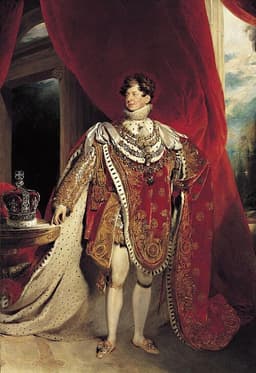
George IV of the United Kingdom
Emperor · Modern
41.1Total

Julius Caesar
General · Ancient
82.8Total
Basic Information
Born
1762
-100
Died
1830
-44
Era
Modern
Ancient
Nationality
United Kingdom
Roman Republic
Occupation
Emperor
General
Civilization
Western
Western
Score Comparison
Military (10%)
27.7
88.0
Political (20%)
27.9
78.0
Influence (20%)
50.2
85.0
Legacy (20%)
37.5
82.0
Leadership (15%)
41.5
80.0
Strategy (15%)
60.0
85.0
TOTAL
41.1
82.8
George IV of the United Kingdom — Complete Timeline
1788 AD
Regency Crisis of 1788Political Action◆ Major
When George III became temporarily insane, the Prince of Wales (future George IV) sought to become regent. The crisis ended when the king recovered, but it established a precedent for parliamentary control over regency.
RegencyCrisisSuccession
Impact: national
1811 AD
Appointed Prince RegentPolitical Action◆ Major
Following George III's final mental collapse, the Prince of Wales was formally appointed Prince Regent under the Regency Act 1811. He exercised royal powers for nine years while his father lived in seclusion.
RegencyGovernmentSuccession
Impact: national
Regency Era Patronage of the ArtsCultural◆ Major
As Prince Regent, George IV commissioned John Nash to design Regent Street, Regent's Park, and the Royal Pavilion in Brighton. His patronage defined the architectural and cultural style of the Regency period.
ArchitecturePatronageRegency
Impact: nationalconstructive
1820 AD
Accession as King George IVPolitical Action◆ Major
Upon George III's death, the Prince Regent became King George IV. His accession was marred by his attempt to divorce Queen Caroline, leading to a public scandal and the Pains and Penalties Bill of 1820.
AccessionScandalDivorce
Impact: national
1821 AD
State Visit to IrelandPolitical Action
George IV became the first British monarch to visit Ireland since the Acts of Union. The visit aimed to promote loyalty but was overshadowed by the ongoing Catholic Emancipation debate.
VisitIrelandUnion
Impact: national
1829 AD
Catholic Emancipation OppositionPolitical Action◆ Major
George IV reluctantly signed the Roman Catholic Relief Act 1829, granting Catholic Emancipation. He had opposed the measure but yielded to Prime Minister Wellington's threat of resignation.
Catholic EmancipationLegislationReligion
Impact: national
Julius Caesar — Complete Timeline
58 BC
Gallic WarsWar◆ Major
Caesar, as proconsul of Gaul, launched a series of campaigns that conquered all of Gaul (modern France, Belgium, and parts of Switzerland). He fought numerous battles, including against the Helvetii, the Belgae, and the Gallic chieftain Vercingetorix. The wars brought immense wealth and a loyal army to Caesar.
Gallic WarsConquestRoman Expansion
Impact: regional
49 BC
Crossing the RubiconPolitical Action◆ Major
Caesar led Legio XIII across the Rubicon River into Italy, defying the Roman Senate's order to disband his army. This act triggered a civil war against Pompey and the Optimates, ultimately leading to Caesar's dictatorship and the end of the Roman Republic.
Roman Civil WarEnd of RepublicPower Struggle
Impact: global
48 BC
Battle of PharsalusWar◆ Major
Caesar's outnumbered army defeated the larger forces of Pompey the Great at Pharsalus in Greece. Caesar's tactical use of a reserve line to counter Pompey's cavalry charge proved decisive. Pompey fled to Egypt, where he was assassinated, leaving Caesar as the undisputed master of the Roman world.
Roman Civil WarBattleDecisive Victory
Impact: regional
44 BC
Appointment as Dictator for LifePolitical Action◆ Major
The Roman Senate appointed Caesar dictator perpetuo (dictator for life), granting him unprecedented personal power. This move concentrated military, legislative, and judicial authority in one person, effectively ending the Roman Republic's traditional system of checks and balances and alarming many senators.
DictatorshipEnd of RepublicPower Consolidation
Impact: regionaldestructive
Assassination on the Ides of MarchPolitical Action◆ Major
A group of Roman senators, led by Marcus Junius Brutus and Gaius Cassius Longinus, stabbed Caesar to death at a meeting of the Senate in the Theatre of Pompey. The assassination was intended to restore the Republic, but instead triggered another civil war that led to the rise of the Roman Empire.
AssassinationRoman PoliticsEnd of Republic
Impact: globaldestructive
Expert Analysis
george-iv-of-the-united-kingdom-vs-julius-caesar
# The Emperor and the King: Two Faces of Western Power
On a January morning in 49 BCE, a Roman general stood at the banks of a small river in northern Italy. The Rubicon was little more than a stream, but crossing it with an army meant civil war—a direct challenge to the Roman Senate and the Republic itself. Julius Caesar paused, then reportedly said, "The die is cast," and marched his legions into history. Nearly two millennia later, in 1811, another man stepped into power under far different circumstances: George, Prince of Wales, became Regent of the United Kingdom as his father, George III, descended into madness. Where Caesar crossed a river to seize destiny, George IV inherited a crown by waiting for a king to lose his mind. These two figures, both Western leaders at moments of transition, could hardly have been more different—and their diverging paths reveal much about the forces that shape leadership.
Origins
Caesar was born into a patrician family that had fallen on hard times. His Rome was a republic tearing itself apart—a world of civil strife, slave revolts, and aristocratic competition. From his youth, he absorbed the brutal logic of ambition: in a state that rewarded military glory and political cunning, a man could rise only by taking risks. He fled Sulla's proscriptions, served as a priest of Jupiter, and learned early that survival required both charm and steel.
George IV, by contrast, was born a prince in a stable monarchy. His England was a global power at the height of the Industrial Revolution, ruled by a king who had lost the American colonies but held onto India. George's upbringing was one of privilege and suffocating expectation: his father, George III, was a strict, pious man who despised the prince's extravagance. Young George rebelled through excess—gambling, drinking, and secret marriages. Where Caesar sharpened himself on the whetstone of crisis, George dulled himself on pleasure.
Rise to Power
Caesar's ascent was a masterpiece of strategic calculation. He climbed the political ladder methodically—quaestor, aedile, praetor—but always with an eye on the ultimate prize. His governorship of Gaul from 58 to 50 BCE was a gamble that paid off spectacularly: he conquered a vast territory, built a loyal army, and amassed wealth that dwarfed his rivals. The Senate's attempt to strip his command triggered the Rubicon crossing. Caesar did not wait for power; he took it at swordpoint.
George IV's rise was a study in impatience and frustration. The Regency Crisis of 1788 erupted when George III's first bout of madness raised the prospect of the prince becoming regent. But the king recovered, and George was left waiting—a prince in his forties, still under his father's shadow. When the Regency finally came in 1811, it was a gift of biology, not ambition. George did not seize power; he received it as a caretaker, with limits imposed by Parliament and a nation wary of his reputation.
Leadership & Governance
Caesar ruled as a military genius and political reformer. His campaigns in Gaul, detailed in his own commentaries, demonstrated tactical brilliance—at Alesia, he besieged a Gallic army while simultaneously fending off a relief force, a feat of logistics and nerve. As dictator, he reformed the calendar, granted citizenship to provincials, and launched public works that transformed Rome. But his governance was autocratic: he centralized power, packed the Senate with loyalists, and accepted the title "dictator for life." His strategy was to remake the state in his image, and he nearly succeeded.
George IV, by contrast, was a figurehead in a constitutional monarchy. His military score of 45.0 reflects a king who never commanded an army; his influence, while real, was exercised through patronage and personal charm. As Prince Regent, he commissioned John Nash to design Regent Street and the Royal Pavilion in Brighton, leaving a legacy of architecture rather than conquest. Politically, he was a reactionary: he opposed Catholic Emancipation for decades, only reluctantly signing the Roman Catholic Relief Act in 1829. Where Caesar built a new order, George clung to an old one.
Triumph & Tragedy
Caesar's greatest triumph was his conquest of Gaul—a campaign that added a vast territory to Roman control and made him the most powerful man in the Republic. His tragedy was the Ides of March, 44 BCE, when senators—many of them his allies—stabbed him to death in the Senate chamber. He had centralized power so completely that his survival depended on his presence; the moment he fell, the Republic fell with him.
George IV's triumph was personal rather than political: his patronage of the arts shaped the Regency style that still defines British elegance. His tragedy was his marriage to Caroline of Brunswick, a union of mutual hatred that culminated in his attempt to divorce her upon his accession in 1820. The "trial" of Queen Caroline became a national scandal, exposing George's cruelty and hypocrisy. He won the legal battle, but lost the public's respect.
Character & Destiny
Caesar was driven by an insatiable hunger for glory—what the Romans called *gloria*—and a cold, calculating intelligence. He forgave enemies when it served him, but never forgot a slight. His personality was a weapon: he could charm, intimidate, and inspire in equal measure. This made him unstoppable, but it also made him a target. His destiny was to destroy the Republic he sought to save.
George IV was driven by appetite—for pleasure, for recognition, for love that he could never quite secure. He was intelligent but lazy, charming but unreliable. His personality was a burden: he alienated his family, betrayed his friends, and indulged himself at public expense. His destiny was to be remembered as a footnote in a century of giants.
Legacy
Caesar's legacy is immeasurable. The Roman Empire, the Latin language, the Western calendar—all bear his mark. His name became a title: *Kaiser* and *Tsar* derive from it. He is studied in military academies and debated in philosophy seminars. His total score of 83.3 reflects a man who shaped the course of history.
George IV's legacy is modest. He is remembered for his architecture, his scandals, and his role as a transitional figure between the Georgian and Victorian eras. His score of 61.2 places him as a minor monarch in a nation of great ones. He did not change the world; he simply lived in it.
Conclusion
Two men, two worlds. Caesar crossed the Rubicon; George IV crossed into middle age. One remade civilization; the other redecorated it. Yet both were products of their times: Caesar's Rome rewarded audacity and violence; George's Britain rewarded patience and conformity. The difference between them is not just personal—it is historical. In the end, Caesar's tragedy was that he lived too dangerously; George's tragedy was that he lived too safely. The die is cast, but the game changes with every age.
Rankings
🥇
Julius CaesarLeader
Mil: 88.0Pol: 78.0Inf: 85.0
82.8
🥈
George IV of the United Kingdom
Mil: 27.7Pol: 27.9Inf: 50.2
41.1
+41.7 behind
How This Comparison Works
Algorithm
Each figure is scored on 6 dimensions (0—100 scale) based on structured historical data: Military (10%), Political (20%), Influence (20%), Legacy (20%), Leadership (15%), Strategy (15%). The weighted total produces the final ranking.
Data Sources
Scores are computed from structured sub-indicators in the database. Scale factors adjust for era (Ancient ×0.85, Modern ×1.0) and civilization size (Eastern ×1.05, Other ×0.80) to account for differences in population and military scale.
Maximum 3 Figures
Comparisons are limited to 2—3 figures to ensure readability and statistical meaningfulness.
Error Margins
±5 points per dimension — Sub-scores are derived from historical records with inherent uncertainty. Two figures within 5 points on a dimension should be considered roughly equivalent in that area.
Total Score Accuracy
±3 points overall — The weighted combination of 6 dimensions produces a total score with approximately ±3 points of uncertainty. Differences of less than 3 points are not statistically significant— the figures are effectively tied.
Known Limitations
- Historical records are incomplete and uneven across civilizations
- Figures from oral-tradition societies may be underrepresented
- Occupation labels can misclassify multi-role figures
- Scores measure capability and impact, not moral character
- Quantitative scoring is a comparison tool, not absolute truth
Capability Radar
Military (10%) — Battles & Warfare
Battles
35
95
Win Rate
38
92
Expansion
41
97
Political (20%) — Governance & Reform
Reform
5
90
Diplomacy
15
85
Economy
10
82
Influence (20%) — Cultural & Global Reach
Cultural
30
88
Global
10
94
Legacy (20%) — Historical Impact
Historical
20
95
Longevity
15
96
Leadership (15%) — Power & Stability
Tenure
10
75
Stability
20
60
Strategy (15%) — Tactics & Innovation
Strategy
43
94
Tactics
50
96
Reform
49
88
Similar Comparisons
Comments & Discussion
RUBICON_SOUP6/17/2026
Caesar crossed a river with a single legion and changed history forever; George IV crossed a room with a glass of brandy and changed his waistcoat size. You can't compare a man who wrote his own commentaries to one who hired someone to write his letters. Caesar's Gallic Wars built an empire; George's regency built a seaside pavilion. One was a conqueror, the other a consumer.
帝国绊脚石6/17/2026
拿凯撒跟乔治四世比?前者从高卢一路杀回罗马,连元老院都抖三抖;后者呢,一辈子最大的仗就是跟老婆闹离婚,还输了。凯撒一天能处理三场战役,乔治一天能试三套礼服。罗马都快被凯撒改造成帝国了,英国呢,被乔治吃成了债务国。这叫对比?这叫侮辱。
CANTO_CURMUDGEON6/17/2026
As a classics scholar, I'm offended. Caesar was dictating the Gallic Wars AND seducing Cleopatra AND reforming the calendar simultaneously. George IV was... eating. Caesar wrote Latin that schoolboys still study; George commissioned a coronation that cost £240,000 while the poor starved. The only thing these two share is a fondness for gold leaf—Caesar on his triumphal chariot, George on his gilded chamber pot.
虚无打工人6/17/2026
说实话,俩都是权力的畸形产物。凯撒假装是为人民,结果当上终身独裁官;乔治假装爱艺术,实际只爱自己。但凯撒至少真打过仗、真改革过历法,乔治最大的改革是把摄政期酒税提高了三倍。一个死在元老院刀下,一个死在暴饮暴食床上。死法已经说明一切:凯撒是悲剧英雄,乔治是滑稽丑角。