Loading...
Gabriel Garcia Moreno vs Ismail Omar Guelleh
Ismail Omar Guelleh leads by 1.0 pts · 2 figures compared
…
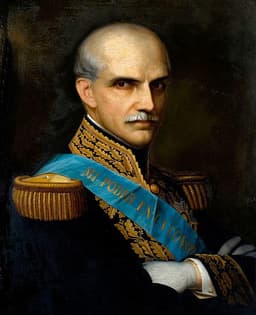
Gabriel Garcia Moreno
Politician · Modern
49.3Total

Ismail Omar Guelleh
Politician · Modern
50.3Total
Basic Information
Born
1821
1947
Died
1875
—
Era
Modern
Modern
Nationality
Ecuador
Djibouti
Occupation
Politician
Politician
Civilization
Western
Other
Score Comparison
Military (10%)
21.2
25.9
Political (20%)
62.7
55.0
Influence (20%)
54.9
52.5
Legacy (20%)
47.5
45.0
Leadership (15%)
53.2
75.0
Strategy (15%)
42.3
38.2
TOTAL
49.3
50.3
Gabriel Garcia Moreno — Complete Timeline
1861 AD
Modernization of InfrastructureReform
García Moreno initiated major infrastructure projects, including the construction of roads, bridges, and the Quito-Guayaquil railway. These projects aimed to integrate Ecuador's regions and boost economic development, though they were financed through heavy borrowing.
InfrastructureRailwayDevelopment
Impact: nationalconstructive
Presidency of EcuadorPolitical Action◆ Major
García Moreno was elected President of Ecuador in 1861, serving until 1865 and again from 1869 to 1875. His administrations were characterized by authoritarian rule, centralization of power, and a strong alliance with the Catholic Church.
PresidencyAuthoritarianismCatholicism
Impact: national
1862 AD
Concordat with the VaticanPolitical Action◆ Major
García Moreno signed a concordat with the Vatican in 1862, granting the Catholic Church control over education and religious affairs in Ecuador. This agreement strengthened church-state ties and made Ecuador a confessional state, aligning with his conservative ideology.
Church-State RelationsConcordatCatholicism
Impact: national
1869 AD
Suppression of Liberal OppositionPolitical Action◆ Major
After returning to power in 1869, Garc
RepressionAuthoritarianismConstitution
Impact: nationaldestructive
1875 AD
Assassination of Gabriel García MorenoPolitical Action
García Moreno was assassinated on August 6, 1875, on the steps of the presidential palace in Quito. His death was carried out by liberal opponents, ending his conservative regime and plunging Ecuador into a period of political instability.
AssassinationPolitical ViolenceEnd of Regime
Impact: nationaltragic
Ismail Omar Guelleh — Complete Timeline
1999 AD
Succeeded Hassan Gouled Aptidon as PresidentPolitical Action◆ Major
Guelleh became President of Djibouti after his uncle, Hassan Gouled Aptidon, stepped down. He won the election with 74% of the vote, continuing the family's political dominance.
PresidencyDjiboutiSuccession
Impact: national
2002 AD
Hosted U.S. Military Base in DjiboutiPolitical Action◆ Major
Guelleh allowed the United States to establish Camp Lemonnier, a major military base in Djibouti. This strengthened Djibouti's strategic importance and brought significant economic benefits.
Military BaseU.S.-Djibouti RelationsStrategic
Impact: globalconstructive
2010 AD
Amended Constitution to Extend Term LimitsPolitical Action◆ Major
Guelleh's government amended the constitution to remove presidential term limits. This allowed him to run for a third term, drawing criticism from opposition groups and international observers.
Constitutional AmendmentTerm LimitsAuthoritarianism
Impact: nationaldestructive
Expert Analysis
Origins
**Gabriel Garcia Moreno** was born in 1821 in Guayaquil, Ecuador, into a wealthy Spanish-descended family. He studied law at the University of Quito and later in Europe, where he was deeply influenced by Catholic social thought. His early career included journalism and politics, advocating for a conservative, theocratic state.
**Ismail Omar Guelleh** was born in 1947 in Dire Dawa, Ethiopia, into the Issa clan. He rose through the ranks of Djibouti's security services under his uncle, President Hassan Gouled Aptidon. Guelleh studied in France and became a key advisor, eventually succeeding his uncle in 1999. His background is rooted in clan politics and pragmatic governance.
Rise to Power
Moreno first became president of Ecuador in 1861 after a period of political instability. He consolidated power by suppressing liberal opposition with the help of the military. His second term began in 1869 after a coup, and he imposed a new constitution that centralized power and aligned Ecuador with the Vatican. His rise was marked by authoritarian methods and religious fervor.
Guelleh succeeded his uncle in 1999, winning 74% of the vote in an election criticized for irregularities. He consolidated power by balancing clan interests and leveraging Djibouti's strategic location. His rise was smooth, aided by his uncle's long rule and careful political maneuvering. Unlike Moreno, Guelleh's path to power was dynastic rather than revolutionary.
Leadership & Governance
Moreno governed Ecuador with a focus on Catholic values and modernization. He signed a concordat with the Vatican in 1862, giving the Church control over education. He invested in infrastructure, including roads and the Quito-Guayaquil railway. However, his rule was repressive: he censored the press, exiled opponents, and executed political enemies. His political score of 62.7 reflects his effectiveness, but his leadership score of 53.2 is tempered by authoritarianism.
Guelleh's governance is pragmatic and focused on economic development and strategic alliances. He allowed the U.S. to establish Camp Lemonnier, a major military base, bringing rent and aid. He also amended the constitution to remove term limits, enabling his extended rule. His leadership score of 75.0 is high, reflecting stability, but his strategy score of 38.2 indicates limited long-term planning beyond survival. He has maintained peace in a volatile region but with limited democratic freedoms.
Triumph & Tragedy
Moreno's triumphs include modernizing Ecuador's infrastructure and strengthening the Catholic Church's role. His greatest failure was his authoritarian suppression of dissent, which led to his assassination in 1875. He was shot on the steps of the presidential palace, a victim of the very polarization he fomented.
Guelleh's triumphs include securing Djibouti's strategic importance and economic growth through foreign base rents. His failures include entrenching a dynastic, authoritarian system and facing international criticism for human rights abuses. His legacy is marked by stability but at the cost of political freedom.
Character & Destiny
Moreno was a zealous Catholic who believed in a theocratic state. His rigid ideology led to uncompromising policies and ultimately his death. Historians view him as a fanatic who modernized Ecuador but destroyed his opposition. His personality shaped his fate: he was assassinated because of his intransigence.
Guelleh is a pragmatic survivor, skilled in clan politics and international diplomacy. His character is cautious and calculating, allowing him to maintain power for over two decades. His destiny is to be a stable autocrat in a volatile region, but his lack of grand vision limits his historical stature.
Legacy
Moreno is remembered as a controversial figure: a modernizer and Catholic champion by some, a tyrant by others. His concordat shaped Ecuador until the 20th century, and his infrastructure projects endure. However, his legacy score of 47.5 reflects the mixed views.
Guelleh's legacy is still unfolding. He has made Djibouti a key strategic player but at the cost of democracy. His influence score of 52.5 reflects his regional importance, but his long-term impact is uncertain. He leaves behind a system reliant on foreign bases and clan loyalty.
Conclusion
Ismail Omar Guelleh scores higher overall (50.3 vs. 49.3), but the margin is narrow. Moreno's impact on Ecuador was more transformative, albeit negative in many ways. Guelleh's stability and strategic acumen have kept Djibouti afloat, but his achievements are less revolutionary. In terms of lasting global influence, Guelleh's role in hosting U.S. forces gives him a broader geopolitical footprint. However, for sheer historical impact on his nation's trajectory, Moreno's changes were more profound. The verdict: Guelleh edges out Moreno due to his higher leadership and sustained influence, but both are relatively minor figures in global history.
Rankings
🥇
Ismail Omar GuellehLeader
Mil: 25.9Pol: 55.0Inf: 52.5
50.3
🥈
Gabriel Garcia Moreno
Mil: 21.2Pol: 62.7Inf: 54.9
49.3
+1.0 behind
How This Comparison Works
Algorithm
Each figure is scored on 6 dimensions (0—100 scale) based on structured historical data: Military (10%), Political (20%), Influence (20%), Legacy (20%), Leadership (15%), Strategy (15%). The weighted total produces the final ranking.
Data Sources
Scores are computed from structured sub-indicators in the database. Scale factors adjust for era (Ancient ×0.85, Modern ×1.0) and civilization size (Eastern ×1.05, Other ×0.80) to account for differences in population and military scale.
Maximum 3 Figures
Comparisons are limited to 2—3 figures to ensure readability and statistical meaningfulness.
Error Margins
±5 points per dimension — Sub-scores are derived from historical records with inherent uncertainty. Two figures within 5 points on a dimension should be considered roughly equivalent in that area.
Total Score Accuracy
±3 points overall — The weighted combination of 6 dimensions produces a total score with approximately ±3 points of uncertainty. Differences of less than 3 points are not statistically significant— the figures are effectively tied.
Known Limitations
- Historical records are incomplete and uneven across civilizations
- Figures from oral-tradition societies may be underrepresented
- Occupation labels can misclassify multi-role figures
- Scores measure capability and impact, not moral character
- Quantitative scoring is a comparison tool, not absolute truth
Capability Radar
Military (10%) — Battles & Warfare
Battles
20
19
Win Rate
25
27
Expansion
15
25
Political (20%) — Governance & Reform
Reform
70
60
Diplomacy
40
75
Economy
60
65
Influence (20%) — Cultural & Global Reach
Cultural
40
20
Global
30
35
Legacy (20%) — Historical Impact
Historical
50
30
Longevity
35
40
Leadership (15%) — Power & Stability
Tenure
55
85
Stability
45
80
Strategy (15%) — Tactics & Innovation
Strategy
20
31
Tactics
15
36
Reform
30
39
Similar Comparisons
Comments & Discussion
No comments yet. Be the first to share your thoughts!