Loading...
Gabriel Boric vs Napoleon Bonaparte
Napoleon Bonaparte leads by 17.7 pts · 2 figures compared
…
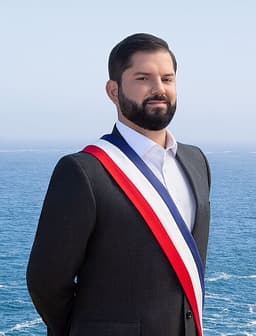
Gabriel Boric
Politician · Modern
53.2Total

Napoleon Bonaparte
General · Modern
70.9Total
Basic Information
Born
1986
1769
Died
—
1821
Era
Modern
Modern
Nationality
Chile
France
Occupation
Politician
General
Civilization
Western
Western
Score Comparison
Military (10%)
48.9
94.0
Political (20%)
68.0
72.0
Influence (20%)
54.1
40.0
Legacy (20%)
41.7
80.0
Leadership (15%)
65.0
78.0
Strategy (15%)
43.6
90.0
TOTAL
53.2
70.9
Gabriel Boric — Complete Timeline
2011 AD
Led 2011 Chilean student protestsPolitical Action◆ Major
As president of the University of Chile Student Federation, Boric co-led months-long nationwide protests demanding free, high-quality public education. The movement forced President Pinera to propose education reforms and made Boric a national political figure.
Student ProtestEducation ReformSocial Movement
Impact: nationalprogressive
2014 AD
Elected to Chamber of DeputiesPolitical Action
Boric was elected to the Chilean Chamber of Deputies representing the Magallanes Region as an independent leftist candidate. He was the youngest deputy at age 27 and quickly became a leading voice for progressive causes.
ElectionCongressPolitical Career
Impact: nationalconstructive
2021 AD
Elected President of ChilePolitical Action◆ Major
Boric won the 2021 Chilean presidential election runoff against Jos
ElectionPresidencyLeft-Wing Victory
Impact: nationalprogressive
2022 AD
Rejected first constitutional draftPolitical Action◆ Major
In September 2022, Chilean voters overwhelmingly rejected the proposed new constitution drafted by a convention dominated by left-wing forces. The defeat was a major setback for Boric's reform agenda and forced him to moderate his government.
Constitutional ReferendumPolitical DefeatReform
Impact: nationaldestructive
Napoleon Bonaparte — Complete Timeline
1799 AD
Coup of 18 BrumaireOther◆ Major
Napoleon Bonaparte, with support from his brother Lucien and key political figures, overthrew the Directory in a bloodless coup. He established the Consulate with himself as First Consul, effectively becoming the ruler of France. This event ended the French Revolution's most unstable period.
French RevolutionCoupRise to Power
Impact: regional
1804 AD
Promulgation of the Napoleonic CodeOther◆ Major
Napoleon enacted the Civil Code of the French, known as the Napoleonic Code, a comprehensive set of laws that replaced the fragmented feudal legal systems. The code established legal equality, protected property rights, and secularized law. It became the basis for legal systems in many European and world countries.
Legal ReformNapoleonic CodeCivil Law
Impact: globalconstructive
1805 AD
Battle of AusterlitzWar◆ Major
Napoleon's Grande Arm
Napoleonic WarsBattleDecisive Victory
Impact: global
1812 AD
Invasion of RussiaWar◆ Major
Napoleon led the Grande Arm
Napoleonic WarsInvasionDisaster
Impact: globaldestructive
1815 AD
Battle of WaterlooWar◆ Major
Napoleon's French army was defeated by the combined forces of the Duke of Wellington's Anglo-Allied army and Gebhard Leberecht von Bl
Napoleonic WarsBattleFinal Defeat
Impact: globaldestructive
Expert Analysis
gabriel-boric-vs-napoleon-bonaparte
# The Emperor and the Student: Two Paths to Power in Different Centuries
On a December morning in 1804, Napoleon Bonaparte placed a crown upon his own head in Notre-Dame Cathedral, signaling to the world that he answered to no one—not the Pope, not the old monarchies of Europe, not even history itself. Two hundred and seventeen years later, on a March afternoon in 2022, Gabriel Boric stood before the Chilean Congress, a young man with an open collar and an unshaven face, sworn in as the youngest president in his nation’s history. Both men seized power through sheer will. But while one built an empire that stretched from Madrid to Moscow, the other inherited a country exhausted by its own contradictions. What separates a conqueror from a reformer? The answer lies not merely in talent, but in the world each was born into—and the world each chose to make.
Origins
Napoleon Bonaparte was born in 1769 on the island of Corsica, a land that had only recently become French. His family was minor nobility, but in the rigid hierarchy of pre-revolutionary France, that meant little. He was short, intense, and spoke French with an Italian accent that invited mockery from his classmates at military school. Yet those same classmates would later kneel before him. The French Revolution, which erupted when he was twenty, tore down every barrier that might have held him back. In the chaos of the 1790s, a brilliant artillery officer could rise faster than any nobleman ever could.
Gabriel Boric was born in 1986 in Punta Arenas, a windswept city at the southern tip of Chile. His family was middle-class, his grandfather a Croatian immigrant who had built a modest life in Patagonia. Boric grew up under the shadow of Augusto Pinochet’s dictatorship, which had ended only a year before his birth. Chile’s transition to democracy was fragile, its constitution still a relic of the military regime. Where Napoleon had been forged in the fire of revolution, Boric was shaped by the slow, grinding work of rebuilding institutions.
Rise to Power
Napoleon’s ascent was a series of explosions. In 1793, at the age of twenty-four, he drove the British out of Toulon and was promoted to brigadier general. In 1795, he saved the revolutionary government from a royalist uprising with a “whiff of grapeshot”—cannon fire into a Parisian crowd. By 1799, he was First Consul, the de facto ruler of France. Every step was marked by violence, risk, and a cold calculation that other men lacked. He did not wait for opportunity; he seized it.
Boric’s rise was slower, more deliberate, and utterly different in character. In 2011, at the age of twenty-five, he emerged as a leader of Chile’s student protests, the largest mass demonstrations since the end of the dictatorship. Hundreds of thousands of young Chileans took to the streets demanding free education, an end to the privatized system that burdened families with debt. Boric was not a military commander but a negotiator, a voice for a generation that felt betrayed by the post-Pinochet settlement. He was elected to Congress in 2014, and in 2021, at age thirty-five, he won the presidency by defeating a far-right opponent who promised to restore order. Napoleon had taken power by coup; Boric took it by ballot.
Leadership & Governance
As emperor, Napoleon governed with the precision of a military campaign. He centralized the state, established the Napoleonic Code—a legal framework that influenced civil law across Europe—and created a system of meritocratic promotion. He built roads, reformed education, and made peace with the Catholic Church. But he also suppressed dissent, censored the press, and crowned himself emperor in 1804. His genius lay in organization and speed; his weakness was an inability to stop.
Boric governs in a very different key. He presides over a coalition of leftist and centrist parties, a fragile alliance that requires constant negotiation. His first major test came in September 2022, when Chilean voters overwhelmingly rejected a proposed new constitution drafted by a convention dominated by his allies. The defeat was devastating. Boric did not respond by tightening his grip. Instead, he reshuffled his cabinet, acknowledged the failure, and began again. Where Napoleon commanded, Boric persuades. Where Napoleon imposed order, Boric navigates chaos.
Triumph & Tragedy
Napoleon’s greatest triumph was the Battle of Austerlitz in 1805, where he crushed the combined armies of Russia and Austria. It was a masterpiece of strategy—feinting weakness, luring the enemy into a trap, then striking with overwhelming force. His greatest tragedy was the invasion of Russia in 1812. He marched 600,000 men into the vastness of the Russian winter; fewer than 100,000 returned. The disaster broke his aura of invincibility and set the stage for his final defeat at Waterloo in 1815.
Boric’s triumph is more modest but no less real: he led a generation of students into the political arena and forced a nation to confront its inequalities. His tragedy is the weight of expectation. The 2022 constitutional rejection revealed the limits of his mandate. He promised transformation, but Chile’s institutions are stubborn, its economy fragile, its society polarized. He cannot conquer these problems; he can only try to manage them.
Character & Destiny
Napoleon was driven by an insatiable hunger for glory. “I am not an ordinary man,” he once declared, and he proved it by rewriting the map of Europe. His character was a paradox: a tireless worker who could read reports for hours, a romantic who wrote love letters to Josephine, a tyrant who believed he was bringing liberty to the peoples he conquered. In the end, his ambition consumed him. He died in exile on Saint Helena in 1821, a prisoner of the British, his empire reduced to memory.
Boric is driven by a different fire. He is a product of the post-dictatorship generation, a man who believes in democracy not as a tactic but as a principle. He is introspective, sometimes hesitant, prone to self-doubt. Where Napoleon saw the world as a chessboard, Boric sees it as a conversation. Whether this makes him weaker or wiser is a question only history will answer.
Legacy
Napoleon left behind a transformed Europe. The Napoleonic Code remains the basis of civil law in dozens of countries. He dismantled the Holy Roman Empire, spread nationalism, and inspired both admiration and fear for centuries. His legacy is contested—some see him as a liberator, others as a precursor to modern dictators. But no one denies his impact.
Boric’s legacy is still being written. He is young, and his presidency may last only one term. But he represents something new: a leader who rose not through war but through protest, who governs not by decree but by coalition. His challenge is to prove that democracy can still deliver change in an age of cynicism.
Conclusion
Napoleon and Boric are separated by more than two centuries. One conquered continents; the other struggles to reform a single country. One died in exile; the other may yet shape his nation’s future. Yet both were outsiders who rose by channeling the energy of their times—Napoleon the energy of revolution, Boric the energy of a generation that refused to accept the world it inherited. The difference between them is not talent but terrain. Napoleon marched across open fields; Boric navigates a landscape of institutions, laws, and votes. The emperor built an empire of steel and blood. The student is trying to build one of paper and patience. Which one lasts longer? That is the question each of us must answer.
Rankings
🥇
Napoleon BonaparteLeader
Mil: 94.0Pol: 72.0Inf: 40.0
70.9
🥈
Gabriel Boric
Mil: 48.9Pol: 68.0Inf: 54.1
53.2
+17.7 behind
How This Comparison Works
Algorithm
Each figure is scored on 6 dimensions (0—100 scale) based on structured historical data: Military (10%), Political (20%), Influence (20%), Legacy (20%), Leadership (15%), Strategy (15%). The weighted total produces the final ranking.
Data Sources
Scores are computed from structured sub-indicators in the database. Scale factors adjust for era (Ancient ×0.85, Modern ×1.0) and civilization size (Eastern ×1.05, Other ×0.80) to account for differences in population and military scale.
Maximum 3 Figures
Comparisons are limited to 2—3 figures to ensure readability and statistical meaningfulness.
Error Margins
±5 points per dimension — Sub-scores are derived from historical records with inherent uncertainty. Two figures within 5 points on a dimension should be considered roughly equivalent in that area.
Total Score Accuracy
±3 points overall — The weighted combination of 6 dimensions produces a total score with approximately ±3 points of uncertainty. Differences of less than 3 points are not statistically significant— the figures are effectively tied.
Known Limitations
- Historical records are incomplete and uneven across civilizations
- Figures from oral-tradition societies may be underrepresented
- Occupation labels can misclassify multi-role figures
- Scores measure capability and impact, not moral character
- Quantitative scoring is a comparison tool, not absolute truth
Capability Radar
Military (10%) — Battles & Warfare
Battles
31
95
Win Rate
34
90
Expansion
32
95
Political (20%) — Governance & Reform
Reform
55
95
Diplomacy
50
80
Economy
45
85
Influence (20%) — Cultural & Global Reach
Cultural
35
85
Global
30
90
Legacy (20%) — Historical Impact
Historical
30
95
Longevity
20
90
Leadership (15%) — Power & Stability
Tenure
40
85
Stability
40
70
Strategy (15%) — Tactics & Innovation
Strategy
37
95
Tactics
43
98
Reform
46
92
Similar Comparisons
Comments & Discussion
No comments yet. Be the first to share your thoughts!