Loading...
Frederick William II of Prussia vs Umberto I
Frederick William II of Prussia leads by 0.6 pts · 2 figures compared
…
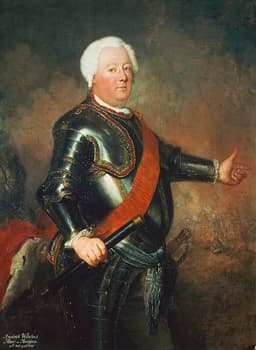
Frederick William II of Prussia
Emperor · Modern
47.2Total

Umberto I
Emperor · Modern
46.6Total
Basic Information
Born
1744
1844
Died
1797
1900
Era
Modern
Modern
Nationality
Prussia
Italy
Occupation
Emperor
Emperor
Civilization
Western
Western
Score Comparison
Military (10%)
50.0
22.6
Political (20%)
39.4
68.0
Influence (20%)
51.0
54.1
Legacy (20%)
39.2
42.5
Leadership (15%)
65.0
40.0
Strategy (15%)
39.6
39.6
TOTAL
47.2
46.6
Frederick William II of Prussia — Complete Timeline
1790 AD
Patronage of Mozart and BeethovenCultural
Frederick William II was a noted patron of music. He was a cellist and commissioned works from Wolfgang Amadeus Mozart, including the 'Prussian Quartets', and from Ludwig van Beethoven, who dedicated his Cello Sonatas Op. 5 to him. His court in Berlin became a center for classical music.
PrussiaMusicMozartBeethovenPatronage
Impact: nationalconstructive
1792 AD
War of the First CoalitionWar◆ Major
Frederick William II led Prussia into the War of the First Coalition against Revolutionary France. The Prussian army was defeated at the Battle of Valmy in 1792, a major symbolic victory for the French Revolution. Prussia withdrew from the coalition in 1795 with the Treaty of Basel, recognizing French gains.
PrussiaFrench RevolutionWarValmy
Impact: globaldestructive
1793 AD
Partition of PolandWar◆ Major
Frederick William II participated in the Second Partition of Poland, acquiring the cities of Danzig and Thorn and the region of South Prussia. This expanded Prussian territory significantly but also brought a large Polish population under Prussian rule, creating long-term ethnic and political tensions.
PrussiaPolandPartitionTerritory
Impact: regionaldestructive
1794 AD
Promulgation of the Prussian General State LawsReform◆ Major
Frederick William II oversaw the completion and promulgation of the Allgemeines Landrecht (General State Laws) for the Prussian States. This comprehensive legal code, begun under Frederick the Great, codified civil, criminal, and constitutional law, unifying the legal system across Prussia's diverse territories.
PrussiaLawCodeReform
Impact: nationalconstructive
Umberto I — Complete Timeline
1882 AD
Triple Alliance RenewalPolitical Action◆ Major
Umberto I oversaw Italy's entry into the Triple Alliance with Germany and Austria-Hungary. This defensive alliance aligned Italy with the Central Powers, shaping its foreign policy until World War I. The alliance was renewed several times during his reign.
AllianceForeign PolicyCentral Powers
Impact: global
1895 AD
First Italo-Ethiopian WarWar◆ Major
Umberto I's government launched a colonial war against Ethiopia. The Italian army suffered a decisive defeat at the Battle of Adwa in 1896, forcing Italy to recognize Ethiopian independence. The defeat caused a political crisis and the fall of Prime Minister Crispi.
Colonial WarDefeatAdwa
Impact: regionaldestructive
1898 AD
Bava-Beccaris MassacrePolitical Action◆ Major
During bread riots in Milan, General Fiorenzo Bava-Beccaris ordered troops to fire on protesters, killing dozens and wounding hundreds. Umberto I publicly praised the general and awarded him a medal, which intensified public anger and contributed to the king's assassination.
RepressionCivil UnrestMonarchy
Impact: nationaldestructive
1900 AD
Assassination of Umberto IPolitical Action◆ Major
Umberto I was shot and killed by anarchist Gaetano Bresci in Monza. Bresci acted in protest of the Bava-Beccaris massacre and the king's support for repressive measures. The assassination ended Umberto's reign and brought Victor Emmanuel III to the throne.
AssassinationAnarchismMonarchy
Impact: nationaltragic
Expert Analysis
Origins
Frederick William II of Prussia was born in 1744 in Berlin, the son of Prince Augustus William and Louise of Brunswick-Wolfenbüttel. He was the nephew of Frederick the Great and received a military education, though his interests leaned toward music and mysticism. His early life was overshadowed by his uncle's dominance. Umberto I of Italy was born in 1844 in Turin, the son of King Victor Emmanuel II and Adelaide of Austria. He was educated in military and political affairs, groomed for kingship. His upbringing was shaped by the Risorgimento and the unification of Italy, which his father helped achieve.
Rise to Power
Frederick William II ascended the Prussian throne in 1786 upon the death of Frederick the Great. He inherited a powerful state but lacked his predecessor's military genius. His early reign saw the completion of the Prussian General State Laws (Allgemeines Landrecht) in 1794, a comprehensive legal code. He also continued cultural patronage, commissioning works from Mozart and Beethoven. Umberto I became King of Italy in 1878 after his father's death. He had served in the military during the unification wars and was seen as a symbol of national unity. His reign began with the Triple Alliance renewal (1882), aligning Italy with Germany and Austria-Hungary.
Leadership & Governance
Frederick William II's governance was marked by conservative religious policies and centralization. He promoted the Prussian General State Laws, which unified legal systems across Prussian territories. However, his military leadership was poor; he led Prussia into the War of the First Coalition (1792-1797) against Revolutionary France, resulting in defeat at the Battle of Valmy (1792) and the Peace of Basel (1795) where Prussia withdrew and ceded territories. Umberto I's leadership was characterized by authoritarianism and colonial ambition. He supported the Bava-Beccaris massacre (1898) where troops fired on protesters, killing dozens. His government launched the First Italo-Ethiopian War (1895-1896), ending in the disastrous Battle of Adwa (1896), Italy's worst colonial defeat. Umberto I's political score of 68.0 reflects his ability to maintain alliances, but his military score of 22.6 shows his strategic failures.
Triumph & Tragedy
Frederick William II's greatest triumph was the promulgation of the Prussian General State Laws, which created a unified legal framework and influenced later German law. His patronage of Mozart and Beethoven enriched cultural history. His greatest tragedy was the War of the First Coalition, where his military score of 50.0 and strategy score of 39.6 indicate poor decision-making. The Peace of Basel lost Prussian influence in the Rhineland. Umberto I's triumph was overseeing Italy's entry into the Triple Alliance, which secured international standing. His tragedy was the Adwa defeat, which caused a political crisis and ended Italian colonial expansion in East Africa. His assassination in 1900 by anarchist Gaetano Bresci, in protest of the Bava-Beccaris massacre, marked a violent end to his reign.
Character & Destiny
Frederick William II was a patron of the arts and a mystic, interested in Rosicrucianism. His character was indecisive and easily influenced by advisors, leading to inconsistent policies. His destiny was to be overshadowed by his uncle Frederick the Great and his son Frederick William III. He scored 65.0 in leadership but 39.4 in political acumen. Umberto I was conservative and authoritarian, believing in strong monarchy. His support for repressive measures alienated the public. His destiny was sealed by the anarchist movement; his assassination was a direct result of his policies. He scored 40.0 in leadership and 68.0 in politics, indicating political skill but poor judgment in social matters.
Legacy
Frederick William II's legacy is mixed: the General State Laws remained in effect until the 20th century, and his cultural patronage is remembered. However, his military failures weakened Prussia temporarily. His influence score of 51.0 reflects moderate impact. Umberto I's legacy is tarnished by the Bava-Beccaris massacre and the Adwa defeat. His assassination highlighted the tensions of the era. The Triple Alliance continued until World War I, but Italy later switched sides. His legacy score of 42.5 is lower due to these failures.
Conclusion
Frederick William II of Prussia had a greater impact than Umberto I, with a total score of 47.2 against 46.6. His legal reforms and cultural patronage had lasting effects, while Umberto I's reign was marked by repression and colonial disaster. Although both were flawed rulers, Frederick William II's contributions to law and music endure, whereas Umberto I's legacy is largely negative. The 0.6 point gap reflects this difference, with Frederick William II's leadership and influence outweighing Umberto I's political maneuvering.
Rankings
🥇
Frederick William II of PrussiaLeader
Mil: 50.0Pol: 39.4Inf: 51.0
47.2
🥈
Umberto I
Mil: 22.6Pol: 68.0Inf: 54.1
46.6
+0.6 behind
How This Comparison Works
Algorithm
Each figure is scored on 6 dimensions (0—100 scale) based on structured historical data: Military (10%), Political (20%), Influence (20%), Legacy (20%), Leadership (15%), Strategy (15%). The weighted total produces the final ranking.
Data Sources
Scores are computed from structured sub-indicators in the database. Scale factors adjust for era (Ancient ×0.85, Modern ×1.0) and civilization size (Eastern ×1.05, Other ×0.80) to account for differences in population and military scale.
Maximum 3 Figures
Comparisons are limited to 2—3 figures to ensure readability and statistical meaningfulness.
Error Margins
±5 points per dimension — Sub-scores are derived from historical records with inherent uncertainty. Two figures within 5 points on a dimension should be considered roughly equivalent in that area.
Total Score Accuracy
±3 points overall — The weighted combination of 6 dimensions produces a total score with approximately ±3 points of uncertainty. Differences of less than 3 points are not statistically significant— the figures are effectively tied.
Known Limitations
- Historical records are incomplete and uneven across civilizations
- Figures from oral-tradition societies may be underrepresented
- Occupation labels can misclassify multi-role figures
- Scores measure capability and impact, not moral character
- Quantitative scoring is a comparison tool, not absolute truth
Capability Radar
Military (10%) — Battles & Warfare
Battles
20
10
Win Rate
15
10
Expansion
10
15
Political (20%) — Governance & Reform
Reform
20
40
Diplomacy
30
50
Economy
25
45
Influence (20%) — Cultural & Global Reach
Cultural
30
30
Global
15
25
Legacy (20%) — Historical Impact
Historical
25
35
Longevity
20
20
Leadership (15%) — Power & Stability
Tenure
60
60
Stability
20
35
Strategy (15%) — Tactics & Innovation
Strategy
10
10
Tactics
10
10
Reform
5
20
Similar Comparisons
Alfonso XIII vs Frederick William II of PrussiaFrederick William II of Prussia vs YambioFerdinand I of Bulgaria vs Frederick William II of PrussiaCheoljong of Joseon vs Frederick William II of PrussiaFrederick William II of Prussia vs George Tupou IFrederick William II of Prussia vs Napoleon Bonaparte
Comments & Discussion
No comments yet. Be the first to share your thoughts!