Loading...
Ferdinand I of Bulgaria vs Frederick William II of Prussia
Ferdinand I of Bulgaria leads by 5.4 pts · 2 figures compared
…

Ferdinand I of Bulgaria
Emperor · Modern
52.6Total
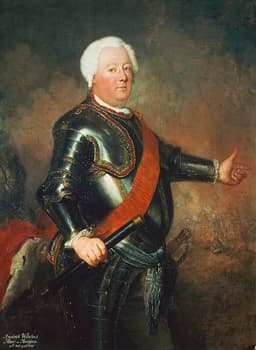
Frederick William II of Prussia
Emperor · Modern
47.2Total
Basic Information
Born
1861
1744
Died
1948
1797
Era
Modern
Modern
Nationality
Bulgaria
Prussia
Occupation
Emperor
Emperor
Civilization
Western
Western
Score Comparison
Military (10%)
20.0
50.0
Political (20%)
62.7
39.4
Influence (20%)
55.7
51.0
Legacy (20%)
44.2
39.2
Leadership (15%)
68.0
65.0
Strategy (15%)
60.0
39.6
TOTAL
52.6
47.2
Ferdinand I of Bulgaria — Complete Timeline
1908 AD
Proclamation of Bulgarian IndependencePolitical Action
Ferdinand I proclaimed Bulgaria's full independence from the Ottoman Empire, declaring himself Tsar. This ended Ottoman suzerainty and established Bulgaria as a sovereign kingdom.
IndependenceOttoman EmpireSovereignty
Impact: nationalconstructive
1912 AD
First Balkan WarWar◆ Major
Ferdinand I led Bulgaria into the First Balkan War against the Ottoman Empire. Bulgaria achieved major victories, capturing Adrianople and much of Thrace, significantly expanding its territory.
Balkan WarsTerritorial ExpansionThrace
Impact: regional
1913 AD
Second Balkan WarWar◆ Major
Ferdinand I ordered an attack on former allies Serbia and Greece, triggering the Second Balkan War. Bulgaria was defeated by a coalition including Romania and the Ottoman Empire, losing most of its gains.
Balkan WarsDefeatTerritorial Loss
Impact: regionaldestructive
1918 AD
Abdication after WWIPolitical Action◆ Major
After Bulgaria's defeat in World War I, Ferdinand I abdicated in favor of his son Boris III. He went into exile, ending his reign amid national crisis and territorial losses.
AbdicationWorld War IExile
Impact: nationaltragic
Frederick William II of Prussia — Complete Timeline
1790 AD
Patronage of Mozart and BeethovenCultural
Frederick William II was a noted patron of music. He was a cellist and commissioned works from Wolfgang Amadeus Mozart, including the 'Prussian Quartets', and from Ludwig van Beethoven, who dedicated his Cello Sonatas Op. 5 to him. His court in Berlin became a center for classical music.
PrussiaMusicMozartBeethovenPatronage
Impact: nationalconstructive
1792 AD
War of the First CoalitionWar◆ Major
Frederick William II led Prussia into the War of the First Coalition against Revolutionary France. The Prussian army was defeated at the Battle of Valmy in 1792, a major symbolic victory for the French Revolution. Prussia withdrew from the coalition in 1795 with the Treaty of Basel, recognizing French gains.
PrussiaFrench RevolutionWarValmy
Impact: globaldestructive
1793 AD
Partition of PolandWar◆ Major
Frederick William II participated in the Second Partition of Poland, acquiring the cities of Danzig and Thorn and the region of South Prussia. This expanded Prussian territory significantly but also brought a large Polish population under Prussian rule, creating long-term ethnic and political tensions.
PrussiaPolandPartitionTerritory
Impact: regionaldestructive
1794 AD
Promulgation of the Prussian General State LawsReform◆ Major
Frederick William II oversaw the completion and promulgation of the Allgemeines Landrecht (General State Laws) for the Prussian States. This comprehensive legal code, begun under Frederick the Great, codified civil, criminal, and constitutional law, unifying the legal system across Prussia's diverse territories.
PrussiaLawCodeReform
Impact: nationalconstructive
Expert Analysis
Origins
Ferdinand I of Bulgaria was born on February 26, 1861, in Vienna, Austria, into the House of Saxe-Coburg and Gotha, a German princely family. He was the son of Prince August of Saxe-Coburg and Gotha and Princess Clémentine of Orléans, daughter of King Louis-Philippe of France. Ferdinand was educated in Vienna and later in various European courts, developing a cosmopolitan outlook. He was elected Prince of Bulgaria in 1887 after the abdication of Prince Alexander Battenberg, largely due to Russian opposition to other candidates. His Catholic faith initially caused tensions in Orthodox Bulgaria.
Frederick William II was born on September 25, 1744, in Berlin, Prussia, the son of Prince Augustus William of Prussia and Duchess Louise Amalie of Brunswick-Wolfenbüttel. He was a nephew of Frederick the Great. His early education emphasized military training and Enlightenment philosophy, but he lacked the discipline of his uncle. He became heir to the throne after his father's death in 1758 and ascended the throne in 1786 upon Frederick the Great's death.
Rise to Power
Ferdinand's rise to power began with his election as Prince of Bulgaria on July 7, 1887, after the previous prince was forced to abdicate. He faced initial hostility from Russia, which refused to recognize him, and he had to navigate between Austro-Hungarian and Russian interests. He consolidated his rule by modernizing the Bulgarian army and infrastructure. In 1908, he proclaimed Bulgaria's full independence from the Ottoman Empire, declaring himself Tsar, a turning point that scored him 62.7 in political acumen. This act ended Ottoman suzerainty and elevated Bulgaria's status.
Frederick William II became king on August 17, 1786, inheriting a powerful Prussia built by Frederick the Great. He initially continued his uncle's policies but soon reversed key reforms, such as dismantling the tobacco monopoly and reducing military efficiency. His reign saw the first partition of Poland in 1793, where he acquired Danzig and Thorn, expanding Prussian territory. However, his leadership in the War of the First Coalition (1792-1797) against Revolutionary France was marked by indecision and defeat, notably at the Battle of Valmy in 1792.
Leadership & Governance
Ferdinand I ruled Bulgaria with an iron hand, centralizing power and suppressing political opposition. He modernized the economy and military, but his autocratic style alienated many. He led Bulgaria into the First Balkan War (1912-1913) against the Ottoman Empire, achieving major victories and capturing Adrianople. However, his decision to attack former allies Serbia and Greece in the Second Balkan War (1913) was a strategic miscalculation, leading to defeat and loss of territory. His governance scored 68.0 in leadership, but his military score was only 20.0 due to these failures.
Frederick William II's governance was characterized by a relaxation of Frederick the Great's strict administrative standards. He issued the Prussian General State Laws (Allgemeines Landrecht) in 1794, a comprehensive legal code that standardized laws across Prussia, scoring him 39.4 in political effectiveness. However, he was heavily influenced by mistresses and religious mystics, leading to inefficient administration. His military score of 50.0 reflects mixed results: territorial gains in Poland but defeats in the West.
Triumph & Tragedy
Ferdinand's greatest triumph was the proclamation of Bulgarian independence in 1908, which ended Ottoman suzerainty and made Bulgaria a sovereign kingdom. Under his leadership, Bulgaria achieved significant territorial gains in the First Balkan War, expanding to the Aegean Sea. His greatest tragedy was the Second Balkan War, where Bulgaria was defeated by a coalition of former allies, Romania, and the Ottoman Empire, losing much of its conquests. He also led Bulgaria into World War I on the side of the Central Powers, resulting in defeat, abdication in 1918, and exile.
Frederick William II's greatest triumph was the Second Partition of Poland in 1793, which added valuable territories to Prussia. His patronage of music, including commissioning Mozart's "Prussian Quartets" and supporting Beethoven, scored high in cultural influence (51.0). His greatest tragedy was the disastrous war against France, where Prussian forces were humiliated at Valmy and later at the Battle of Jena-Auerstedt (though after his death). The war drained Prussian resources and exposed military weaknesses.
Character & Destiny
Ferdinand I was ambitious, cunning, and ruthless. He was known for his diplomatic maneuvering and desire to make Bulgaria a major Balkan power. However, his overconfidence and poor strategic judgment led to repeated failures. His character shaped his destiny: his ambition drove Bulgaria's expansion but also its downfall. Historians often view him as a capable but flawed leader, with a legacy scored at 44.2.
Frederick William II was indecisive, pleasure-seeking, and easily influenced. He lacked the military and administrative genius of his uncle. His character led to a decline in Prussian efficiency and military readiness. His patronage of arts was commendable, but his governance failures set the stage for Prussia's later defeat by Napoleon. His legacy score of 39.2 reflects his mixed impact.
Legacy
Ferdinand I's legacy is complex. He is remembered for achieving Bulgarian independence and territorial expansion, but also for the national catastrophe of the Second Balkan War and World War I. His actions shaped Bulgaria's modern borders and national identity. The score of 44.2 in legacy reflects his mixed impact: he established Bulgaria as a sovereign state but also led it into ruin.
Frederick William II's legacy is primarily cultural: his support for music enriched European heritage. The Prussian General State Laws influenced later German legal systems. However, his military and political failures weakened Prussia, allowing Revolutionary France to dominate. His legacy score of 39.2 reflects limited lasting impact.
Conclusion
Ferdinand I of Bulgaria had a greater impact than Frederick William II of Prussia. With a total score of 52.6 versus 47.2, Ferdinand's actions reshaped the Balkans, achieving independence and major territorial changes. While both had failures, Ferdinand's decisions had more significant and lasting consequences for Bulgaria and the region. Frederick William II, despite cultural contributions, presided over a period of decline that was soon reversed by his successors. Ferdinand's political score of 62.7 and leadership score of 68.0 outweigh Frederick's modest military and political scores. The data supports Ferdinand as the more impactful figure.
Rankings
🥇
Ferdinand I of BulgariaLeader
Mil: 20.0Pol: 62.7Inf: 55.7
52.6
🥈
Frederick William II of Prussia
Mil: 50.0Pol: 39.4Inf: 51.0
47.2
+5.4 behind
How This Comparison Works
Algorithm
Each figure is scored on 6 dimensions (0—100 scale) based on structured historical data: Military (10%), Political (20%), Influence (20%), Legacy (20%), Leadership (15%), Strategy (15%). The weighted total produces the final ranking.
Data Sources
Scores are computed from structured sub-indicators in the database. Scale factors adjust for era (Ancient ×0.85, Modern ×1.0) and civilization size (Eastern ×1.05, Other ×0.80) to account for differences in population and military scale.
Maximum 3 Figures
Comparisons are limited to 2—3 figures to ensure readability and statistical meaningfulness.
Error Margins
±5 points per dimension — Sub-scores are derived from historical records with inherent uncertainty. Two figures within 5 points on a dimension should be considered roughly equivalent in that area.
Total Score Accuracy
±3 points overall — The weighted combination of 6 dimensions produces a total score with approximately ±3 points of uncertainty. Differences of less than 3 points are not statistically significant— the figures are effectively tied.
Known Limitations
- Historical records are incomplete and uneven across civilizations
- Figures from oral-tradition societies may be underrepresented
- Occupation labels can misclassify multi-role figures
- Scores measure capability and impact, not moral character
- Quantitative scoring is a comparison tool, not absolute truth
Capability Radar
Military (10%) — Battles & Warfare
Battles
45
20
Win Rate
40
15
Expansion
40
10
Political (20%) — Governance & Reform
Reform
50
20
Diplomacy
60
30
Economy
45
25
Influence (20%) — Cultural & Global Reach
Cultural
35
30
Global
40
15
Legacy (20%) — Historical Impact
Historical
45
25
Longevity
30
20
Leadership (15%) — Power & Stability
Tenure
75
60
Stability
30
20
Strategy (15%) — Tactics & Innovation
Strategy
50
10
Tactics
35
10
Reform
55
5
Similar Comparisons
Comments & Discussion
No comments yet. Be the first to share your thoughts!