Loading...
Frederick William II of Prussia vs Napoleon Bonaparte
Napoleon Bonaparte leads by 23.7 pts · 2 figures compared
…
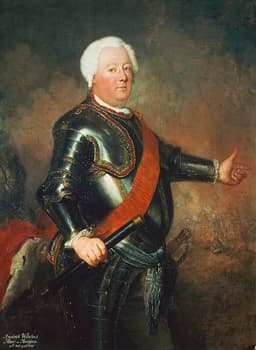
Frederick William II of Prussia
Emperor · Modern
47.2Total

Napoleon Bonaparte
General · Modern
70.9Total
Basic Information
Born
1744
1769
Died
1797
1821
Era
Modern
Modern
Nationality
Prussia
France
Occupation
Emperor
General
Civilization
Western
Western
Score Comparison
Military (10%)
50.0
94.0
Political (20%)
39.4
72.0
Influence (20%)
51.0
40.0
Legacy (20%)
39.2
80.0
Leadership (15%)
65.0
78.0
Strategy (15%)
39.6
90.0
TOTAL
47.2
70.9
Frederick William II of Prussia — Complete Timeline
1790 AD
Patronage of Mozart and BeethovenCultural
Frederick William II was a noted patron of music. He was a cellist and commissioned works from Wolfgang Amadeus Mozart, including the 'Prussian Quartets', and from Ludwig van Beethoven, who dedicated his Cello Sonatas Op. 5 to him. His court in Berlin became a center for classical music.
PrussiaMusicMozartBeethovenPatronage
Impact: nationalconstructive
1792 AD
War of the First CoalitionWar◆ Major
Frederick William II led Prussia into the War of the First Coalition against Revolutionary France. The Prussian army was defeated at the Battle of Valmy in 1792, a major symbolic victory for the French Revolution. Prussia withdrew from the coalition in 1795 with the Treaty of Basel, recognizing French gains.
PrussiaFrench RevolutionWarValmy
Impact: globaldestructive
1793 AD
Partition of PolandWar◆ Major
Frederick William II participated in the Second Partition of Poland, acquiring the cities of Danzig and Thorn and the region of South Prussia. This expanded Prussian territory significantly but also brought a large Polish population under Prussian rule, creating long-term ethnic and political tensions.
PrussiaPolandPartitionTerritory
Impact: regionaldestructive
1794 AD
Promulgation of the Prussian General State LawsReform◆ Major
Frederick William II oversaw the completion and promulgation of the Allgemeines Landrecht (General State Laws) for the Prussian States. This comprehensive legal code, begun under Frederick the Great, codified civil, criminal, and constitutional law, unifying the legal system across Prussia's diverse territories.
PrussiaLawCodeReform
Impact: nationalconstructive
Napoleon Bonaparte — Complete Timeline
1799 AD
Coup of 18 BrumaireOther◆ Major
Napoleon Bonaparte, with support from his brother Lucien and key political figures, overthrew the Directory in a bloodless coup. He established the Consulate with himself as First Consul, effectively becoming the ruler of France. This event ended the French Revolution's most unstable period.
French RevolutionCoupRise to Power
Impact: regional
1804 AD
Promulgation of the Napoleonic CodeOther◆ Major
Napoleon enacted the Civil Code of the French, known as the Napoleonic Code, a comprehensive set of laws that replaced the fragmented feudal legal systems. The code established legal equality, protected property rights, and secularized law. It became the basis for legal systems in many European and world countries.
Legal ReformNapoleonic CodeCivil Law
Impact: globalconstructive
1805 AD
Battle of AusterlitzWar◆ Major
Napoleon's Grande Arm
Napoleonic WarsBattleDecisive Victory
Impact: global
1812 AD
Invasion of RussiaWar◆ Major
Napoleon led the Grande Arm
Napoleonic WarsInvasionDisaster
Impact: globaldestructive
1815 AD
Battle of WaterlooWar◆ Major
Napoleon's French army was defeated by the combined forces of the Duke of Wellington's Anglo-Allied army and Gebhard Leberecht von Bl
Napoleonic WarsBattleFinal Defeat
Impact: globaldestructive
Expert Analysis
frederick-william-ii-of-prussia-vs-napoleon-bonaparte
# The Conqueror and the Cellist King
On a crisp autumn morning in 1806, Napoleon Bonaparte rode through the streets of Berlin, his Grande Armée marching in perfect formation behind him. Just a decade earlier, the Prussian capital had been a haven for music and enlightenment, where King Frederick William II had personally commissioned Mozart’s last opera and hosted Beethoven’s early symphonies. Now, the same kingdom lay shattered—its army destroyed at Jena, its king in flight, its very existence hanging on the mercy of a Corsican artilleryman who had risen from nothing. How did two rulers, contemporaries on the same continent, produce such radically different outcomes? The answer lies not merely in talent, but in the collision of ambition with circumstance, and of character with fate.
Origins
Napoleon Bonaparte was born in 1769 on the island of Corsica, a recently acquired French territory where his family belonged to the minor nobility. He entered the world speaking Italian, not French, and his childhood was marked by resentment toward the French who had conquered his homeland. At nine, he was sent to military school in mainland France, where classmates mocked his accent and his poverty. This outsider status forged an iron will—he would prove himself not through birth, but through brilliance. The French Revolution, which erupted when he was twenty, shattered the old order and opened paths that had been closed for centuries. A young artillery officer with talent and ambition could now rise faster than any nobleman.
Frederick William II of Prussia, born in 1744, inhabited a different universe. He was a Hohenzollern, heir to a kingdom built by his famous uncle, Frederick the Great. Prussia had been forged through war and discipline, but Frederick William inherited a throne, not a struggle. He grew up surrounded by courtly splendor, his education emphasizing music and the arts over statecraft and soldiering. Where Napoleon learned to read maps and calculate trajectories, Frederick William learned to read scores and finger a cello. Their eras shaped them as surely as their genes: Napoleon was a child of revolution, Frederick William a child of the old regime.
Rise to Power
Napoleon’s ascent was a thunderbolt. At twenty-four, he drove the British out of Toulon. At twenty-six, he suppressed a royalist uprising in Paris with a “whiff of grapeshot.” At twenty-seven, he took command of the French army in Italy and, in a campaign of breathtaking speed, defeated Austria and dictated peace terms. By 1799, at thirty, he seized power in a coup and became First Consul. Every step was earned through victory, through the loyalty of soldiers who saw him share their rations and their dangers. He was not born to rule; he conquered the right.
Frederick William II became king in 1786, at forty-two, by inheritance. He had waited decades for the crown, and when it came, he had no military victories, no political crises overcome, no personal transformation to mark the moment. He was simply the next in line. His uncle Frederick the Great had left Prussia a formidable state, but also a fearful one—the old king had despised his nephew, calling him “weak and dissipated.” Frederick William’s rise required no struggle, and perhaps that was the problem. He had never been tested.
Leadership & Governance
Napoleon ruled with a mixture of genius and tyranny. His military campaigns rewrote the art of war: he massed artillery, moved armies faster than anyone thought possible, and struck at the enemy’s rear with devastating precision. His strategic score of 93 reflects this mastery. But he was also a reformer. The Napoleonic Code, established in 1804, standardized French law, abolished feudal privileges, and protected property rights. It spread across Europe and remains influential today. He built schools, roads, and a centralized bureaucracy. Yet his political score of 75 hints at the flaw: he could not stop conquering. Every victory demanded another, and his empire grew too large to govern.
Frederick William II governed Prussia as a patron, not a reformer. His political score of 62.4 and military score of 34.0 tell a story of missed opportunity. He completed the Prussian General State Laws (the Allgemeines Landrecht), a comprehensive legal code that his uncle had begun, but it was cautious and conservative, designed to preserve the old social order rather than transform it. His military leadership was disastrous: when Prussia joined the War of the First Coalition against Revolutionary France in 1792, the army performed poorly, and the king quickly sought peace. His one significant territorial gain came not through battle but through diplomacy—the Second Partition of Poland in 1793, which added Danzig and Thorn to Prussia. But this was a gift from neighboring powers, not a conquest.
Triumph & Tragedy
Napoleon’s greatest moment was Austerlitz, December 2, 1805, where he crushed the combined armies of Russia and Austria. It was a masterpiece of deception and timing. His soldiers wept with joy when he announced the victory. His worst was the invasion of Russia in 1812, where hubris met winter. Of 600,000 men who crossed the Niemen, fewer than 100,000 returned. The disaster broke his aura of invincibility and led to his first abdication in 1814. He returned for the Hundred Days in 1815, only to meet final defeat at Waterloo—a battle he might have won if a single rainstorm had not delayed his attack.
Frederick William II’s triumph was cultural: he commissioned Mozart’s *The Magic Flute* and Beethoven’s early works, enriching Western civilization. His tragedy was political: he inherited a great power and left it weakened, its army demoralized, its treasury depleted, its prestige tarnished. When he died in 1797, Prussia was a second-rate state, waiting for his son—and later, for reformers like Stein and Hardenberg—to restore its strength.
Character & Destiny
Napoleon was driven by an insatiable hunger for glory. “I live only for posterity,” he once said. His character combined extraordinary intelligence with colossal egotism. He trusted no one fully, manipulated everyone, and believed his destiny was to remake Europe. This ambition made him great and destroyed him. He could not stop, could not compromise, could not accept limits.
Frederick William II, by contrast, was a man of moderate appetites and limited vision. He loved music, women, and comfort. He was not cruel or stupid, but he lacked the fire that forges empires. His destiny was to preside over decline, not because he was evil, but because he was ordinary in an age that demanded extraordinary leadership.
Legacy
Napoleon’s legacy is vast and contested. He is remembered as a military genius, a lawgiver, and a tyrant. His name adorns streets, codes, and battles. He reshaped Europe, destroyed the Holy Roman Empire, and inspired nationalism across the continent. His total score of 82.4 reflects this immense impact.
Frederick William II is remembered, if at all, as a footnote. His legacy score of 53.6 places him among the forgettable. Music lovers know him as the cellist king who supported Mozart and Beethoven, but historians see him as the man who let Prussia slip from greatness. He is a cautionary tale: that thrones do not confer ability, and that inheritance without merit leads to ruin.
Conclusion
Standing in Berlin in 1806, Napoleon could have sneered at the ghost of Frederick William II. But the Corsican’s own fate would mirror the Prussian’s in one crucial way: both men left their nations weaker than they found them. Napoleon’s France was exhausted and occupied; Frederick William’s Prussia was humiliated and diminished. The difference was scale, not substance. One conquered the world and lost it; the other inherited a kingdom and lost its soul. Their stories remind us that leadership is not about birth or brilliance alone—it is about what one does with opportunity. And opportunity, once squandered, rarely returns.
Rankings
🥇
Napoleon BonaparteLeader
Mil: 94.0Pol: 72.0Inf: 40.0
70.9
🥈
Frederick William II of Prussia
Mil: 50.0Pol: 39.4Inf: 51.0
47.2
+23.7 behind
How This Comparison Works
Algorithm
Each figure is scored on 6 dimensions (0—100 scale) based on structured historical data: Military (10%), Political (20%), Influence (20%), Legacy (20%), Leadership (15%), Strategy (15%). The weighted total produces the final ranking.
Data Sources
Scores are computed from structured sub-indicators in the database. Scale factors adjust for era (Ancient ×0.85, Modern ×1.0) and civilization size (Eastern ×1.05, Other ×0.80) to account for differences in population and military scale.
Maximum 3 Figures
Comparisons are limited to 2—3 figures to ensure readability and statistical meaningfulness.
Error Margins
±5 points per dimension — Sub-scores are derived from historical records with inherent uncertainty. Two figures within 5 points on a dimension should be considered roughly equivalent in that area.
Total Score Accuracy
±3 points overall — The weighted combination of 6 dimensions produces a total score with approximately ±3 points of uncertainty. Differences of less than 3 points are not statistically significant— the figures are effectively tied.
Known Limitations
- Historical records are incomplete and uneven across civilizations
- Figures from oral-tradition societies may be underrepresented
- Occupation labels can misclassify multi-role figures
- Scores measure capability and impact, not moral character
- Quantitative scoring is a comparison tool, not absolute truth
Capability Radar
Military (10%) — Battles & Warfare
Battles
20
95
Win Rate
15
90
Expansion
10
95
Political (20%) — Governance & Reform
Reform
20
95
Diplomacy
30
80
Economy
25
85
Influence (20%) — Cultural & Global Reach
Cultural
30
85
Global
15
90
Legacy (20%) — Historical Impact
Historical
25
95
Longevity
20
90
Leadership (15%) — Power & Stability
Tenure
60
85
Stability
20
70
Strategy (15%) — Tactics & Innovation
Strategy
10
95
Tactics
10
98
Reform
5
92
Similar Comparisons
Comments & Discussion
PRUSSIAN_SOUL6/17/2026
Frederick William II wasn't a great commander, but he wasn't just a dilettante either. He modernized Prussia's judicial system and commissioned Mozart's "Die Zauberflöte" while Napoleon was still sacking minor Italian towns. The real failure was the French Revolution's gale-force change, which no cello-loving king could withstand. Napoleon exploited chaos; Frederick William governed stability. Give me the patron of Beethoven over the emperor of corpses any day.
炮灰之眼6/17/2026
拿破仑的胜利?不过是踩着几十万法国农民的白骨爬上来的。数据很明白:弗里德里希·威廉二世治下普鲁士人口增长率稳定,税收改革让学校多了三成。拿破仑呢?每场战役损失一万兵,换来的领土没守住五年。你们吹的“军事天才”,就是拿人命填出来的统计学灾难。我更相信一个能养活国民的国王,而不是把欧洲当赌场的赌徒。