Loading...
This comparison has not been analyzed yet.
One-time AI generation (~1 minute). Scores and timeline are already available below.
Frederick William II of Prussia vs Osman II
Frederick William II of Prussia leads by 12.3 pts · 2 figures compared
…
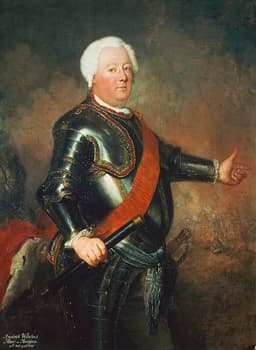
Frederick William II of Prussia
Emperor · Modern
47.2Total

Osman II
Emperor · Modern
34.9Total
Basic Information
Born
1744
1604
Died
1797
1622
Era
Modern
Modern
Nationality
Prussia
Ottoman Empire
Occupation
Emperor
Emperor
Civilization
Western
Middle Eastern
Score Comparison
Military (10%)
50.0
10.2
Political (20%)
39.4
27.9
Influence (20%)
51.0
47.1
Legacy (20%)
39.2
36.7
Leadership (15%)
65.0
31.2
Strategy (15%)
39.6
41.0
TOTAL
47.2
34.9
Frederick William II of Prussia — Complete Timeline
1790 AD
Patronage of Mozart and BeethovenCultural
Frederick William II was a noted patron of music. He was a cellist and commissioned works from Wolfgang Amadeus Mozart, including the 'Prussian Quartets', and from Ludwig van Beethoven, who dedicated his Cello Sonatas Op. 5 to him. His court in Berlin became a center for classical music.
PrussiaMusicMozartBeethovenPatronage
Impact: nationalconstructive
1792 AD
War of the First CoalitionWar◆ Major
Frederick William II led Prussia into the War of the First Coalition against Revolutionary France. The Prussian army was defeated at the Battle of Valmy in 1792, a major symbolic victory for the French Revolution. Prussia withdrew from the coalition in 1795 with the Treaty of Basel, recognizing French gains.
PrussiaFrench RevolutionWarValmy
Impact: globaldestructive
1793 AD
Partition of PolandWar◆ Major
Frederick William II participated in the Second Partition of Poland, acquiring the cities of Danzig and Thorn and the region of South Prussia. This expanded Prussian territory significantly but also brought a large Polish population under Prussian rule, creating long-term ethnic and political tensions.
PrussiaPolandPartitionTerritory
Impact: regionaldestructive
1794 AD
Promulgation of the Prussian General State LawsReform◆ Major
Frederick William II oversaw the completion and promulgation of the Allgemeines Landrecht (General State Laws) for the Prussian States. This comprehensive legal code, begun under Frederick the Great, codified civil, criminal, and constitutional law, unifying the legal system across Prussia's diverse territories.
PrussiaLawCodeReform
Impact: nationalconstructive
Osman II — Complete Timeline
1621 AD
Failed Siege of KhotynWar◆ Major
Osman II personally led the Ottoman army in a siege of the Polish-Lithuanian fortress of Khotyn. The campaign ended in a stalemate, and the Treaty of Khotyn was signed, confirming the existing border. The failure weakened Osman's prestige.
Polish-Ottoman WarKhotynTreaty
Impact: regionaldestructive
1622 AD
Attempted Reform of the JanissariesReform◆ Major
Osman II attempted to reform the Janissary corps by creating a new army loyal to him, bypassing the Janissaries. He also planned to move the capital to Cairo. These moves threatened Janissary power and led to their revolt.
Military ReformJanissariesCapital Move
Impact: nationalprogressive
Murder by JanissariesPolitical Action
Osman II was captured and murdered by Janissaries during a revolt in Istanbul. He was the first Ottoman sultan to be killed by his own soldiers. His death marked a turning point, showing the Janissaries' power to depose and kill sultans.
AssassinationJanissariesRevolt
Impact: nationaltragic
This comparison has not been analyzed yet.
One-time AI generation (~1 minute). Scores and timeline are already available below.
Rankings
🥇
Frederick William II of PrussiaLeader
Mil: 50.0Pol: 39.4Inf: 51.0
47.2
🥈
Osman II
Mil: 10.2Pol: 27.9Inf: 47.1
34.9
+12.3 behind
How This Comparison Works
Algorithm
Each figure is scored on 6 dimensions (0—100 scale) based on structured historical data: Military (10%), Political (20%), Influence (20%), Legacy (20%), Leadership (15%), Strategy (15%). The weighted total produces the final ranking.
Data Sources
Scores are computed from structured sub-indicators in the database. Scale factors adjust for era (Ancient ×0.85, Modern ×1.0) and civilization size (Eastern ×1.05, Other ×0.80) to account for differences in population and military scale.
Maximum 3 Figures
Comparisons are limited to 2—3 figures to ensure readability and statistical meaningfulness.
Error Margins
±5 points per dimension — Sub-scores are derived from historical records with inherent uncertainty. Two figures within 5 points on a dimension should be considered roughly equivalent in that area.
Total Score Accuracy
±3 points overall — The weighted combination of 6 dimensions produces a total score with approximately ±3 points of uncertainty. Differences of less than 3 points are not statistically significant— the figures are effectively tied.
Known Limitations
- Historical records are incomplete and uneven across civilizations
- Figures from oral-tradition societies may be underrepresented
- Occupation labels can misclassify multi-role figures
- Scores measure capability and impact, not moral character
- Quantitative scoring is a comparison tool, not absolute truth
Capability Radar
Military (10%) — Battles & Warfare
Battles
20
15
Win Rate
15
10
Expansion
10
10
Political (20%) — Governance & Reform
Reform
20
25
Diplomacy
30
15
Economy
25
10
Influence (20%) — Cultural & Global Reach
Cultural
30
10
Global
15
10
Legacy (20%) — Historical Impact
Historical
25
20
Longevity
20
10
Leadership (15%) — Power & Stability
Tenure
60
10
Stability
20
5
Strategy (15%) — Tactics & Innovation
Strategy
10
15
Tactics
10
20
Reform
5
30
Similar Comparisons
Alfonso XIII vs Frederick William II of PrussiaFrederick William II of Prussia vs YambioFerdinand I of Bulgaria vs Frederick William II of PrussiaCheoljong of Joseon vs Frederick William II of PrussiaFrederick William II of Prussia vs George Tupou IFrederick William II of Prussia vs Napoleon Bonaparte
Comments & Discussion
No comments yet. Be the first to share your thoughts!