Loading...
Frederick VII of Denmark vs Sophia Alekseyevna
Frederick VII of Denmark leads by 9.5 pts · 2 figures compared
…
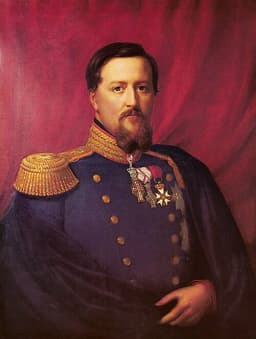
Frederick VII of Denmark
Emperor · Modern
55.4Total

Sophia Alekseyevna
Emperor · Modern
45.9Total
Basic Information
Born
1808
1657
Died
1863
1704
Era
Modern
Modern
Nationality
Denmark
Russia
Occupation
Emperor
Emperor
Civilization
Western
Western
Score Comparison
Military (10%)
25.0
20.0
Political (20%)
72.0
48.0
Influence (20%)
51.8
50.2
Legacy (20%)
48.3
41.7
Leadership (15%)
74.0
55.3
Strategy (15%)
60.0
54.6
TOTAL
55.4
45.9
Frederick VII of Denmark — Complete Timeline
1848 AD
First Schleswig WarWar◆ Major
Frederick VII faced a rebellion in the duchies of Schleswig and Holstein, supported by Prussia. The war ended in 1851 with the London Protocol, which confirmed Danish sovereignty over Schleswig-Holstein but required Denmark not to integrate Schleswig into the kingdom.
Schleswig-HolsteinWarNationalism
Impact: regional
1849 AD
Granted the Constitution of DenmarkPolitical Action
Frederick VII signed the Danish Constitution on June 5, 1849, transforming Denmark from an absolute monarchy into a constitutional monarchy. The constitution established a bicameral parliament (Rigsdag) and granted civil rights to citizens, ending royal absolutism.
ConstitutionConstitutional MonarchyReform
Impact: nationalprogressive
1857 AD
Abolition of the Øresund TollReform◆ Major
Frederick VII agreed to the abolition of the
TradeBaltic SeaReform
Impact: regionalconstructive
1863 AD
Promulgation of the November ConstitutionPolitical Action◆ Major
Frederick VII signed the November Constitution, which incorporated Schleswig into Denmark in violation of the London Protocol. This act provoked the Second Schleswig War with Prussia and Austria, leading to Danish defeat and loss of the duchies.
ConstitutionSchleswig-HolsteinWar
Impact: regionaldestructive
Sophia Alekseyevna — Complete Timeline
1682 AD
Became regent for Ivan V and Peter IPolitical Action◆ Major
Sophia Alekseyevna became regent for her younger brothers Ivan V and Peter I after the Moscow Uprising of 1682. She ruled Russia for seven years, becoming the first woman to effectively govern the country since the 16th century, with the support of the streltsy and Prince Golitsyn.
RegencySophiaPower
Impact: national
1686 AD
Signed the 1686 Treaty of Perpetual Peace with PolandPolitical Action◆ Major
Sophia's government signed the Treaty of Perpetual Peace with the Polish-Lithuanian Commonwealth, confirming Russian control over left-bank Ukraine, Kiev, and Zaporizhia. The treaty also committed Russia to join the Holy League against the Ottoman Empire, shifting Russian foreign policy.
TreatyPolandUkraine
Impact: regionalconstructive
1687 AD
Launched the 1687 and 1689 Crimean campaignsWar◆ Major
Sophia ordered two military campaigns against the Crimean Khanate, led by Prince Vasily Golitsyn. Both campaigns failed due to logistical problems and scorched-earth tactics, with the Russian army retreating without engaging the main Tatar forces, damaging Sophia's prestige.
CrimeaCampaignFailure
Impact: regionaldestructive
1689 AD
Overthrown by Peter I and imprisoned in the Novodevichy ConventPolitical Action◆ Major
Sophia was overthrown by Peter I, who had come of age and gathered support from loyal troops. She was forced to retire to the Novodevichy Convent in Moscow, where she was kept under guard until her death in 1704, ending her regency and political influence.
OverthrowImprisonmentPeter I
Impact: nationaltragic
Expert Analysis
Origins
Frederick VII of Denmark (1808-1863) was born into the Oldenburg dynasty, the son of Christian VIII and Charlotte Frederica of Mecklenburg-Schwerin. His early life was marked by a lackluster education and a strained relationship with his father, who viewed him as unfit for rule. Frederick's personal interests leaned towards the arts and archaeology, and he was known for his informal manner, which contrasted with the expectations of a royal heir.
Sophia Alekseyevna (1657-1704) was born to Tsar Alexis I of Russia and his first wife, Maria Miloslavskaya. She was one of six daughters and received an unusually comprehensive education for a woman of her time, studying under the tutelage of the scholar Simeon Polotsky. Sophia was well-versed in Polish, Latin, and history, and she demonstrated political ambition early on. The death of her father and the subsequent power struggles between the Miloslavsky and Naryshkin families shaped her formative years.
Rise to Power
Frederick VII ascended the throne in January 1848, following the death of his father. His accession coincided with a wave of revolutionary fervor across Europe. In March 1848, a delegation of liberal nationalists presented him with demands for a constitution. Unlike other monarchs who resisted, Frederick VII yielded quickly, appointing a new government and accepting the drafting of a constitution. This decision was influenced by his desire to avoid bloodshed and his lack of enthusiasm for absolute rule. The Danish Constitution was signed on June 5, 1849, transforming Denmark into a constitutional monarchy. Frederick's score of 72.0 in political leadership reflects this pivotal move.
Sophia Alekseyevna's rise came after the Moscow Uprising of 1682, when the Streltsy (musketeers) rebelled, resulting in the deaths of several Naryshkin relatives. The uprising led to the installation of Ivan V as senior tsar and Peter I as junior tsar, with Sophia as regent. She effectively ruled Russia from 1682 to 1689, leveraging her intelligence and political acumen. Her score of 50.2 in influence indicates her ability to maintain power for seven years in a male-dominated society.
Leadership & Governance
Frederick VII's governance was characterized by a hands-off approach. He allowed his ministers, particularly the National Liberal leader D.G. Monrad, to shape policy. His main contribution was his willingness to sign the constitution, which established a bicameral parliament (Rigsdag) and civil liberties. However, his later decision to sign the November Constitution in 1863, which incorporated Schleswig into Denmark, violated the 1852 London Protocol and provoked the Second Schleswig War. This act of executive overreach, despite his usual passivity, led to disaster. Frederick's leadership score of 74.0 reflects his role in democratization but also his strategic misstep.
Sophia Alekseyevna governed through her favorite, Prince Vasily Golitsyn, who was the de facto head of government. She focused on internal reforms, including tax collection improvements and legal codification. Her foreign policy secured the Treaty of Perpetual Peace with Poland in 1686, confirming Russian control over left-bank Ukraine and Kyiv. However, her military campaigns against the Crimean Khanate in 1687 and 1689 were costly failures, revealing her lack of military acumen (score 20.0). Sophia's political score of 48.0 reflects her competent but ultimately unstable reign.
Triumph & Tragedy
Frederick VII's greatest triumph was the peaceful transition to constitutional monarchy. The 1849 constitution is still the basis of Danish democracy, and his willingness to cede power is unique among 19th-century monarchs. His tragedy was the November Constitution, which led to the Second Schleswig War (1864), resulting in Denmark losing Schleswig, Holstein, and Lauenburg to Prussia and Austria. This defeat diminished Danish territory by about 40% and humiliated the nation.
Sophia Alekseyevna's triumph was maintaining power as a female regent in a hostile environment. She successfully navigated court intrigues and secured a favorable peace with Poland. Her tragedy was her downfall: when Peter I came of age, he overthrew her in 1689, forcing her into the Novodevichy Convent, where she lived under guard until her death in 1704. Her legacy is overshadowed by Peter's reforms.
Character & Destiny
Frederick VII was known for his affable, unconventional personality. He preferred the company of commoners and was nicknamed the "Constitutional King." His lack of ambition made him willing to cede power, but also led to indecisiveness. Historians note that he was easily influenced by his advisors, which contributed to the disastrous November Constitution. His character—a mix of benevolence and weakness—shaped Denmark's destiny toward democracy but also territorial loss.
Sophia Alekseyevna was intelligent, ambitious, and ruthless. She cultivated a network of supporters and used propaganda to legitimize her regency. However, her reliance on Golitsyn and her failure to secure military success eroded her authority. Her character—driven by a desire to rule—ultimately led to her imprisonment. She is remembered as a precursor to powerful female rulers like Catherine the Great.
Legacy
Frederick VII's legacy is overwhelmingly positive in Denmark. He is celebrated as the king who gave Denmark democracy. The 1849 constitution remains in effect, and his statue stands in Copenhagen. His score of 48.3 in legacy reflects his enduring impact on Danish governance. However, his role in the November Constitution is a cautionary tale about executive overreach.
Sophia Alekseyevna's legacy is more mixed. She is often seen as a capable regent who laid groundwork for Peter's reforms, but her defeat and imprisonment marginalized her contributions. Her score of 41.7 in legacy is lower due to Peter's deliberate erasure of her achievements. In modern Russian historiography, she is gaining recognition as a reformer in her own right.
Conclusion
Frederick VII of Denmark had a more significant and lasting impact than Sophia Alekseyevna. His political score (72.0 vs. 48.0) and legacy score (48.3 vs. 41.7) reflect his role in establishing a constitutional monarchy that persists today. While Sophia's regency was notable, her failures in military and eventual overthrow limit her influence. Frederick VII's decision to grant a constitution fundamentally changed Danish society, whereas Sophia's achievements were largely undone by Peter the Great. The score gap of 9.5 points supports this assessment.
Rankings
🥇
Frederick VII of DenmarkLeader
Mil: 25.0Pol: 72.0Inf: 51.8
55.4
🥈
Sophia Alekseyevna
Mil: 20.0Pol: 48.0Inf: 50.2
45.9
+9.5 behind
How This Comparison Works
Algorithm
Each figure is scored on 6 dimensions (0—100 scale) based on structured historical data: Military (10%), Political (20%), Influence (20%), Legacy (20%), Leadership (15%), Strategy (15%). The weighted total produces the final ranking.
Data Sources
Scores are computed from structured sub-indicators in the database. Scale factors adjust for era (Ancient ×0.85, Modern ×1.0) and civilization size (Eastern ×1.05, Other ×0.80) to account for differences in population and military scale.
Maximum 3 Figures
Comparisons are limited to 2—3 figures to ensure readability and statistical meaningfulness.
Error Margins
±5 points per dimension — Sub-scores are derived from historical records with inherent uncertainty. Two figures within 5 points on a dimension should be considered roughly equivalent in that area.
Total Score Accuracy
±3 points overall — The weighted combination of 6 dimensions produces a total score with approximately ±3 points of uncertainty. Differences of less than 3 points are not statistically significant— the figures are effectively tied.
Known Limitations
- Historical records are incomplete and uneven across civilizations
- Figures from oral-tradition societies may be underrepresented
- Occupation labels can misclassify multi-role figures
- Scores measure capability and impact, not moral character
- Quantitative scoring is a comparison tool, not absolute truth
Capability Radar
Military (10%) — Battles & Warfare
Battles
37
5
Win Rate
38
5
Expansion
40
5
Political (20%) — Governance & Reform
Reform
75
40
Diplomacy
50
35
Economy
30
30
Influence (20%) — Cultural & Global Reach
Cultural
30
25
Global
20
15
Legacy (20%) — Historical Impact
Historical
50
30
Longevity
40
20
Leadership (15%) — Power & Stability
Tenure
25
30
Stability
40
20
Strategy (15%) — Tactics & Innovation
Strategy
48
5
Tactics
47
5
Reform
50
10
Similar Comparisons
Comments & Discussion
No comments yet. Be the first to share your thoughts!