Loading...
Frederick VII of Denmark vs Malharrao Gaekwad
Frederick VII of Denmark leads by 17.7 pts · 2 figures compared
…
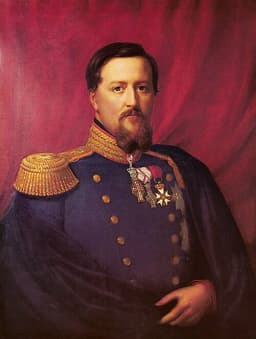
Frederick VII of Denmark
Emperor · Modern
55.4Total

Malharrao Gaekwad
Emperor · Modern
37.7Total
Basic Information
Born
1808
1831
Died
1863
1882
Era
Modern
Modern
Nationality
Denmark
India
Occupation
Emperor
Emperor
Civilization
Western
Indian
Score Comparison
Military (10%)
25.0
20.0
Political (20%)
72.0
26.4
Influence (20%)
51.8
46.3
Legacy (20%)
48.3
34.2
Leadership (15%)
74.0
41.5
Strategy (15%)
60.0
54.3
TOTAL
55.4
37.7
Frederick VII of Denmark — Complete Timeline
1848 AD
First Schleswig WarWar◆ Major
Frederick VII faced a rebellion in the duchies of Schleswig and Holstein, supported by Prussia. The war ended in 1851 with the London Protocol, which confirmed Danish sovereignty over Schleswig-Holstein but required Denmark not to integrate Schleswig into the kingdom.
Schleswig-HolsteinWarNationalism
Impact: regional
1849 AD
Granted the Constitution of DenmarkPolitical Action
Frederick VII signed the Danish Constitution on June 5, 1849, transforming Denmark from an absolute monarchy into a constitutional monarchy. The constitution established a bicameral parliament (Rigsdag) and granted civil rights to citizens, ending royal absolutism.
ConstitutionConstitutional MonarchyReform
Impact: nationalprogressive
1857 AD
Abolition of the Øresund TollReform◆ Major
Frederick VII agreed to the abolition of the
TradeBaltic SeaReform
Impact: regionalconstructive
1863 AD
Promulgation of the November ConstitutionPolitical Action◆ Major
Frederick VII signed the November Constitution, which incorporated Schleswig into Denmark in violation of the London Protocol. This act provoked the Second Schleswig War with Prussia and Austria, leading to Danish defeat and loss of the duchies.
ConstitutionSchleswig-HolsteinWar
Impact: regionaldestructive
Malharrao Gaekwad — Complete Timeline
1870 AD
Ascended the Throne of BarodaPolitical Action◆ Major
Malharrao Gaekwad became Maharaja of Baroda after the deposition of his predecessor. His reign was marked by administrative inefficiency and personal extravagance, leading to widespread discontent.
SuccessionPrincely StateBaroda
Impact: regional
1874 AD
Accused of Attempted Poisoning of British ResidentPolitical Action◆ Major
Malharrao was accused of attempting to poison Colonel Robert Phayre, the British Resident in Baroda. The trial was a major scandal, and although the evidence was disputed, it contributed to his deposition.
ScandalBritish RajBaroda
Impact: regionaldestructive
1875 AD
Deposed by the British for MisrulePolitical Action◆ Major
The British East India Company deposed Malharrao Gaekwad on charges of misgovernment and financial mismanagement. He was exiled to Madras (Chennai), where he lived under British supervision until his death.
DepositionBritish RajBaroda
Impact: regionaldestructive
Expert Analysis
Origins
Frederick VII of Denmark was born on October 6, 1808, in Copenhagen, the son of King Christian VIII and Princess Charlotte Frederica of Mecklenburg-Schwerin. His early life was marked by a troubled relationship with his father and a lack of preparation for rule. He received a military education but showed little interest in governance. Malharrao Gaekwad was born in 1831 in Baroda, India, into the Gaekwad dynasty. He was the son of Sayajirao Gaekwad II and was adopted by his predecessor, Khanderao II. His upbringing was within the princely court, but he lacked formal education in statecraft.
Rise to Power
Frederick VII ascended the Danish throne on January 20, 1848, following his father's death. His rise was immediate and hereditary. The key turning point came in March 1848, when a political crisis forced him to abandon absolutism. He appointed the March Cabinet and agreed to a constitutional convention. On June 5, 1849, he signed the Danish Constitution, transforming Denmark into a constitutional monarchy. Malharrao Gaekwad became Maharaja of Baroda in 1870 after the deposition of his predecessor, Malharrao's uncle, Khanderao II, by the British. He was chosen by the British due to his perceived pliability. However, his reign quickly deteriorated due to administrative incompetence and personal excesses.
Leadership & Governance
Frederick VII's leadership was characterized by a willingness to delegate power. He allowed Prime Ministers such as A.W. Moltke and D.G. Monrad to govern while he focused on symbolic duties. His political score of 72.0 reflects his role in the peaceful transition to constitutional rule. In contrast, Malharrao Gaekwad's governance score of 26.4 reflects chronic mismanagement. He was known for extravagance, neglecting public works, and alienating both his subjects and the British. His attempts to centralize power led to conflicts with the British Resident.
Triumph & Tragedy
Frederick VII's greatest triumph was the peaceful establishment of constitutional monarchy, which ended absolutism without revolution. He also presided over the abolition of the Øresund toll in 1857, boosting Baltic trade. However, his greatest failure was the November Constitution of 1863, which violated the London Protocol and triggered the Second Schleswig War, resulting in Danish defeat and loss of territory. Malharrao's triumph was merely ascending the throne, but his reign was a series of failures. He was deposed in 1875 after the British accused him of attempting to poison Colonel Robert Phayre. The trial was a scandal, and although he was acquitted of poisoning, he was exiled to Madras for misrule.
Character & Destiny
Frederick VII was known as a jovial but weak ruler. He lacked the intellect for absolute rule but had the wisdom to accept constitutional limits. His character shaped Denmark's peaceful transition to democracy. Malharrao was described as arrogant and vindictive. His poor judgment and inability to manage finances led to his downfall. The British assessment was that he was unfit to rule, and his fate was sealed by his own actions.
Legacy
Frederick VII is remembered as the 'Father of the Danish Constitution.' His legacy is the Danish constitutional monarchy, which remains stable today. His political score of 72.0 and legacy score of 48.3 reflect his lasting impact on Danish governance. Malharrao Gaekwad's legacy is largely negative. He is remembered for his misrule and deposition. His influence score of 46.3 is inflated by the notoriety of his trial, but his legacy score of 34.2 indicates little positive impact.
Conclusion
Frederick VII of Denmark had a significantly greater impact than Malharrao Gaekwad. With a total score of 55.4 against 37.7, Frederick's role in establishing constitutional monarchy shaped Denmark's modern identity. Malharrao's brief and disastrous reign contributed nothing positive to Baroda's development. Frederick's willingness to cede power ensured a lasting legacy, while Malharrao's incompetence led to his removal and obscurity. The data clearly supports Frederick VII as the more consequential ruler.
Rankings
🥇
Frederick VII of DenmarkLeader
Mil: 25.0Pol: 72.0Inf: 51.8
55.4
🥈
Malharrao Gaekwad
Mil: 20.0Pol: 26.4Inf: 46.3
37.7
+17.7 behind
How This Comparison Works
Algorithm
Each figure is scored on 6 dimensions (0—100 scale) based on structured historical data: Military (10%), Political (20%), Influence (20%), Legacy (20%), Leadership (15%), Strategy (15%). The weighted total produces the final ranking.
Data Sources
Scores are computed from structured sub-indicators in the database. Scale factors adjust for era (Ancient ×0.85, Modern ×1.0) and civilization size (Eastern ×1.05, Other ×0.80) to account for differences in population and military scale.
Maximum 3 Figures
Comparisons are limited to 2—3 figures to ensure readability and statistical meaningfulness.
Error Margins
±5 points per dimension — Sub-scores are derived from historical records with inherent uncertainty. Two figures within 5 points on a dimension should be considered roughly equivalent in that area.
Total Score Accuracy
±3 points overall — The weighted combination of 6 dimensions produces a total score with approximately ±3 points of uncertainty. Differences of less than 3 points are not statistically significant— the figures are effectively tied.
Known Limitations
- Historical records are incomplete and uneven across civilizations
- Figures from oral-tradition societies may be underrepresented
- Occupation labels can misclassify multi-role figures
- Scores measure capability and impact, not moral character
- Quantitative scoring is a comparison tool, not absolute truth
Capability Radar
Military (10%) — Battles & Warfare
Battles
37
5
Win Rate
38
5
Expansion
40
5
Political (20%) — Governance & Reform
Reform
75
10
Diplomacy
50
15
Economy
30
10
Influence (20%) — Cultural & Global Reach
Cultural
30
10
Global
20
5
Legacy (20%) — Historical Impact
Historical
50
10
Longevity
40
5
Leadership (15%) — Power & Stability
Tenure
25
20
Stability
40
10
Strategy (15%) — Tactics & Innovation
Strategy
48
5
Tactics
47
5
Reform
50
5
Similar Comparisons
Comments & Discussion
No comments yet. Be the first to share your thoughts!