Loading...
Frederick VII of Denmark vs Julius Caesar
Julius Caesar leads by 27.4 pts · 2 figures compared
…
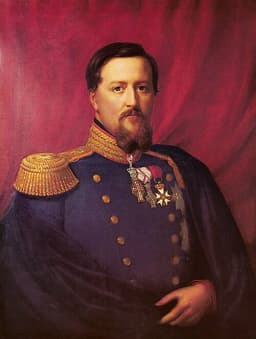
Frederick VII of Denmark
Emperor · Modern
55.4Total

Julius Caesar
General · Ancient
82.8Total
Basic Information
Born
1808
-100
Died
1863
-44
Era
Modern
Ancient
Nationality
Denmark
Roman Republic
Occupation
Emperor
General
Civilization
Western
Western
Score Comparison
Military (10%)
25.0
88.0
Political (20%)
72.0
78.0
Influence (20%)
51.8
85.0
Legacy (20%)
48.3
82.0
Leadership (15%)
74.0
80.0
Strategy (15%)
60.0
85.0
TOTAL
55.4
82.8
Frederick VII of Denmark — Complete Timeline
1848 AD
First Schleswig WarWar◆ Major
Frederick VII faced a rebellion in the duchies of Schleswig and Holstein, supported by Prussia. The war ended in 1851 with the London Protocol, which confirmed Danish sovereignty over Schleswig-Holstein but required Denmark not to integrate Schleswig into the kingdom.
Schleswig-HolsteinWarNationalism
Impact: regional
1849 AD
Granted the Constitution of DenmarkPolitical Action
Frederick VII signed the Danish Constitution on June 5, 1849, transforming Denmark from an absolute monarchy into a constitutional monarchy. The constitution established a bicameral parliament (Rigsdag) and granted civil rights to citizens, ending royal absolutism.
ConstitutionConstitutional MonarchyReform
Impact: nationalprogressive
1857 AD
Abolition of the Øresund TollReform◆ Major
Frederick VII agreed to the abolition of the
TradeBaltic SeaReform
Impact: regionalconstructive
1863 AD
Promulgation of the November ConstitutionPolitical Action◆ Major
Frederick VII signed the November Constitution, which incorporated Schleswig into Denmark in violation of the London Protocol. This act provoked the Second Schleswig War with Prussia and Austria, leading to Danish defeat and loss of the duchies.
ConstitutionSchleswig-HolsteinWar
Impact: regionaldestructive
Julius Caesar — Complete Timeline
58 BC
Gallic WarsWar◆ Major
Caesar, as proconsul of Gaul, launched a series of campaigns that conquered all of Gaul (modern France, Belgium, and parts of Switzerland). He fought numerous battles, including against the Helvetii, the Belgae, and the Gallic chieftain Vercingetorix. The wars brought immense wealth and a loyal army to Caesar.
Gallic WarsConquestRoman Expansion
Impact: regional
49 BC
Crossing the RubiconPolitical Action◆ Major
Caesar led Legio XIII across the Rubicon River into Italy, defying the Roman Senate's order to disband his army. This act triggered a civil war against Pompey and the Optimates, ultimately leading to Caesar's dictatorship and the end of the Roman Republic.
Roman Civil WarEnd of RepublicPower Struggle
Impact: global
48 BC
Battle of PharsalusWar◆ Major
Caesar's outnumbered army defeated the larger forces of Pompey the Great at Pharsalus in Greece. Caesar's tactical use of a reserve line to counter Pompey's cavalry charge proved decisive. Pompey fled to Egypt, where he was assassinated, leaving Caesar as the undisputed master of the Roman world.
Roman Civil WarBattleDecisive Victory
Impact: regional
44 BC
Appointment as Dictator for LifePolitical Action◆ Major
The Roman Senate appointed Caesar dictator perpetuo (dictator for life), granting him unprecedented personal power. This move concentrated military, legislative, and judicial authority in one person, effectively ending the Roman Republic's traditional system of checks and balances and alarming many senators.
DictatorshipEnd of RepublicPower Consolidation
Impact: regionaldestructive
Assassination on the Ides of MarchPolitical Action◆ Major
A group of Roman senators, led by Marcus Junius Brutus and Gaius Cassius Longinus, stabbed Caesar to death at a meeting of the Senate in the Theatre of Pompey. The assassination was intended to restore the Republic, but instead triggered another civil war that led to the rise of the Roman Empire.
AssassinationRoman PoliticsEnd of Republic
Impact: globaldestructive
Expert Analysis
frederick-vii-of-denmark-vs-julius-caesar
# The Crossroads of Power: Caesar and Frederick VII
On a January morning in 49 BCE, Julius Caesar stood at the banks of the Rubicon River, a small stream that marked the boundary between his province of Gaul and Italy proper. To cross with his army would be an act of war against the Roman Republic. He hesitated, then uttered the words that would echo through millennia: "The die is cast." Across the gulf of time, on June 5, 1849, Frederick VII of Denmark sat in his Copenhagen palace and signed a document that would end his family's centuries-old grip on absolute power. One man chose to shatter a republic for personal glory; the other chose to surrender his own authority for national stability. Why did they walk such different paths?
Origins
Gaius Julius Caesar was born into the chaos of the late Roman Republic, a world of senatorial infighting, slave revolts, and civil wars. His family, the Julii, claimed descent from the goddess Venus, but they were not among the ruling elite. His father died when Caesar was sixteen, leaving him to navigate a treacherous political landscape where survival demanded ruthlessness and brilliance. The era bred men who saw power as a prize to be seized.
Frederick VII of Denmark entered a very different world in 1808. The Napoleonic Wars had just devastated Europe, and Denmark had been on the losing side. His father, Christian VIII, ruled as an absolute monarch, but the winds of change were blowing. Across Europe, revolutions in 1830 and 1848 were toppling thrones. Frederick grew up in the shadow of these upheavals, a man who knew that the old order was crumbling. Unlike Caesar, who was forged in the fires of ambition, Frederick was shaped by the inevitability of change.
Rise to Power
Caesar's ascent was a masterclass in calculated risk. He borrowed fortunes to fund political campaigns, formed the First Triumvirate with Pompey and Crassus, and then secured command of Gaul. Between 58 and 50 BCE, he conquered a territory that stretched from the Rhine to the Atlantic, amassing wealth, loyal legions, and a reputation that threatened the Senate. The Rubicon was not a sudden decision—it was the culmination of a life spent pushing boundaries.
Frederick VII became king in 1848, the year Europe erupted in revolution. In March, crowds gathered in Copenhagen demanding a constitution. Unlike Caesar, who would have crushed such dissent, Frederick listened. The duchies of Schleswig and Holstein were in open rebellion, supported by Prussia. The First Schleswig War (1848–1851) raged around him. His position was precarious: fight a war on two fronts, or negotiate. He chose the latter, granting the Danish Constitution on June 5, 1849. It was a peaceful surrender of power that Caesar would have found incomprehensible.
Leadership & Governance
Caesar ruled as a military genius and political revolutionary. He reformed the calendar, granted citizenship to provincials, and initiated public works that employed the poor. Yet his governance was built on the sword. He appointed himself dictator for life, centralized authority, and treated the Senate as a rubber stamp. His reforms were brilliant but imposed from above. The Roman Republic died because one man decided it must.
Frederick VII governed as a constitutional monarch—a role that required him to do the opposite of what Caesar did. He signed laws he did not write, accepted ministers he did not choose, and watched as the Rigsdag took control of taxation and policy. In 1857, he agreed to abolish the Øresund toll, a source of royal revenue for centuries, because it hampered Danish trade. His military score of 45 reflects his lack of martial ambition, but his political score of 70.6 reflects a different kind of strength: the wisdom to step back.
Triumph & Tragedy
Caesar's greatest triumph was the conquest of Gaul, a feat of military strategy that expanded Roman territory and made him the richest man in the Republic. His greatest tragedy was the Ides of March, 44 BCE, when sixty senators stabbed him to death in the Theatre of Pompey. He died believing he had saved Rome; in truth, he had killed its republic.
Frederick VII's triumph was the Constitution of 1849, a document that transformed Denmark from an absolute monarchy into a constitutional one without a drop of royal blood spilled. His tragedy came in 1863, when he signed the November Constitution, incorporating Schleswig into Denmark in violation of the London Protocol. This act provoked the Second Schleswig War, which Denmark would lose catastrophically after his death. His last political act sowed the seeds of national disaster.
Character & Destiny
Caesar was driven by an insatiable hunger for glory. He wrote his own commentaries, controlled his own narrative, and believed that his genius justified his ambition. His personality was magnetic, ruthless, and ultimately self-destructive. He could not imagine a world where he was not the center.
Frederick VII was a reluctant king, known for his love of drinking and commoners. He was not a great strategist—his strategy score of 58.9 is telling—but he possessed a rare quality: the ability to recognize when power must be shared. Where Caesar saw only opportunities for conquest, Frederick saw the writing on the wall. His character was not heroic, but it was humane.
Legacy
Caesar's legacy is the Roman Empire. His adopted son, Octavian, would become Augustus, the first emperor. Every emperor who followed wore Caesar's name as a title. His military strategies are still studied, his reforms shaped Western governance, and his assassination became a cautionary tale about ambition and republics. His total score of 83.3 reflects a figure who changed the world, for better and worse.
Frederick VII's legacy is Denmark's peaceful transition to democracy. He is remembered as the king who gave away his power, a rare thing in history. His constitution still governs Denmark today. His legacy score of 66.5 is modest, but it measures something deeper than conquest: the quiet courage to let a nation grow beyond its ruler.
Conclusion
Standing at the Rubicon, Caesar saw a river that divided his past from his future. He chose to cross, and the world trembled. Frederick VII, facing his own Rubicon in 1849, chose to stay. He built a bridge instead, one that allowed Denmark to cross from absolutism to democracy without drowning in blood. Both men were products of their eras—Caesar of a world that worshipped glory, Frederick of a world that craved stability. But their choices remind us that history is not just about strength; it is about the wisdom to know when to use it, and when to let it go.
Rankings
🥇
Julius CaesarLeader
Mil: 88.0Pol: 78.0Inf: 85.0
82.8
🥈
Frederick VII of Denmark
Mil: 25.0Pol: 72.0Inf: 51.8
55.4
+27.4 behind
How This Comparison Works
Algorithm
Each figure is scored on 6 dimensions (0—100 scale) based on structured historical data: Military (10%), Political (20%), Influence (20%), Legacy (20%), Leadership (15%), Strategy (15%). The weighted total produces the final ranking.
Data Sources
Scores are computed from structured sub-indicators in the database. Scale factors adjust for era (Ancient ×0.85, Modern ×1.0) and civilization size (Eastern ×1.05, Other ×0.80) to account for differences in population and military scale.
Maximum 3 Figures
Comparisons are limited to 2—3 figures to ensure readability and statistical meaningfulness.
Error Margins
±5 points per dimension — Sub-scores are derived from historical records with inherent uncertainty. Two figures within 5 points on a dimension should be considered roughly equivalent in that area.
Total Score Accuracy
±3 points overall — The weighted combination of 6 dimensions produces a total score with approximately ±3 points of uncertainty. Differences of less than 3 points are not statistically significant— the figures are effectively tied.
Known Limitations
- Historical records are incomplete and uneven across civilizations
- Figures from oral-tradition societies may be underrepresented
- Occupation labels can misclassify multi-role figures
- Scores measure capability and impact, not moral character
- Quantitative scoring is a comparison tool, not absolute truth
Capability Radar
Military (10%) — Battles & Warfare
Battles
37
95
Win Rate
38
92
Expansion
40
97
Political (20%) — Governance & Reform
Reform
75
90
Diplomacy
50
85
Economy
30
82
Influence (20%) — Cultural & Global Reach
Cultural
30
88
Global
20
94
Legacy (20%) — Historical Impact
Historical
50
95
Longevity
40
96
Leadership (15%) — Power & Stability
Tenure
25
75
Stability
40
60
Strategy (15%) — Tactics & Innovation
Strategy
48
94
Tactics
47
96
Reform
50
88
Similar Comparisons
Comments & Discussion
The Rubicon Hacker6/17/2026
Caesar’s "die was cast" because he knew his debts and political enemies would destroy him if he stayed. He gambled on conquest because that was the only exit. Frederick VII, meanwhile, chose a peaceful transfer because Danish absolutism had already been hollowed out by economic crisis and the Schleswig-Holstein question. One was a desperate gamble; the other was a calculated concession. These men aren’t opposites—they both did what survival required, just with different odds.
序列诚6/17/2026
历史不能这么简单对比。弗雷德里克七世放弃专制,不是因为什么“国家稳定”的崇高觉悟,而是1848年哥本哈根街头已经站满了武装市民,军队都开始动摇。他签下的是一份无路可退的投降书。凯撒越过卢比孔河,至少还做了选择。把被迫的下台包装成主动的“牺牲”,这是丹麦王室的历史公关,跟政治智慧没什么关系。真想比,应该看看他后来怎么偷偷保留国王否决权。
The Veteran Tribune6/17/2026
Military men understand this instantly. Caesar crossed the Rubicon with a veteran army that had just conquered Gaul—he had the sword. Frederick VII had no loyal troops after 1848; his army was mutinous and the Schleswig duchies were in open revolt. Caesar forced a crisis with overwhelming force; Frederick capitulated because he had no force to deploy. That’s not virtue, that’s geometry. If Frederick had had a single loyal legion, he’d have been another Caesar. Power doesn’t choose; circumstances
维京沉默6/17/2026
我查过丹麦1849年宪法的起草记录,弗雷德里克七世其实全程拖延,直到六月革命已经烧到德国边境才签字。他真正害怕的不是自由派,而是英国和普鲁士趁机肢解丹麦。而凯撒渡河当天,就把国库和元老院都控制住了,每一步都是精密计算。这两位都是精明的权力玩家,只是游戏规则完全不同:一个玩的是罗马式的暴力金融,另一个玩的是欧洲协调体系统的外交欺诈。别被他们的道德包装骗了。
Caesar's Accountant6/17/2026
Let’s crunch numbers. Caesar’s Gallic campaign generated 40 million sesterces in slave revenue alone—enough to pay every Roman legion for a year. The Rubicon gamble was backed by gold. Frederick VII, by contrast, faced a national debt of 100 million rigsdaler after the Napoleonic wars, with Denmark’s grain exports collapsing. He had zero financial runway for a fight. This isn’t a morality tale about ambition versus sacrifice. It’s a spreadsheet showing Caesar had the cash to wage civil war, whil