Loading...
Frederick V of Austria vs Philip II Augustus
Philip II Augustus leads by 13.3 pts · 2 figures compared
…
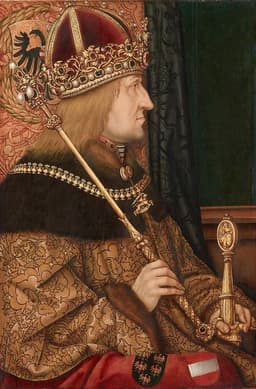
Frederick V of Austria
Emperor · Medieval
50.6Total

Philip II Augustus
Emperor · Medieval
63.9Total
Basic Information
Born
1415
1165
Died
1493
1223
Era
Medieval
Medieval
Nationality
Austria
France
Occupation
Emperor
Emperor
Civilization
Western
Western
Score Comparison
Military (10%)
50.0
76.0
Political (20%)
45.1
70.0
Influence (20%)
51.8
55.0
Legacy (20%)
49.2
55.0
Leadership (15%)
74.0
78.0
Strategy (15%)
25.0
66.3
TOTAL
50.6
63.9
Frederick V of Austria — Complete Timeline
1440 AD
Election as King of the RomansPolitical Action◆ Major
Frederick was elected King of the Romans in Frankfurt, succeeding his cousin Albert II. This election placed him at the head of the Holy Roman Empire, beginning his long reign as Frederick III.
ElectionHoly Roman EmpireKingship
Impact: regional
Adoption of the AEIOU MottoCultural
Frederick III adopted the cryptic motto AEIOU, which he used on his personal belongings and buildings. The meaning remains debated, but it symbolized his claim to universal rule and Habsburg destiny.
MottoSymbolismHabsburg
1452 AD
Coronation as Holy Roman EmperorPolitical Action◆ Major
Frederick III was crowned Holy Roman Emperor by Pope Nicholas V in Rome. This was the last imperial coronation to take place in Rome, and it solidified his authority over the empire.
CoronationHoly Roman EmpirePapacy
Impact: regional
1477 AD
Marriage of Maximilian I and Mary of BurgundyPolitical Action◆ Major
Frederick III arranged the marriage of his son Maximilian to Mary of Burgundy, heiress of the Burgundian state. This union brought the Burgundian Netherlands into the Habsburg domain, greatly expanding Habsburg power.
Marriage AllianceHabsburg ExpansionBurgundy
Impact: regionalconstructive
1485 AD
Siege of Vienna (Austrian-Hungarian War)War◆ Major
Frederick III lost Vienna to the Hungarian king Matthias Corvinus after a prolonged siege. The city remained under Hungarian control until 1490, marking a significant territorial loss for Frederick.
SiegeTerritorial LossHungary
Impact: regionaldestructive
Philip II Augustus — Complete Timeline
1180 AD
Granting of Charters to TownsReform
Philip II Augustus granted charters to many towns in the royal domain, granting them self-governance and privileges. This policy encouraged urban growth and trade. It also strengthened the monarchy by gaining the support of the bourgeoisie.
ChartersUrbanizationReform
Impact: regionalconstructive
1182 AD
Expulsion of the Jews from FrancePolitical Action◆ Major
Philip II Augustus expelled the Jews from the French royal domain and confiscated their property. The expulsion was motivated by religious and financial reasons. It was a harsh measure that disrupted Jewish communities and set a precedent for later persecutions.
ExpulsionJewsPersecution
Impact: regionaldestructive
1190 AD
Construction of the Louvre FortressCultural
Philip II Augustus ordered the construction of the Louvre Fortress in Paris. The fortress was built to defend the city from English attacks. It later became the Louvre Palace and eventually the Louvre Museum, a symbol of French culture.
ArchitectureParisFortification
constructive
1204 AD
Conquest of NormandyWar◆ Major
Philip II Augustus conquered Normandy from King John of England. He captured the castle of Ch
ConquestNormandyFrance
Impact: regionalconstructive
1214 AD
Battle of BouvinesWar◆ Major
Philip II Augustus defeated a coalition of English, Flemish, and German forces at the Battle of Bouvines. This victory secured French control over the territories of Normandy, Anjou, and Maine. It also strengthened the French monarchy and weakened the Angevin Empire.
BattleFranceAngevin Empire
Impact: regionalconstructive
Expert Analysis
Origins
Frederick V of Austria (1415-1493), also known as Frederick III, was born into the Habsburg dynasty, the eldest son of Duke Ernest the Iron of Inner Austria. His early life was shaped by the political fragmentation of the Habsburg lands and the ongoing conflicts with the Hungarian kingdom. He was educated in the traditions of the Holy Roman Empire, and his family's motto AEIOU (often interpreted as "Austriae est imperare orbi universo" – All the world is subject to Austria) foreshadowed his ambitions.
Philip II Augustus (1165-1223) was born in Paris, the son of King Louis VII and Adela of Champagne. He was the first Capetian king to be crowned during his father's lifetime (1179), ensuring a smooth succession. His upbringing was marked by the rivalry with the Plantagenet kings of England, who controlled vast territories in France. Philip was trained in military and administrative skills, and his reign would transform the French monarchy.
Rise to Power
Frederick III was elected King of the Romans in 1440 at Frankfurt, succeeding his cousin Albert II. His election was contested, but he secured the support of the electors through promises and concessions. He was crowned Holy Roman Emperor by Pope Nicholas V in 1452 in Rome, the last imperial coronation to take place there. This event solidified his position but also highlighted the empire's declining influence.
Philip II became king at age 15 in 1180, inheriting a realm with limited royal authority. He quickly asserted his independence from his regents, including his mother and the Count of Flanders. His first major challenge was the rebellion of his vassals, which he suppressed. He then turned his attention to the Plantagenet domains, exploiting the conflicts between Henry II and his sons. By 1200, he had significantly expanded the royal domain through diplomacy and war.
Leadership & Governance
Frederick III's leadership was characterized by a cautious and often passive approach. He scored 74.0 in leadership, but his political score was only 45.1. He focused on consolidating Habsburg power through marriage alliances, most notably arranging the marriage of his son Maximilian to Mary of Burgundy in 1477, which brought the Burgundian Netherlands into Habsburg hands. However, his governance was weak; he lost Vienna to Matthias Corvinus in 1485 after a prolonged siege, and his empire suffered from internal divisions. His motto AEIOU reflected his aspirations but not his achievements.
Philip II Augustus, with a leadership score of 78.0 and political score of 70.0, was an active and strategic ruler. He reformed the French administration, establishing the bailli system for local governance. He granted charters to towns, encouraging urban growth and securing their loyalty. He also expelled the Jews from the royal domain in 1182, confiscating their property to finance his campaigns. His construction of the Louvre Fortress in Paris symbolized his commitment to centralizing power and defense.
Triumph & Tragedy
Frederick III's greatest triumph was the successful marriage alliance with Burgundy, which laid the foundation for the Habsburgs' future dominance in Europe. However, his greatest failure was the loss of Vienna to Hungary, a humiliating defeat that exposed his military weakness. He scored only 50.0 in military and 25.0 in strategy. His reign saw the erosion of imperial authority and the rise of territorial princes.
Philip II's triumph was the Battle of Bouvines in 1214, where he defeated a coalition of English, Flemish, and German forces. This victory secured French control over the conquered territories and established France as a major power. He also conquered Normandy from King John in 1204, doubling the royal domain. His tragedy was the failed Third Crusade (1190-1191), where he quarreled with Richard the Lionheart and returned to France early, leaving the crusade in disarray. Additionally, his expulsion of the Jews was a brutal act that damaged the economy and his moral legacy.
Character & Destiny
Frederick III was known for his patience and frugality, but also for his indecisiveness. He often avoided conflict, preferring diplomacy and delay. His character led to missed opportunities and territorial losses. He was nicknamed "the Arch-Sleepyhead of the Empire" by some contemporaries. His destiny was to be the last emperor crowned in Rome, symbolizing the end of an era.
Philip II was shrewd, ambitious, and calculating. He was a master of political maneuvering, often outsmarting his enemies. His determination to expand royal power at any cost shaped his reign. He was also ruthless, as seen in his treatment of the Jews and his exploitation of John's unpopularity. His character drove him to achieve lasting territorial gains, but his early return from the Crusade tarnished his reputation.
Legacy
Frederick III's legacy is mixed. He is remembered as the founder of the Habsburg dynasty's rise through marriage, but his military and political failures limited his impact. His AEIOU motto remains a symbol of Habsburg ambition. His son Maximilian would later realize many of his dreams. He scored 49.2 in legacy and 51.8 in influence.
Philip II Augustus transformed France from a weak feudal kingdom into a centralized state. His conquests doubled the royal domain, and his administrative reforms laid the groundwork for future French kings. The Battle of Bouvines is considered a turning point in European history. He scored 55.0 in both legacy and influence. His construction of the Louvre fortress later became the iconic Louvre Museum.
Conclusion
Philip II Augustus had a greater impact than Frederick III. With a total score of 63.9 compared to Frederick's 50.6, Philip's military and political achievements were more consequential. He decisively expanded French territory, defeated a major coalition, and strengthened the monarchy. Frederick, while important for Habsburg dynastic strategy, failed to defend his own capital and left the empire weakened. Philip's reforms and conquests shaped the future of France and Europe, whereas Frederick's legacy is primarily dynastic. The data supports Philip II Augustus as the more effective and influential ruler.
Rankings
🥇
Philip II AugustusLeader
Mil: 76.0Pol: 70.0Inf: 55.0
63.9
🥈
Frederick V of Austria
Mil: 50.0Pol: 45.1Inf: 51.8
50.6
+13.3 behind
How This Comparison Works
Algorithm
Each figure is scored on 6 dimensions (0—100 scale) based on structured historical data: Military (10%), Political (20%), Influence (20%), Legacy (20%), Leadership (15%), Strategy (15%). The weighted total produces the final ranking.
Data Sources
Scores are computed from structured sub-indicators in the database. Scale factors adjust for era (Ancient ×0.85, Modern ×1.0) and civilization size (Eastern ×1.05, Other ×0.80) to account for differences in population and military scale.
Maximum 3 Figures
Comparisons are limited to 2—3 figures to ensure readability and statistical meaningfulness.
Error Margins
±5 points per dimension — Sub-scores are derived from historical records with inherent uncertainty. Two figures within 5 points on a dimension should be considered roughly equivalent in that area.
Total Score Accuracy
±3 points overall — The weighted combination of 6 dimensions produces a total score with approximately ±3 points of uncertainty. Differences of less than 3 points are not statistically significant— the figures are effectively tied.
Known Limitations
- Historical records are incomplete and uneven across civilizations
- Figures from oral-tradition societies may be underrepresented
- Occupation labels can misclassify multi-role figures
- Scores measure capability and impact, not moral character
- Quantitative scoring is a comparison tool, not absolute truth
Capability Radar
Military (10%) — Battles & Warfare
Battles
15
75
Win Rate
20
80
Expansion
10
85
Political (20%) — Governance & Reform
Reform
40
80
Diplomacy
55
85
Economy
30
70
Influence (20%) — Cultural & Global Reach
Cultural
30
60
Global
20
60
Legacy (20%) — Historical Impact
Historical
50
75
Longevity
45
70
Leadership (15%) — Power & Stability
Tenure
70
85
Stability
35
75
Strategy (15%) — Tactics & Innovation
Strategy
15
85
Tactics
10
70
Reform
10
60
Similar Comparisons
Comments & Discussion
No comments yet. Be the first to share your thoughts!