Loading...
Philip II Augustus vs Tomislav of Croatia
Philip II Augustus leads by 16.7 pts · 2 figures compared
…

Philip II Augustus
Emperor · Medieval
63.9Total
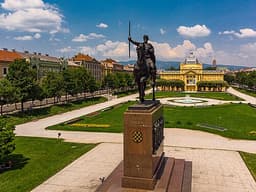
Tomislav of Croatia
Emperor · Medieval
47.2Total
Basic Information
Born
1165
753
Died
1223
928
Era
Medieval
Medieval
Nationality
France
Croatia
Occupation
Emperor
Emperor
Civilization
Western
Western
Score Comparison
Military (10%)
76.0
10.0
Political (20%)
70.0
45.1
Influence (20%)
55.0
54.9
Legacy (20%)
55.0
45.8
Leadership (15%)
78.0
65.0
Strategy (15%)
66.3
45.0
TOTAL
63.9
47.2
Philip II Augustus — Complete Timeline
1180 AD
Granting of Charters to TownsReform
Philip II Augustus granted charters to many towns in the royal domain, granting them self-governance and privileges. This policy encouraged urban growth and trade. It also strengthened the monarchy by gaining the support of the bourgeoisie.
ChartersUrbanizationReform
Impact: regionalconstructive
1182 AD
Expulsion of the Jews from FrancePolitical Action◆ Major
Philip II Augustus expelled the Jews from the French royal domain and confiscated their property. The expulsion was motivated by religious and financial reasons. It was a harsh measure that disrupted Jewish communities and set a precedent for later persecutions.
ExpulsionJewsPersecution
Impact: regionaldestructive
1190 AD
Construction of the Louvre FortressCultural
Philip II Augustus ordered the construction of the Louvre Fortress in Paris. The fortress was built to defend the city from English attacks. It later became the Louvre Palace and eventually the Louvre Museum, a symbol of French culture.
ArchitectureParisFortification
constructive
1204 AD
Conquest of NormandyWar◆ Major
Philip II Augustus conquered Normandy from King John of England. He captured the castle of Ch
ConquestNormandyFrance
Impact: regionalconstructive
1214 AD
Battle of BouvinesWar◆ Major
Philip II Augustus defeated a coalition of English, Flemish, and German forces at the Battle of Bouvines. This victory secured French control over the territories of Normandy, Anjou, and Maine. It also strengthened the French monarchy and weakened the Angevin Empire.
BattleFranceAngevin Empire
Impact: regionalconstructive
Tomislav of Croatia — Complete Timeline
925 AD
Coronation as King of CroatiaPolitical Action
Tomislav was crowned the first king of Croatia by Pope John X. His coronation established the Kingdom of Croatia and recognized his authority over both Pannonian and Dalmatian Croatia.
CoronationKingdomUnification
Impact: regionalconstructive
Unification of Pannonian and Dalmatian CroatiaPolitical Action◆ Major
Tomislav united the duchies of Pannonian Croatia and Dalmatian Croatia under his rule. This unification created a single Croatian state for the first time, laying the foundation for the medieval Kingdom of Croatia.
UnificationState FormationMedieval
Impact: regionalconstructive
926 AD
Battle of the Bosnian HighlandsWar◆ Major
Tomislav defeated the Bulgarian Empire under Tsar Simeon I in the Battle of the Bosnian Highlands. This victory prevented Bulgarian expansion into Croatia and secured Croatian independence.
BattleBulgarian EmpireIndependence
Impact: regionalconstructive
Expert Analysis
Origins
Philip II Augustus was born in 1165 in Paris, son of King Louis VII and Adela of Champagne. He inherited a kingdom with limited royal domain, overshadowed by powerful vassals like the Plantagenets. His education was typical for a medieval prince, focusing on military and administrative skills. In contrast, Tomislav of Croatia emerged in the early 10th century, likely born around 910. He was a duke of the Croats, ruling over Pannonian Croatia, a region fragmented by tribal divisions. Little is known of his early life, but he rose from a ducal line that had fought for independence from Frankish and Byzantine influence.
Rise to Power
Philip became king at age 15 in 1180, after his father's death. He quickly asserted authority, marrying Isabella of Hainaut to gain the county of Artois. His early reign focused on undermining the Angevin Empire of Henry II of England. By exploiting conflicts between Henry and his sons, Philip gained territories like Vexin in 1185. Tomislav's rise is less documented. He was recognized as Duke of the Croats by 910 and sought to unify the Croatian lands. His coronation as king in 925 by Pope John X at the Council of Split marked a turning point, giving him legitimacy and papal support. This event unified Pannonian and Dalmatian Croatia into a single kingdom.
Leadership & Governance
Philip II Augustus was a master of medieval statecraft. He expanded the royal domain from a small area around Paris to include Normandy, Maine, Anjou, and others. He reformed administration by appointing bailiffs (baillis) to oversee justice and finance in the domains. He also granted charters to towns, fostering urban growth and loyalty. His governance scored 70.0 in political acumen. Tomislav, with a political score of 45.1, ruled a less centralized state. He relied on tribal loyalty and the Church. He convened church councils to strengthen ties with the papacy. However, his kingdom lacked the bureaucratic machinery of France. Tomislav's leadership score of 65.0 reflects his ability to unite warring duchies, but his governance was more personal than institutional.
Triumph & Tragedy
Philip's greatest triumph was the Battle of Bouvines in 1214, where he defeated a coalition of King John of England, Emperor Otto IV, and Count Ferrand of Flanders. This victory secured French control over conquered territories and broke Angevin power. His conquest of Normandy in 1204 doubled the royal domain. However, his expulsion of Jews in 1182 was a moral and economic failure, costing him skilled financiers and drawing criticism. Tomislav's triumph was the Battle of the Bosnian Highlands in 926, where he defeated Tsar Simeon I of Bulgaria, preventing Bulgarian expansion. His unification of Croatia was his lasting achievement. Yet, his kingdom fragmented after his death, and he failed to establish a stable succession, leading to civil war. His military score of 10.0 is low, likely due to limited records, but his victory over Bulgaria suggests strategic skill.
Character & Destiny
Philip was shrewd, patient, and calculating. He often outmaneuvered his rivals through diplomacy and timing. His character is reflected in his strategy score of 66.3. He was known for his piety but also pragmatism, as when he married and then divorced Ingeborg of Denmark for political reasons. Tomislav is portrayed as a unifier and defender of Christendom. His coronation by the Pope indicates his diplomatic skill. However, his reliance on personal authority meant his kingdom lacked durable institutions. His destiny was to be remembered as the first king, but his realm did not survive intact.
Legacy
Philip II Augustus's legacy is foundational for France. He transformed a weak monarchy into a dominant power. The Louvre Fortress, built by him, became a symbol of royal authority. His administrative reforms influenced later French kings. His legacy score of 55.0 reflects his enduring impact on state-building. Tomislav's legacy is as the first king of Croatia, a national symbol. He is celebrated in Croatian history for unity and independence. However, his kingdom dissolved, and Croatia later entered personal union with Hungary. His influence score of 54.9 is similar to Philip's, but his tangible impact on governance is less.
Conclusion
Philip II Augustus had greater impact due to his scores of 63.9 overall compared to Tomislav's 47.2. Philip's military (76.0) and political (70.0) achievements reshaped Western Europe, establishing France as a major power. Tomislav's unification of Croatia was significant but temporary. Philip's administrative innovations outlasted him, while Tomislav's kingdom crumbled. The data supports Philip as the more influential figure in medieval history.
Rankings
🥇
Philip II AugustusLeader
Mil: 76.0Pol: 70.0Inf: 55.0
63.9
🥈
Tomislav of Croatia
Mil: 10.0Pol: 45.1Inf: 54.9
47.2
+16.7 behind
How This Comparison Works
Algorithm
Each figure is scored on 6 dimensions (0—100 scale) based on structured historical data: Military (10%), Political (20%), Influence (20%), Legacy (20%), Leadership (15%), Strategy (15%). The weighted total produces the final ranking.
Data Sources
Scores are computed from structured sub-indicators in the database. Scale factors adjust for era (Ancient ×0.85, Modern ×1.0) and civilization size (Eastern ×1.05, Other ×0.80) to account for differences in population and military scale.
Maximum 3 Figures
Comparisons are limited to 2—3 figures to ensure readability and statistical meaningfulness.
Error Margins
±5 points per dimension — Sub-scores are derived from historical records with inherent uncertainty. Two figures within 5 points on a dimension should be considered roughly equivalent in that area.
Total Score Accuracy
±3 points overall — The weighted combination of 6 dimensions produces a total score with approximately ±3 points of uncertainty. Differences of less than 3 points are not statistically significant— the figures are effectively tied.
Known Limitations
- Historical records are incomplete and uneven across civilizations
- Figures from oral-tradition societies may be underrepresented
- Occupation labels can misclassify multi-role figures
- Scores measure capability and impact, not moral character
- Quantitative scoring is a comparison tool, not absolute truth
Capability Radar
Military (10%) — Battles & Warfare
Battles
75
35
Win Rate
80
40
Expansion
85
45
Political (20%) — Governance & Reform
Reform
80
40
Diplomacy
85
50
Economy
70
35
Influence (20%) — Cultural & Global Reach
Cultural
60
40
Global
60
20
Legacy (20%) — Historical Impact
Historical
75
45
Longevity
70
30
Leadership (15%) — Power & Stability
Tenure
85
55
Stability
75
45
Strategy (15%) — Tactics & Innovation
Strategy
85
35
Tactics
70
30
Reform
60
25
Similar Comparisons
Comments & Discussion
No comments yet. Be the first to share your thoughts!