Loading...
This comparison has not been analyzed yet.
One-time AI generation (~1 minute). Scores and timeline are already available below.
Frank Forde vs K. R. Narayanan
K. R. Narayanan leads by 15.5 pts · 2 figures compared
…
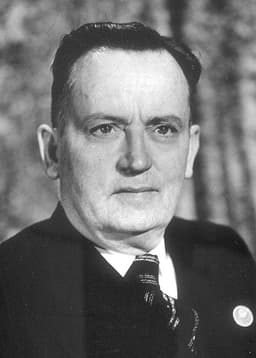
Frank Forde
Politician · Modern
38.0Total

K. R. Narayanan
Politician · Modern
53.5Total
Basic Information
Born
1890
1920
Died
1983
—
Era
Modern
Modern
Nationality
Australia
India
Occupation
Politician
Politician
Civilization
Western
Indian
Score Comparison
Military (10%)
50.0
18.6
Political (20%)
26.4
62.7
Influence (20%)
45.5
58.3
Legacy (20%)
35.8
52.0
Leadership (15%)
31.2
72.0
Strategy (15%)
40.5
38.4
TOTAL
38.0
53.5
Frank Forde — Complete Timeline
1941 AD
Appointed Minister for the ArmyPolitical Action◆ Major
Forde was appointed Minister for the Army in John Curtin's Labor government. He oversaw Australia's military operations during World War II, including the defense against Japanese advances in the Pacific.
World War IIMilitary Administration
Impact: national
1945 AD
Became Prime Minister of AustraliaPolitical Action◆ Major
Forde became Prime Minister on 6 July 1945 following the death of John Curtin. He served for only 8 days until Ben Chifley was elected as Labor leader and succeeded him.
Prime MinisterShortest Tenure
Impact: national
1946 AD
Australian Ambassador to CanadaPolitical Action
After leaving politics, Forde was appointed as Australia's first High Commissioner to Canada. He served in this diplomatic role until 1953, representing Australian interests in North America.
DiplomacyPost-Political Career
Impact: nationalconstructive
K. R. Narayanan — Complete Timeline
1980 AD
Appointed Ambassador to the United StatesPolitical Action◆ Major
K. R. Narayanan was appointed as India's Ambassador to the United States, serving from 1980 to 1984. He played a key role in strengthening Indo-US relations during a period of strategic alignment.
DiplomacyAmbassadorUS
Impact: nationalconstructive
1992 AD
Elected Vice President of IndiaPolitical Action◆ Major
K. R. Narayanan was elected as the Vice President of India, serving from 1992 to 1997. He also served as the Chairman of the Rajya Sabha, presiding over the upper house of Parliament.
Vice PresidentRajya SabhaConstitutional
Impact: nationalconstructive
1997 AD
Elected President of IndiaPolitical Action◆ Major
K. R. Narayanan was elected as the 10th President of India, becoming the first Dalit to hold the office. His election was seen as a landmark for social justice and representation.
PresidencyDalitElection
Impact: nationalconstructive
1998 AD
Dissolved Lok Sabha in 1998Political Action◆ Major
President K. R. Narayanan dissolved the Lok Sabha in 1998 after the Vajpayee government lost a confidence motion. He played a constitutional role in the political crisis, ensuring democratic processes were followed.
ConstitutionalDissolutionCrisis
Impact: national
2000 AD
Delivered address on UN reformPolitical Action
President K. R. Narayanan addressed the UN Millennium Summit, advocating for reform of the United Nations Security Council and greater representation for developing nations. He emphasized India's commitment to global peace.
UNReformDiplomacy
Impact: globalconstructive
This comparison has not been analyzed yet.
One-time AI generation (~1 minute). Scores and timeline are already available below.
Rankings
🥇
K. R. NarayananLeader
Mil: 18.6Pol: 62.7Inf: 58.3
53.5
🥈
Frank Forde
Mil: 50.0Pol: 26.4Inf: 45.5
38.0
+15.5 behind
How This Comparison Works
Algorithm
Each figure is scored on 6 dimensions (0—100 scale) based on structured historical data: Military (10%), Political (20%), Influence (20%), Legacy (20%), Leadership (15%), Strategy (15%). The weighted total produces the final ranking.
Data Sources
Scores are computed from structured sub-indicators in the database. Scale factors adjust for era (Ancient ×0.85, Modern ×1.0) and civilization size (Eastern ×1.05, Other ×0.80) to account for differences in population and military scale.
Maximum 3 Figures
Comparisons are limited to 2—3 figures to ensure readability and statistical meaningfulness.
Error Margins
±5 points per dimension — Sub-scores are derived from historical records with inherent uncertainty. Two figures within 5 points on a dimension should be considered roughly equivalent in that area.
Total Score Accuracy
±3 points overall — The weighted combination of 6 dimensions produces a total score with approximately ±3 points of uncertainty. Differences of less than 3 points are not statistically significant— the figures are effectively tied.
Known Limitations
- Historical records are incomplete and uneven across civilizations
- Figures from oral-tradition societies may be underrepresented
- Occupation labels can misclassify multi-role figures
- Scores measure capability and impact, not moral character
- Quantitative scoring is a comparison tool, not absolute truth
Capability Radar
Military (10%) — Battles & Warfare
Battles
27
25
Win Rate
32
25
Expansion
35
29
Political (20%) — Governance & Reform
Reform
10
55
Diplomacy
15
65
Economy
10
50
Influence (20%) — Cultural & Global Reach
Cultural
5
55
Global
5
55
Legacy (20%) — Historical Impact
Historical
10
60
Longevity
5
50
Leadership (15%) — Power & Stability
Tenure
5
60
Stability
10
60
Strategy (15%) — Tactics & Innovation
Strategy
35
31
Tactics
40
37
Reform
42
37
Similar Comparisons
Comments & Discussion
No comments yet. Be the first to share your thoughts!