Loading...
Frank Forde vs Kaja Kallas
Kaja Kallas leads by 11.7 pts · 2 figures compared
…
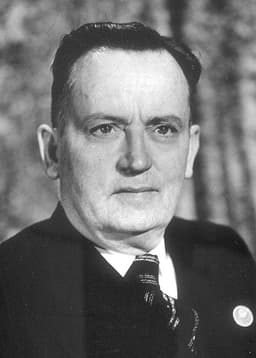
Frank Forde
Politician · Modern
38.0Total

Kaja Kallas
Politician · Modern
49.7Total
Basic Information
Born
1890
1977
Died
1983
—
Era
Modern
Modern
Nationality
Australia
Estonia
Occupation
Politician
Politician
Civilization
Western
Western
Score Comparison
Military (10%)
50.0
19.7
Political (20%)
26.4
60.0
Influence (20%)
45.5
56.4
Legacy (20%)
35.8
41.7
Leadership (15%)
31.2
72.0
Strategy (15%)
40.5
34.0
TOTAL
38.0
49.7
Frank Forde — Complete Timeline
1941 AD
Appointed Minister for the ArmyPolitical Action◆ Major
Forde was appointed Minister for the Army in John Curtin's Labor government. He oversaw Australia's military operations during World War II, including the defense against Japanese advances in the Pacific.
World War IIMilitary Administration
Impact: national
1945 AD
Became Prime Minister of AustraliaPolitical Action◆ Major
Forde became Prime Minister on 6 July 1945 following the death of John Curtin. He served for only 8 days until Ben Chifley was elected as Labor leader and succeeded him.
Prime MinisterShortest Tenure
Impact: national
1946 AD
Australian Ambassador to CanadaPolitical Action
After leaving politics, Forde was appointed as Australia's first High Commissioner to Canada. He served in this diplomatic role until 1953, representing Australian interests in North America.
DiplomacyPost-Political Career
Impact: nationalconstructive
Kaja Kallas — Complete Timeline
2021 AD
Appointed Prime Minister of EstoniaPolitical Action◆ Major
Kallas became Estonia's first female prime minister, leading a coalition government. She was the leader of the Reform Party and previously served as a Member of the European Parliament.
Prime MinisterFirst FemaleCoalition
Impact: nationalconstructive
2022 AD
Strong Support for Ukraine During Russian InvasionPolitical Action◆ Major
Kallas became a leading European voice in supporting Ukraine after Russia's full-scale invasion. Estonia provided significant military and humanitarian aid, and Kallas advocated for EU sanctions against Russia.
UkraineSanctionsForeign Policy
Impact: globalconstructive
Resignation Over Coalition DisputePolitical Action
Kallas resigned as prime minister after a dispute with coalition partner the Center Party over family benefits. She was reappointed days later leading a new coalition with the Social Democrats and Isamaa.
ResignationCoalitionPolitical Crisis
Impact: national
2024 AD
Nominated as EU Foreign Policy ChiefPolitical Action◆ Major
Kallas was nominated by EU leaders to become the High Representative of the Union for Foreign Affairs and Security Policy, succeeding Josep Borrell. She was expected to take office later in 2024.
EUForeign PolicyAppointment
Impact: globalconstructive
Expert Analysis
Origins
Frank Forde was born on 18 July 1890 in Mitchell, Queensland, Australia. His father was a farmer, and Forde left school at 12 to work. He later became a railway clerk and joined the Australian Labor Party. Kaja Kallas was born on 18 June 1977 in Tallinn, Estonia. Her mother was a diplomat and her father was a businessman; her great-grandfather was Estonia's first prime minister. She studied law at the University of Tartu and later at the European College of Bruges.
Rise to Power
Forde entered federal parliament in 1922, representing the seat of Capricornia. He held various ministerial roles, including Minister for the Army (1941-1945) under John Curtin, where he managed Australia's WWII military operations. After Curtin's death on 5 July 1945, Forde became Prime Minister on 6 July 1945 but served only 8 days until Ben Chifley won the Labor leadership on 13 July 1945. Kallas was elected to the Estonian parliament in 2011 and became a Member of the European Parliament in 2014. She led the Reform Party to victory in the 2019 parliamentary election and became Prime Minister on 26 January 2021, Estonia's first female PM.
Leadership & Governance
Forde's leadership was brief and constrained; his main governance act was overseeing the transition of power. As Minister for the Army, he scored 31.2 in leadership and 40.5 in strategy, reflecting his administrative role. Kallas, with a leadership score of 72.0, led Estonia through the COVID-19 pandemic and the Russian invasion of Ukraine. She implemented digital governance reforms and maintained a balanced budget. Her political score of 60.0 compares to Forde's 26.4, indicating her greater political acumen.
Triumph & Tragedy
Forde's greatest success was his service as Minister for the Army during WWII, where he contributed to Australia's war effort. His tragedy was his 8-day prime ministership, the shortest in Australian history, leaving no legislative legacy. Kallas's triumph was her strong support for Ukraine after Russia's 2022 invasion, providing military aid equal to 1% of Estonia's GDP. Her tragedy was a coalition dispute in 2022 that led to her temporary resignation, though she was swiftly reappointed.
Character & Destiny
Forde was a loyal party man, described as dutiful but not ambitious. His character led to him being passed over for leadership. Kallas is decisive and outspoken, traits that made her a leading European voice against Russian aggression. Her destiny was shaped by her family's political history and her own assertiveness.
Legacy
Forde's legacy is minimal: he is remembered as Australia's shortest-serving PM. His influence score of 45.5 reflects his wartime role. Kallas's legacy is growing: she has influenced EU foreign policy and Estonia's digital governance. Her legacy score of 41.7 is modest but likely to increase.
Conclusion
Kaja Kallas has had a greater impact than Frank Forde. Her leadership score (72.0 vs 31.2), political score (60.0 vs 26.4), and total score (49.7 vs 38.0) all indicate her superior effectiveness. While Forde served in a critical wartime role, his brief prime ministership limits his historical significance. Kallas has shaped Estonia's modern trajectory and European security.
Rankings
🥇
Kaja KallasLeader
Mil: 19.7Pol: 60.0Inf: 56.4
49.7
🥈
Frank Forde
Mil: 50.0Pol: 26.4Inf: 45.5
38.0
+11.7 behind
How This Comparison Works
Algorithm
Each figure is scored on 6 dimensions (0—100 scale) based on structured historical data: Military (10%), Political (20%), Influence (20%), Legacy (20%), Leadership (15%), Strategy (15%). The weighted total produces the final ranking.
Data Sources
Scores are computed from structured sub-indicators in the database. Scale factors adjust for era (Ancient ×0.85, Modern ×1.0) and civilization size (Eastern ×1.05, Other ×0.80) to account for differences in population and military scale.
Maximum 3 Figures
Comparisons are limited to 2—3 figures to ensure readability and statistical meaningfulness.
Error Margins
±5 points per dimension — Sub-scores are derived from historical records with inherent uncertainty. Two figures within 5 points on a dimension should be considered roughly equivalent in that area.
Total Score Accuracy
±3 points overall — The weighted combination of 6 dimensions produces a total score with approximately ±3 points of uncertainty. Differences of less than 3 points are not statistically significant— the figures are effectively tied.
Known Limitations
- Historical records are incomplete and uneven across civilizations
- Figures from oral-tradition societies may be underrepresented
- Occupation labels can misclassify multi-role figures
- Scores measure capability and impact, not moral character
- Quantitative scoring is a comparison tool, not absolute truth
Capability Radar
Military (10%) — Battles & Warfare
Battles
27
23
Win Rate
32
28
Expansion
35
28
Political (20%) — Governance & Reform
Reform
10
60
Diplomacy
15
70
Economy
10
65
Influence (20%) — Cultural & Global Reach
Cultural
5
30
Global
5
50
Legacy (20%) — Historical Impact
Historical
10
40
Longevity
5
20
Leadership (15%) — Power & Stability
Tenure
5
55
Stability
10
55
Strategy (15%) — Tactics & Innovation
Strategy
35
31
Tactics
40
32
Reform
42
40
Similar Comparisons
Comments & Discussion
No comments yet. Be the first to share your thoughts!