Loading...
Francis II vs Gojong of Korea
Gojong of Korea leads by 8.2 pts · 2 figures compared
…

Francis II
Emperor · Modern
47.3Total
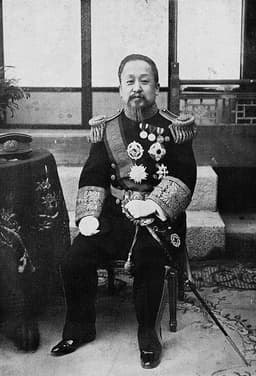
Gojong of Korea
Emperor · Modern
55.5Total
Basic Information
Born
1768
1852
Died
1835
1919
Era
Modern
Modern
Nationality
Holy Roman Empire
Korea
Occupation
Emperor
Emperor
Civilization
Western
Eastern
Score Comparison
Military (10%)
10.2
43.3
Political (20%)
46.6
68.0
Influence (20%)
53.3
60.0
Legacy (20%)
46.7
50.0
Leadership (15%)
65.0
53.2
Strategy (15%)
45.0
54.6
TOTAL
47.3
55.5
Francis II — Complete Timeline
1805 AD
Battle of AusterlitzWar◆ Major
Francis II's Russian and Austrian armies were decisively defeated by Napoleon at Austerlitz. The defeat forced Austria to sign the Treaty of Pressburg, ceding territory to France and Bavaria and ending the Third Coalition. It led directly to the dissolution of the Holy Roman Empire.
Napoleonic WarsBattleThird Coalition
Impact: globaldestructive
1806 AD
Dissolved the Holy Roman EmpirePolitical Action
Francis II, facing Napoleon's creation of the Confederation of the Rhine and the threat of French invasion, abdicated as Holy Roman Emperor and dissolved the empire. This ended the thousand-year-old institution, and Francis continued as Emperor of Austria (Francis I).
Holy Roman EmpireNapoleonDissolution
Impact: global
1810 AD
Married Marie Louise of AustriaPolitical Action
Francis II arranged the marriage of his daughter Marie Louise to Napoleon Bonaparte, sealing the Treaty of Sch
NapoleonMarriageAlliance
Impact: regional
1814 AD
Congress of ViennaPolitical Action
Francis II (as Emperor Francis I of Austria) hosted the Congress of Vienna, which redrew the map of Europe after Napoleon's defeat. Austria gained territory in Italy and Germany, and the congress established a conservative order that lasted until the revolutions of 1848.
Congress of ViennaPost-NapoleonicDiplomacy
Impact: global
Gojong of Korea — Complete Timeline
1897 AD
Proclamation of the Korean EmpirePolitical Action
Gojong declared Korea an empire, assuming the title of Emperor. This was an attempt to assert Korea's sovereignty and equal status with China and Japan, and to modernize the state. The move was partly a response to the assassination of his wife, Empress Myeongseong.
Korean EmpireSovereigntyModernization
Impact: nationalconstructive
1905 AD
Signing of the Japan-Korea Treaty of 1905Political Action
Under Japanese pressure, Gojong's government signed the Eulsa Treaty, making Korea a Japanese protectorate. Gojong did not sign the treaty himself and later attempted to appeal to international powers, but the treaty stripped Korea of its diplomatic sovereignty.
TreatyJapanese ProtectorateLoss of Sovereignty
Impact: nationaltragic
1907 AD
Forced Abdication by JapanPolitical Action◆ Major
Japanese authorities forced Gojong to abdicate in favor of his son, Sunjong, after Gojong sent a secret envoy to the Hague Peace Conference to protest Japanese control. The abdication was part of Japan's consolidation of power over Korea.
AbdicationJapanese ImperialismHague Secret Envoy Affair
Impact: nationaltragic
1919 AD
Death and Funeral of GojongOther
Gojong died suddenly, with rumors of poisoning by Japanese agents. His funeral on March 1, 1919, became a catalyst for the March First Movement, a massive nationwide protest against Japanese rule. The movement was brutally suppressed but galvanized Korean independence efforts.
DeathMarch First MovementKorean Independence
Impact: nationaltragic
Expert Analysis
Origins
Francis II (1768-1835) was born in Florence, the son of Leopold II of the Habsburg-Lorraine dynasty. He was raised in a strict, conservative court environment, receiving a traditional education focused on history, law, and languages. His early life was marked by the French Revolution, which deeply influenced his worldview. Gojong of Korea (1852-1919) was born in Seoul, the son of Prince Regent Heungseon Daewongun. He ascended the throne at age 12, with his father acting as regent. Gojong received a Confucian education and was immersed in the complex politics of the Joseon court, facing internal factions and external pressures from China, Japan, and Western powers.
Rise to Power
Francis II became Holy Roman Emperor in 1792 at age 24, inheriting a realm fragmented by revolutionary France. He immediately faced the French Revolutionary Wars, forming coalitions against France. His rise was a matter of dynastic succession, but his power was constrained by the growing influence of Napoleon. Gojong became king of Joseon in 1863, but his father, the Daewongun, ruled as regent until 1873. After the regency, Gojong took direct control, attempting to modernize Korea while preserving its sovereignty. In 1897, he declared the Korean Empire, assuming the title of Emperor to assert equal status with China and Japan.
Leadership & Governance
Francis II governed as an absolute monarch, relying on a conservative bureaucracy and the army. He opposed liberal reforms and nationalism, maintaining the old order. His governance was reactive, often responding to crises rather than initiating change. For example, he dissolved the Holy Roman Empire in 1806 to prevent Napoleon from claiming the crown, but this marked the end of a thousand-year institution. Gojong pursued a policy of 'enlightenment' (Gaehwa), promoting Western technology and institutions while trying to balance conservative and reformist factions. He established the Korean Empire, modernized the military, and sent envoys abroad. However, his leadership was weakened by court infighting and Japanese interference. Gojong's political score of 68.0 reflects his efforts to modernize, while Francis II's 46.6 indicates his struggle to adapt.
Triumph & Tragedy
Francis II's greatest triumph was his role after Napoleon's defeat, hosting the Congress of Vienna in 1815. He regained territories and established the Austrian Empire as a major power. His greatest tragedy was the dissolution of the Holy Roman Empire in 1806, a humiliating end to a venerable institution. The Battle of Austerlitz in 1805 was a devastating defeat, with combined Russian and Austrian forces crushed by Napoleon. Gojong's triumph was the proclamation of the Korean Empire in 1897, a bold assertion of sovereignty. He also initiated modern reforms, such as the telegraph and railway. His tragedy was the forced abdication in 1907 after the Eulsa Treaty of 1905 made Korea a Japanese protectorate. His death in 1919, possibly by poison, sparked the March First Movement, a massive independence protest. Gojong's military score of 43.3 and strategy of 54.6 reflect his inability to resist Japanese encroachment, while Francis II's scores are even lower (10.2 military, 45.0 strategy) due to his repeated military failures.
Character & Destiny
Francis II was cautious, conservative, and deeply religious, often indecisive. His character led him to rely on ministers like Metternich, who shaped Austrian policy. His destiny was to oversee the decline of the Holy Roman Empire and the rise of the Austrian Empire. Gojong was more progressive but also wavering, caught between isolationist and reformist advisors. His character led him to attempt diplomatic maneuvers, like sending a secret envoy to the Hague in 1907, but this backfired, leading to his abdication. Both rulers were products of their environments, but Gojong faced a more existential threat from Japan. Francis II, despite losses, managed to preserve the Habsburg legacy in Austria.
Legacy
Francis II is remembered as the last Holy Roman Emperor, a symbol of the old order's collapse. His legacy includes the Congress of Vienna, which established a balance of power in Europe for decades. The Austrian Empire he created lasted until 1918. Gojong is remembered as a patriot who tried to modernize Korea and resist Japan. His death sparked the March First Movement, a key event in Korean independence. The Korean Empire he proclaimed was short-lived (1897-1910), but his efforts laid groundwork for future nationalism. Francis II's legacy score is 46.7, while Gojong's is 50.0, reflecting the enduring impact of his symbolic resistance.
Conclusion
Gojong of Korea had a greater overall impact than Francis II, as measured by his higher total score (55.5 vs 47.3). While Francis II presided over the dissolution of an empire and the Congress of Vienna, his role was largely reactive. Gojong, despite his failures, actively sought to modernize and assert sovereignty against a more powerful adversary. His death catalyzed the March First Movement, which became a cornerstone of Korean identity. Francis II's legacy is tied to the end of the Holy Roman Empire, but Gojong's struggle against imperialism resonates more strongly in modern history. Therefore, Gojong's impact, though tragic, was more significant in shaping future events.
Rankings
🥇
Gojong of KoreaLeader
Mil: 43.3Pol: 68.0Inf: 60.0
55.5
🥈
Francis II
Mil: 10.2Pol: 46.6Inf: 53.3
47.3
+8.2 behind
How This Comparison Works
Algorithm
Each figure is scored on 6 dimensions (0—100 scale) based on structured historical data: Military (10%), Political (20%), Influence (20%), Legacy (20%), Leadership (15%), Strategy (15%). The weighted total produces the final ranking.
Data Sources
Scores are computed from structured sub-indicators in the database. Scale factors adjust for era (Ancient ×0.85, Modern ×1.0) and civilization size (Eastern ×1.05, Other ×0.80) to account for differences in population and military scale.
Maximum 3 Figures
Comparisons are limited to 2—3 figures to ensure readability and statistical meaningfulness.
Error Margins
±5 points per dimension — Sub-scores are derived from historical records with inherent uncertainty. Two figures within 5 points on a dimension should be considered roughly equivalent in that area.
Total Score Accuracy
±3 points overall — The weighted combination of 6 dimensions produces a total score with approximately ±3 points of uncertainty. Differences of less than 3 points are not statistically significant— the figures are effectively tied.
Known Limitations
- Historical records are incomplete and uneven across civilizations
- Figures from oral-tradition societies may be underrepresented
- Occupation labels can misclassify multi-role figures
- Scores measure capability and impact, not moral character
- Quantitative scoring is a comparison tool, not absolute truth
Capability Radar
Military (10%) — Battles & Warfare
Battles
10
5
Win Rate
10
5
Expansion
5
5
Political (20%) — Governance & Reform
Reform
30
40
Diplomacy
40
30
Economy
30
30
Influence (20%) — Cultural & Global Reach
Cultural
20
50
Global
30
40
Legacy (20%) — Historical Impact
Historical
50
60
Longevity
30
40
Leadership (15%) — Power & Stability
Tenure
60
60
Stability
20
20
Strategy (15%) — Tactics & Innovation
Strategy
5
5
Tactics
5
5
Reform
5
10
Similar Comparisons
Comments & Discussion
No comments yet. Be the first to share your thoughts!