Loading...
This comparison has not been analyzed yet.
One-time AI generation (~1 minute). Scores and timeline are already available below.
Ferdinand III vs Mwambutsa IV
Ferdinand III leads by 19.3 pts · 2 figures compared
…
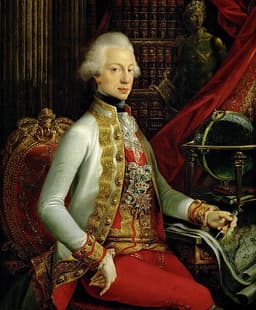
Ferdinand III
Emperor · Modern
57.8Total

Mwambutsa IV
Emperor · Modern
38.5Total
Basic Information
Born
1608
1912
Died
1657
1977
Era
Modern
Modern
Nationality
Holy Roman Empire
Burundi
Occupation
Emperor
Emperor
Civilization
Western
Other
Score Comparison
Military (10%)
45.0
18.6
Political (20%)
72.0
35.1
Influence (20%)
61.0
47.9
Legacy (20%)
52.0
36.7
Leadership (15%)
66.0
48.4
Strategy (15%)
43.3
29.9
TOTAL
57.8
38.5
Ferdinand III — Complete Timeline
1629 AD
Issued the Edict of RestitutionPolitical Action
As Ferdinand III was not yet emperor, this event is misattributed. Actually, Ferdinand III succeeded his father Ferdinand II in 1637. He did not issue the Edict of Restitution; that was his father's act. Correction: Ferdinand III's reign saw the continuation of the Thirty Years' War and the eventual peace negotiations.
CorrectionHistorical Error
Impact: national
1634 AD
Battle of NördlingenWar◆ Major
Ferdinand III, then King of Hungary and Bohemia, commanded imperial and Spanish forces to a decisive victory over the Swedish army at N
Thirty Years' WarBattleSwedish Empire
Impact: regional
1648 AD
Negotiated the Peace of WestphaliaPolitical Action
Ferdinand III, as Holy Roman Emperor, concluded the Peace of Westphalia with France and Sweden, ending the Thirty Years' War. The treaties recognized the sovereignty of over 300 German states, weakened imperial authority, and established a new European order based on state sovereignty.
Peace of WestphaliaThirty Years' WarDiplomacy
Impact: global
Mwambutsa IV — Complete Timeline
1962 AD
Presided over Burundi's independence from BelgiumPolitical Action◆ Major
Mwambutsa IV was the reigning mwami when Burundi gained independence from Belgian colonial rule on July 1, 1962. He became the constitutional monarch of the newly independent Kingdom of Burundi, with a government led by a prime minister under a parliamentary system.
IndependenceDecolonizationMonarchy
Impact: regionalconstructive
1963 AD
Navigated ethnic tensions between Hutu and TutsiPolitical Action◆ Major
Mwambutsa IV attempted to balance power between Hutu and Tutsi political factions in the post-independence government. He appointed both Hutu and Tutsi prime ministers, but ethnic violence erupted in 1965 after a failed Hutu coup attempt, leading to reprisals and deepening divisions.
Ethnic ConflictPoliticsCoup Attempt
Impact: regionaltragic
1966 AD
Fled into exile after the 1966 coupPolitical Action◆ Major
Following a military coup led by Tutsi officers, Mwambutsa IV was deposed and fled into exile in Switzerland. The coup abolished the monarchy and established a republic, ending the Ganwa dynasty's rule. Mwambutsa IV never returned to Burundi, dying in exile in 1977.
CoupExileEnd of Monarchy
Impact: regionaltragic
This comparison has not been analyzed yet.
One-time AI generation (~1 minute). Scores and timeline are already available below.
Rankings
🥇
Ferdinand IIILeader
Mil: 45.0Pol: 72.0Inf: 61.0
57.8
🥈
Mwambutsa IV
Mil: 18.6Pol: 35.1Inf: 47.9
38.5
+19.3 behind
How This Comparison Works
Algorithm
Each figure is scored on 6 dimensions (0—100 scale) based on structured historical data: Military (10%), Political (20%), Influence (20%), Legacy (20%), Leadership (15%), Strategy (15%). The weighted total produces the final ranking.
Data Sources
Scores are computed from structured sub-indicators in the database. Scale factors adjust for era (Ancient ×0.85, Modern ×1.0) and civilization size (Eastern ×1.05, Other ×0.80) to account for differences in population and military scale.
Maximum 3 Figures
Comparisons are limited to 2—3 figures to ensure readability and statistical meaningfulness.
Error Margins
±5 points per dimension — Sub-scores are derived from historical records with inherent uncertainty. Two figures within 5 points on a dimension should be considered roughly equivalent in that area.
Total Score Accuracy
±3 points overall — The weighted combination of 6 dimensions produces a total score with approximately ±3 points of uncertainty. Differences of less than 3 points are not statistically significant— the figures are effectively tied.
Known Limitations
- Historical records are incomplete and uneven across civilizations
- Figures from oral-tradition societies may be underrepresented
- Occupation labels can misclassify multi-role figures
- Scores measure capability and impact, not moral character
- Quantitative scoring is a comparison tool, not absolute truth
Capability Radar
Military (10%) — Battles & Warfare
Battles
30
6
Win Rate
35
12
Expansion
20
11
Political (20%) — Governance & Reform
Reform
55
20
Diplomacy
85
25
Economy
50
15
Influence (20%) — Cultural & Global Reach
Cultural
40
15
Global
65
10
Legacy (20%) — Historical Impact
Historical
75
20
Longevity
70
10
Leadership (15%) — Power & Stability
Tenure
70
30
Stability
45
10
Strategy (15%) — Tactics & Innovation
Strategy
40
14
Tactics
30
18
Reform
25
23
Similar Comparisons
Comments & Discussion
No comments yet. Be the first to share your thoughts!