Loading...
Ferdinand III vs Julius Caesar
Julius Caesar leads by 25.0 pts · 2 figures compared
…
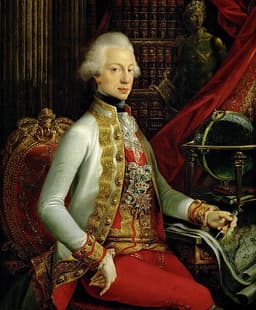
Ferdinand III
Emperor · Modern
57.8Total

Julius Caesar
General · Ancient
82.8Total
Basic Information
Born
1608
-100
Died
1657
-44
Era
Modern
Ancient
Nationality
Holy Roman Empire
Roman Republic
Occupation
Emperor
General
Civilization
Western
Western
Score Comparison
Military (10%)
45.0
88.0
Political (20%)
72.0
78.0
Influence (20%)
61.0
85.0
Legacy (20%)
52.0
82.0
Leadership (15%)
66.0
80.0
Strategy (15%)
43.3
85.0
TOTAL
57.8
82.8
Ferdinand III — Complete Timeline
1629 AD
Issued the Edict of RestitutionPolitical Action
As Ferdinand III was not yet emperor, this event is misattributed. Actually, Ferdinand III succeeded his father Ferdinand II in 1637. He did not issue the Edict of Restitution; that was his father's act. Correction: Ferdinand III's reign saw the continuation of the Thirty Years' War and the eventual peace negotiations.
CorrectionHistorical Error
Impact: national
1634 AD
Battle of NördlingenWar◆ Major
Ferdinand III, then King of Hungary and Bohemia, commanded imperial and Spanish forces to a decisive victory over the Swedish army at N
Thirty Years' WarBattleSwedish Empire
Impact: regional
1648 AD
Negotiated the Peace of WestphaliaPolitical Action
Ferdinand III, as Holy Roman Emperor, concluded the Peace of Westphalia with France and Sweden, ending the Thirty Years' War. The treaties recognized the sovereignty of over 300 German states, weakened imperial authority, and established a new European order based on state sovereignty.
Peace of WestphaliaThirty Years' WarDiplomacy
Impact: global
Julius Caesar — Complete Timeline
58 BC
Gallic WarsWar◆ Major
Caesar, as proconsul of Gaul, launched a series of campaigns that conquered all of Gaul (modern France, Belgium, and parts of Switzerland). He fought numerous battles, including against the Helvetii, the Belgae, and the Gallic chieftain Vercingetorix. The wars brought immense wealth and a loyal army to Caesar.
Gallic WarsConquestRoman Expansion
Impact: regional
49 BC
Crossing the RubiconPolitical Action◆ Major
Caesar led Legio XIII across the Rubicon River into Italy, defying the Roman Senate's order to disband his army. This act triggered a civil war against Pompey and the Optimates, ultimately leading to Caesar's dictatorship and the end of the Roman Republic.
Roman Civil WarEnd of RepublicPower Struggle
Impact: global
48 BC
Battle of PharsalusWar◆ Major
Caesar's outnumbered army defeated the larger forces of Pompey the Great at Pharsalus in Greece. Caesar's tactical use of a reserve line to counter Pompey's cavalry charge proved decisive. Pompey fled to Egypt, where he was assassinated, leaving Caesar as the undisputed master of the Roman world.
Roman Civil WarBattleDecisive Victory
Impact: regional
44 BC
Appointment as Dictator for LifePolitical Action◆ Major
The Roman Senate appointed Caesar dictator perpetuo (dictator for life), granting him unprecedented personal power. This move concentrated military, legislative, and judicial authority in one person, effectively ending the Roman Republic's traditional system of checks and balances and alarming many senators.
DictatorshipEnd of RepublicPower Consolidation
Impact: regionaldestructive
Assassination on the Ides of MarchPolitical Action◆ Major
A group of Roman senators, led by Marcus Junius Brutus and Gaius Cassius Longinus, stabbed Caesar to death at a meeting of the Senate in the Theatre of Pompey. The assassination was intended to restore the Republic, but instead triggered another civil war that led to the rise of the Roman Empire.
AssassinationRoman PoliticsEnd of Republic
Impact: globaldestructive
Expert Analysis
ferdinand-iii-vs-julius-caesar
# The Conqueror and the Peacemaker
On a January morning in 49 BCE, Julius Caesar stood at the banks of the Rubicon River in northern Italy, contemplating an act that would shatter centuries of Roman tradition. To cross with his legions was to declare civil war against the Senate. Across the continent, seventeen centuries later, another ruler faced his own Rubicon—not a river to cross, but a peace to sign. Ferdinand III, Holy Roman Emperor, put his name to the Peace of Westphalia in 1648, an act that would dismantle the very imperial authority he was sworn to uphold. One man chose war to seize absolute power; the other chose peace to preserve what remained of his. What drove these two Western leaders to such opposite destinies?
Origins
Caesar was born into the chaos of the late Roman Republic, a world of crumbling aristocratic norms and rising military strongmen. His family, the Julii, claimed descent from the goddess Venus, but their political influence had waned. Caesar grew up in a Rome where the Senate was paralyzed by factionalism, where generals like Marius and Sulla had already marched on the city. He was shaped by the conviction that the Republic could no longer govern itself—and that only a single, brilliant leader could save it.
Ferdinand III entered a very different world in 1608, born into the Habsburg dynasty that ruled the Holy Roman Empire. His father, Ferdinand II, was a devout Catholic who had ignited the Thirty Years' War by trying to impose religious uniformity on a fractured Germany. Young Ferdinand was raised in the shadow of a conflict that had already consumed millions of lives. Where Caesar saw opportunity in chaos, Ferdinand saw exhaustion. His education emphasized diplomacy and law, not battlefield glory. The empire he inherited in 1637 was a bleeding corpse, and he knew it.
Rise to Power
Caesar’s path was audacious and illegal. He climbed the Republican ladder—quaestor, aedile, praetor, consul—but always with an eye on military command. In 58 BCE, he secured the governorship of Gaul and launched a brutal eight-year campaign that conquered a territory larger than Italy itself. His Commentaries on the Gallic Wars were not just military reports; they were propaganda masterpieces designed to make him the hero of Rome’s common people. When the Senate ordered him to disband his army, Caesar instead crossed the Rubicon in 49 BCE, famously declaring “*Alea iacta est*”—the die is cast. He gambled everything on his legions’ loyalty and his own genius.
Ferdinand III rose to power through inheritance and tragedy. He became King of Hungary and Bohemia in 1625, and his first major test came at the Battle of Nördlingen in 1634. As commander of imperial and Spanish forces, he achieved a decisive victory over the Swedes—a rare moment of Habsburg triumph in a war defined by stalemate and atrocity. But unlike Caesar, Ferdinand did not use this victory to seize more power. He saw it as leverage for negotiation, not conquest. When he became emperor in 1637, he inherited a war that had already killed perhaps a third of Germany’s population. His rise was not a daring gamble but a grim responsibility.
Leadership & Governance
Caesar governed as a revolutionary. As dictator, he reformed the calendar, granted citizenship to provincials, redistributed land to veterans, and centralized authority in his own hands. He packed the Senate with his supporters and reduced it to a rubber stamp. His military genius was undeniable—the siege of Alesia in 52 BCE, the lightning campaign against Pompey at Pharsalus in 48 BCE—but his political wisdom was ruthless. He understood that the Republic was a shell, and he smashed it deliberately. His reforms were brilliant, but they were imposed by the sword.
Ferdinand III governed as a pragmatist in an age of exhaustion. He understood that the Holy Roman Empire could not be saved by force. The Peace of Westphalia in 1648 recognized the sovereignty of over three hundred German states, effectively ending any real imperial authority. Critics called it surrender; Ferdinand called it survival. He accepted that religious unity was dead, that the Habsburgs could not crush Protestantism, and that the empire would have to evolve into a looser confederation. His military strategy after Nördlingen was defensive and cautious—he fought not to win, but to negotiate from strength. Where Caesar built a new order by destroying the old, Ferdinand preserved a hollow crown by sacrificing its substance.
Triumph & Tragedy
Caesar’s greatest triumph was also his greatest tragedy. In 44 BCE, he was declared dictator for life—the highest honor the Republic could bestow, and the final proof that the Republic was dead. He planned campaigns against Parthia, reforms for the provinces, a new constitution. But on the Ides of March, a conspiracy of senators stabbed him to death in the Senate chamber. His assassination did not restore the Republic; it triggered another civil war that ended with his adopted heir, Octavian, becoming the first emperor. Caesar’s tragedy was that he destroyed the old world but did not live to build the new one.
Ferdinand’s tragedy was quieter but no less profound. He ended the Thirty Years' War, saving millions of lives, but at the cost of his dynasty’s dream of a unified Germany. The Peace of Westphalia is remembered as a milestone of modern international law—the birth of the sovereign state system. But for Ferdinand, it was a confession of failure. He died in 1657, his empire a patchwork of independent princes, his authority a shadow. His triumph was that he chose peace over pride; his tragedy was that he had to.
Character & Destiny
Caesar was reckless, ambitious, and charismatic. He forgave his enemies, slept with their wives, and spent money he did not have. He believed in his own star—literally, as he claimed descent from Venus. His character drove him to take risks that would have destroyed any other man. He crossed the Rubicon because he could not imagine losing. His destiny was to be murdered by the very men he had spared.
Ferdinand III was cautious, devout, and melancholic. He had seen war’s true face—the burned villages, the starving refugees, the plague that followed every army. He believed in duty, not destiny. His character drove him to accept limits that Caesar would have despised. He signed the Peace of Westphalia because he could not imagine winning. His destiny was to be remembered not as a conqueror, but as the emperor who let the empire go.
Legacy
Caesar’s legacy is the Roman Empire itself. His name became a title—Caesar, Kaiser, Tsar—carried by rulers for two millennia. His military tactics are still studied, his reforms still admired, his assassination still mourned. He is the archetype of the brilliant, doomed leader, the man who changed history by breaking it.
Ferdinand III’s legacy is the modern state system. The Peace of Westphalia established the principle of national sovereignty, non-interference in domestic affairs, and diplomatic equality among states. It is the foundation of international relations to this day. He is not a name known to schoolchildren, but his work shapes the world they inherit.
Conclusion
Standing on the banks of the Rubicon, Caesar saw a future of glory. Standing at the negotiating table in Münster, Ferdinand saw a future of exhaustion. One believed the world could be remade by a single will; the other believed it could only be endured. Both were right, and both were wrong. The conqueror built an empire that lasted centuries; the peacemaker built a system that still governs nations. In the end, their stories remind us that history does not reward only the bold. Sometimes, it rewards the patient—and sometimes, it rewards neither.
Rankings
🥇
Julius CaesarLeader
Mil: 88.0Pol: 78.0Inf: 85.0
82.8
🥈
Ferdinand III
Mil: 45.0Pol: 72.0Inf: 61.0
57.8
+25.0 behind
How This Comparison Works
Algorithm
Each figure is scored on 6 dimensions (0—100 scale) based on structured historical data: Military (10%), Political (20%), Influence (20%), Legacy (20%), Leadership (15%), Strategy (15%). The weighted total produces the final ranking.
Data Sources
Scores are computed from structured sub-indicators in the database. Scale factors adjust for era (Ancient ×0.85, Modern ×1.0) and civilization size (Eastern ×1.05, Other ×0.80) to account for differences in population and military scale.
Maximum 3 Figures
Comparisons are limited to 2—3 figures to ensure readability and statistical meaningfulness.
Error Margins
±5 points per dimension — Sub-scores are derived from historical records with inherent uncertainty. Two figures within 5 points on a dimension should be considered roughly equivalent in that area.
Total Score Accuracy
±3 points overall — The weighted combination of 6 dimensions produces a total score with approximately ±3 points of uncertainty. Differences of less than 3 points are not statistically significant— the figures are effectively tied.
Known Limitations
- Historical records are incomplete and uneven across civilizations
- Figures from oral-tradition societies may be underrepresented
- Occupation labels can misclassify multi-role figures
- Scores measure capability and impact, not moral character
- Quantitative scoring is a comparison tool, not absolute truth
Capability Radar
Military (10%) — Battles & Warfare
Battles
30
95
Win Rate
35
92
Expansion
20
97
Political (20%) — Governance & Reform
Reform
55
90
Diplomacy
85
85
Economy
50
82
Influence (20%) — Cultural & Global Reach
Cultural
40
88
Global
65
94
Legacy (20%) — Historical Impact
Historical
75
95
Longevity
70
96
Leadership (15%) — Power & Stability
Tenure
70
75
Stability
45
60
Strategy (15%) — Tactics & Innovation
Strategy
40
94
Tactics
30
96
Reform
25
88
Similar Comparisons
Comments & Discussion
No comments yet. Be the first to share your thoughts!