Loading...
Charles VII vs Ferdinand III
Ferdinand III leads by 7.4 pts · 2 figures compared
…

Charles VII
Emperor · Modern
50.4Total
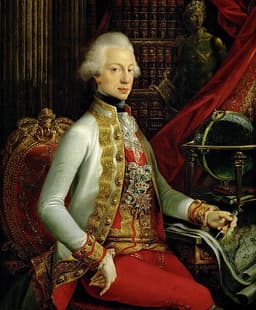
Ferdinand III
Emperor · Modern
57.8Total
Basic Information
Born
1697
1608
Died
1745
1657
Era
Modern
Modern
Nationality
Holy Roman Empire
Holy Roman Empire
Occupation
Emperor
Emperor
Civilization
Western
Western
Score Comparison
Military (10%)
55.0
45.0
Political (20%)
46.6
72.0
Influence (20%)
50.2
61.0
Legacy (20%)
40.0
52.0
Leadership (15%)
62.2
66.0
Strategy (15%)
60.0
43.3
TOTAL
50.4
57.8
Charles VII — Complete Timeline
1742 AD
Lost Bavaria to Austrian occupationWar◆ Major
After his election, Austrian forces under Maria Theresa invaded and occupied Bavaria, Charles VII's hereditary lands. He was forced to flee to Frankfurt, and his rule as emperor was largely nominal, as he lacked effective control over the empire.
War of the Austrian SuccessionOccupationBavaria
Impact: regionaldestructive
Elected Holy Roman EmperorPolitical Action◆ Major
Charles VII, a Wittelsbach prince, was elected Holy Roman Emperor during the War of the Austrian Succession, becoming the first non-Habsburg emperor in over 300 years. His election was supported by France and Prussia, challenging Habsburg dominance.
ElectionWar of the Austrian SuccessionWittelsbach
Impact: regional
1745 AD
Died in exileOther
Charles VII died in Munich shortly after returning from exile, ending his brief and troubled reign. His death allowed the Habsburgs to regain the imperial title, as his son Maximilian III Joseph made peace with Maria Theresa.
DeathExilePeace
Impact: regionaltragic
Ferdinand III — Complete Timeline
1629 AD
Issued the Edict of RestitutionPolitical Action
As Ferdinand III was not yet emperor, this event is misattributed. Actually, Ferdinand III succeeded his father Ferdinand II in 1637. He did not issue the Edict of Restitution; that was his father's act. Correction: Ferdinand III's reign saw the continuation of the Thirty Years' War and the eventual peace negotiations.
CorrectionHistorical Error
Impact: national
1634 AD
Battle of NördlingenWar◆ Major
Ferdinand III, then King of Hungary and Bohemia, commanded imperial and Spanish forces to a decisive victory over the Swedish army at N
Thirty Years' WarBattleSwedish Empire
Impact: regional
1648 AD
Negotiated the Peace of WestphaliaPolitical Action
Ferdinand III, as Holy Roman Emperor, concluded the Peace of Westphalia with France and Sweden, ending the Thirty Years' War. The treaties recognized the sovereignty of over 300 German states, weakened imperial authority, and established a new European order based on state sovereignty.
Peace of WestphaliaThirty Years' WarDiplomacy
Impact: global
Expert Analysis
Origins
Charles VII, born in 1697, was a Wittelsbach prince from the House of Bavaria. His father, Maximilian II Emanuel, was a prominent elector who sought to elevate his family's status within the Holy Roman Empire. Charles was educated in military and political affairs, preparing for rule. In contrast, Ferdinand III, born in 1608 in Graz, was a Habsburg archduke, the son of Emperor Ferdinand II. He was raised in a deeply Catholic environment, shaped by the Counter-Reformation and the ongoing Thirty Years' War. His early education emphasized piety, statecraft, and military command.
Rise to Power
Charles VII rose to power through the War of the Austrian Succession. In 1742, he was elected Holy Roman Emperor, succeeding Charles VI, the last Habsburg male. This election was a major blow to the Habsburgs, as Charles VII became the first non-Habsburg emperor in over 300 years. However, his position was precarious. Meanwhile, Ferdinand III ascended as King of Hungary and Bohemia in 1625 and 1627 respectively, and succeeded his father as emperor in 1637. His rise was marked by military command: at the Battle of Nördlingen in 1634, he led imperial and Spanish forces to a decisive victory over the Swedes, securing his reputation. This battle was a turning point in the war, allowing the Habsburgs to negotiate from strength.
Leadership & Governance
Charles VII's leadership was defined by his struggle to maintain his throne. After his election, Austrian forces invaded and occupied Bavaria, his hereditary lands, forcing him into exile in Frankfurt. He lacked the military and political resources to counter Maria Theresa's forces. His governance was largely reactive, focused on survival. Ferdinand III, on the other hand, was a skilled diplomat. He recognized that the Thirty Years' War had exhausted the empire. His decisive act was negotiating the Peace of Westphalia in 1648, which ended the war. This treaty recognized the sovereignty of over 300 German states, effectively ending Habsburg dominance. Ferdinand III's leadership was pragmatic; he sacrificed imperial unity for peace.
Triumph & Tragedy
Charles VII's greatest triumph was his election as emperor, a feat that briefly broke Habsburg control. However, his tragedy was the loss of Bavaria and his death in exile in 1745, just months after returning to Munich. His reign was short and ineffective, scoring only 40.0 in legacy. Ferdinand III's triumph was the Peace of Westphalia, which brought stability to Europe. His tragedy was the fragmentation of imperial authority; the treaty diminished the emperor's power, scoring 72.0 in political skill. He also faced ongoing conflicts with France and Sweden. His military score of 45.0 reflects his reliance on others for command.
Character & Destiny
Charles VII was ambitious but overreached. His election provoked a Habsburg response he could not counter. His character was that of a traditional prince, but he lacked the strategic depth to secure his gains. Ferdinand III was cautious and calculating. He understood the limits of Habsburg power and chose negotiation over continued war. His character shaped a destiny of peace, albeit at the cost of imperial prestige. Historical assessments note Ferdinand III as a pragmatic leader, while Charles VII is seen as a tragic figure whose ambitions exceeded his resources.
Legacy
Charles VII's legacy is minimal; his brief reign is a footnote in the Habsburg-Wittelsbach rivalry. He scored 50.2 in influence and 40.0 in legacy. In contrast, Ferdinand III's legacy is profound. The Peace of Westphalia established the modern state system, with principles of sovereignty and non-interference. It also recognized the independence of Switzerland and the Dutch Republic. Ferdinand III's political score of 72.0 and influence of 61.0 reflect this enduring impact. His leadership score of 66.0 underscores his ability to navigate a complex war to a lasting settlement.
Conclusion
Ferdinand III had a greater impact on history. While Charles VII's election was a dramatic event, his reign was a failure. Ferdinand III's negotiation of the Peace of Westphalia reshaped Europe, establishing principles that endure today. With a total score of 57.8 against Charles VII's 50.4, Ferdinand III's political and leadership skills produced a lasting legacy. Charles VII's story is one of ambition defeated by reality; Ferdinand III's is of pragmatism that secured peace.
Rankings
🥇
Ferdinand IIILeader
Mil: 45.0Pol: 72.0Inf: 61.0
57.8
🥈
Charles VII
Mil: 55.0Pol: 46.6Inf: 50.2
50.4
+7.4 behind
How This Comparison Works
Algorithm
Each figure is scored on 6 dimensions (0—100 scale) based on structured historical data: Military (10%), Political (20%), Influence (20%), Legacy (20%), Leadership (15%), Strategy (15%). The weighted total produces the final ranking.
Data Sources
Scores are computed from structured sub-indicators in the database. Scale factors adjust for era (Ancient ×0.85, Modern ×1.0) and civilization size (Eastern ×1.05, Other ×0.80) to account for differences in population and military scale.
Maximum 3 Figures
Comparisons are limited to 2—3 figures to ensure readability and statistical meaningfulness.
Error Margins
±5 points per dimension — Sub-scores are derived from historical records with inherent uncertainty. Two figures within 5 points on a dimension should be considered roughly equivalent in that area.
Total Score Accuracy
±3 points overall — The weighted combination of 6 dimensions produces a total score with approximately ±3 points of uncertainty. Differences of less than 3 points are not statistically significant— the figures are effectively tied.
Known Limitations
- Historical records are incomplete and uneven across civilizations
- Figures from oral-tradition societies may be underrepresented
- Occupation labels can misclassify multi-role figures
- Scores measure capability and impact, not moral character
- Quantitative scoring is a comparison tool, not absolute truth
Capability Radar
Military (10%) — Battles & Warfare
Battles
35
30
Win Rate
30
35
Expansion
25
20
Political (20%) — Governance & Reform
Reform
25
55
Diplomacy
45
85
Economy
30
50
Influence (20%) — Cultural & Global Reach
Cultural
20
40
Global
20
65
Legacy (20%) — Historical Impact
Historical
30
75
Longevity
20
70
Leadership (15%) — Power & Stability
Tenure
40
70
Stability
20
45
Strategy (15%) — Tactics & Innovation
Strategy
35
40
Tactics
40
30
Reform
20
25
Similar Comparisons
Comments & Discussion
No comments yet. Be the first to share your thoughts!