Loading...
This comparison has not been analyzed yet.
One-time AI generation (~1 minute). Scores and timeline are already available below.
Ferdinand III vs Louis IV of Hesse
Ferdinand III leads by 19.0 pts · 2 figures compared
…
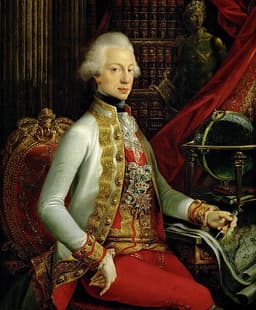
Ferdinand III
Emperor · Modern
57.8Total

Louis IV of Hesse
Emperor · Modern
38.8Total
Basic Information
Born
1608
1837
Died
1657
1892
Era
Modern
Modern
Nationality
Holy Roman Empire
Hesse-Darmstadt
Occupation
Emperor
Emperor
Civilization
Western
Western
Score Comparison
Military (10%)
45.0
45.5
Political (20%)
72.0
25.0
Influence (20%)
61.0
45.5
Legacy (20%)
52.0
33.3
Leadership (15%)
66.0
41.5
Strategy (15%)
43.3
46.2
TOTAL
57.8
38.8
Ferdinand III — Complete Timeline
1629 AD
Issued the Edict of RestitutionPolitical Action
As Ferdinand III was not yet emperor, this event is misattributed. Actually, Ferdinand III succeeded his father Ferdinand II in 1637. He did not issue the Edict of Restitution; that was his father's act. Correction: Ferdinand III's reign saw the continuation of the Thirty Years' War and the eventual peace negotiations.
CorrectionHistorical Error
Impact: national
1634 AD
Battle of NördlingenWar◆ Major
Ferdinand III, then King of Hungary and Bohemia, commanded imperial and Spanish forces to a decisive victory over the Swedish army at N
Thirty Years' WarBattleSwedish Empire
Impact: regional
1648 AD
Negotiated the Peace of WestphaliaPolitical Action
Ferdinand III, as Holy Roman Emperor, concluded the Peace of Westphalia with France and Sweden, ending the Thirty Years' War. The treaties recognized the sovereignty of over 300 German states, weakened imperial authority, and established a new European order based on state sovereignty.
Peace of WestphaliaThirty Years' WarDiplomacy
Impact: global
Louis IV of Hesse — Complete Timeline
1862 AD
Married Princess Alice of the UKPolitical Action◆ Major
Louis IV married Princess Alice, daughter of Queen Victoria. This marriage strengthened ties between Hesse-Darmstadt and the British royal family, and their children included the future Tsarina Alexandra of Russia.
MarriageBritish Royal Family
Impact: globalconstructive
1871 AD
Ruled During German UnificationPolitical Action
As Grand Duke, Louis IV presided over Hesse-Darmstadt's integration into the German Empire. He supported Prussian-led policies, including militarization and industrialization, while maintaining a ceremonial role.
German EmpireIntegration
Impact: regional
1877 AD
Became Grand Duke of HessePolitical Action◆ Major
Louis IV succeeded his uncle Louis III as Grand Duke of Hesse-Darmstadt. He inherited a state that was part of the German Empire, with limited autonomy under Prussian dominance.
SuccessionHesse-Darmstadt
Impact: regional
1878 AD
Lost Children to DiphtheriaOther◆ Major
In 1878, Louis IV's wife Alice and their daughter Marie died of diphtheria. This personal tragedy devastated the family and left Louis IV a widower, deeply affecting his later life and rule.
DiphtheriaFamily Tragedy
Impact: nationaltragic
This comparison has not been analyzed yet.
One-time AI generation (~1 minute). Scores and timeline are already available below.
Rankings
🥇
Ferdinand IIILeader
Mil: 45.0Pol: 72.0Inf: 61.0
57.8
🥈
Louis IV of Hesse
Mil: 45.5Pol: 25.0Inf: 45.5
38.8
+19.0 behind
How This Comparison Works
Algorithm
Each figure is scored on 6 dimensions (0—100 scale) based on structured historical data: Military (10%), Political (20%), Influence (20%), Legacy (20%), Leadership (15%), Strategy (15%). The weighted total produces the final ranking.
Data Sources
Scores are computed from structured sub-indicators in the database. Scale factors adjust for era (Ancient ×0.85, Modern ×1.0) and civilization size (Eastern ×1.05, Other ×0.80) to account for differences in population and military scale.
Maximum 3 Figures
Comparisons are limited to 2—3 figures to ensure readability and statistical meaningfulness.
Error Margins
±5 points per dimension — Sub-scores are derived from historical records with inherent uncertainty. Two figures within 5 points on a dimension should be considered roughly equivalent in that area.
Total Score Accuracy
±3 points overall — The weighted combination of 6 dimensions produces a total score with approximately ±3 points of uncertainty. Differences of less than 3 points are not statistically significant— the figures are effectively tied.
Known Limitations
- Historical records are incomplete and uneven across civilizations
- Figures from oral-tradition societies may be underrepresented
- Occupation labels can misclassify multi-role figures
- Scores measure capability and impact, not moral character
- Quantitative scoring is a comparison tool, not absolute truth
Capability Radar
Military (10%) — Battles & Warfare
Battles
30
26
Win Rate
35
28
Expansion
20
31
Political (20%) — Governance & Reform
Reform
55
10
Diplomacy
85
20
Economy
50
10
Influence (20%) — Cultural & Global Reach
Cultural
40
5
Global
65
5
Legacy (20%) — Historical Impact
Historical
75
5
Longevity
70
5
Leadership (15%) — Power & Stability
Tenure
70
15
Stability
45
15
Strategy (15%) — Tactics & Innovation
Strategy
40
31
Tactics
30
37
Reform
25
37
Similar Comparisons
Comments & Discussion
No comments yet. Be the first to share your thoughts!