Loading...
Ferdinand I of Bohemia vs Sukjong of Joseon
Ferdinand I of Bohemia leads by 3.2 pts · 2 figures compared
…
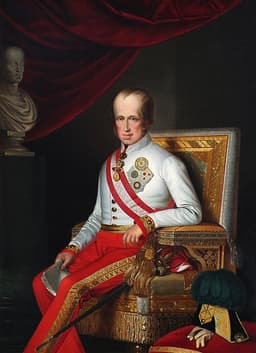
Ferdinand I of Bohemia
Emperor · Modern
55.1Total

Sukjong of Joseon
Emperor · Modern
51.9Total
Basic Information
Born
1503
1661
Died
1564
1720
Era
Modern
Modern
Nationality
Bohemia
Korea
Occupation
Emperor
Emperor
Civilization
Western
Eastern
Score Comparison
Military (10%)
47.5
20.0
Political (20%)
62.7
60.0
Influence (20%)
57.2
57.2
Legacy (20%)
49.2
50.0
Leadership (15%)
68.0
66.0
Strategy (15%)
41.7
42.3
TOTAL
55.1
51.9
Ferdinand I of Bohemia — Complete Timeline
1526 AD
Establishment of the Habsburg MonarchyPolitical Action
Ferdinand I inherited the crowns of Bohemia and Hungary after the death of Louis II. He consolidated these territories under Habsburg rule, creating a powerful Central European monarchy that would last until 1918.
Dynastic UnionTerritorial ExpansionHabsburg
Impact: regional
1527 AD
Coronation as King of BohemiaPolitical Action
Ferdinand I was crowned King of Bohemia in Prague, establishing Habsburg rule over the kingdom. This coronation followed the death of Louis II at Moh
CoronationHabsburg DynastyBohemia
Impact: regional
1555 AD
Peace of AugsburgPolitical Action
Ferdinand I played a key role in negotiating the Peace of Augsburg, which ended religious conflicts in the Holy Roman Empire. The treaty established the principle of cuius regio, eius religio, allowing princes to choose the religion of their territories.
Religious PeaceTreatyHoly Roman Empire
Impact: globalconstructive
Sukjong of Joseon — Complete Timeline
1680 AD
Gyeongsin Hwanguk (1680)Political Action◆ Major
Sukjong purged the Southerners faction, accusing them of plotting treason. He replaced them with the Westerners, who then split into Noron and Soron factions. This marked the beginning of Sukjong's pattern of switching factions to maintain royal power.
PurgeFactional StrifePower Shift
Impact: nationaldestructive
1689 AD
Gisa Hwanguk (1689)Political Action◆ Major
Sukjong purged the Westerners faction after a dispute over the succession of his son (later Gyeongjong). He reinstated the Southerners, who supported the son. This purge solidified the Soron faction's influence and deepened factional hatred.
PurgeSuccessionFactional Strife
Impact: nationaldestructive
1694 AD
Gabo Hwanguk (1694)Political Action◆ Major
Sukjong purged the Southerners faction again, accusing them of plotting against Queen Inhyeon. He reinstated the Westerners (Noron faction). This was the third major purge of his reign, demonstrating his strategy of balancing factions.
PurgeFactional StrifePower Shift
Impact: nationaldestructive
1708 AD
Introduction of Daeedongbeop (Uniform Land Tax)Reform◆ Major
Sukjong implemented the Daeedongbeop, a uniform land tax system that replaced various tribute payments with a single rice tax. This simplified taxation, reduced corruption, and increased state revenue, though it burdened peasants in some regions.
Tax ReformEconomyAdministration
Impact: nationalconstructive
Expert Analysis
Origins
Ferdinand I of Bohemia was born in 1503 in Alcalá de Henares, Spain, as the younger brother of Emperor Charles V. Raised in the Spanish court, he received a thorough education in governance and military affairs. His marriage to Anna of Bohemia and Hungary in 1521 linked him to the Jagiellonian dynasty, setting the stage for his later inheritance.
Sukjong of Joseon was born in 1661 in Seoul, Korea, as the son of King Hyeonjong. He received a Confucian education and ascended the throne at age 14 in 1674. His early reign was dominated by factional strife among the scholar-official groups—the Southerners and Westerners—which had been entrenched since the 16th century.
Rise to Power
Ferdinand's rise was tied to the Battle of Mohács in 1526, where King Louis II of Bohemia and Hungary died. Through his marriage to Louis's sister Anna, Ferdinand claimed both crowns. He was crowned King of Bohemia in 1527 in Prague, overcoming initial resistance from the Bohemian estates. By 1529, he secured recognition as King of Hungary, though he faced prolonged conflict with John Zápolya and the Ottomans.
Sukjong became king at 14, but real power initially lay with his grandmother Queen Dowager Jangnyeol and the Westerners faction. His first major turning point was the Gyeongsin Hwanguk in 1680, when he purged the Southerners, accusing them of treason, and installed the Westerners. This established his pattern of using purges to consolidate authority.
Leadership & Governance
Ferdinand's leadership style was methodical and administrative. He centralized Habsburg rule by creating a unified administration for his Austrian, Bohemian, and Hungarian lands. He established the Hofkriegsrat (Court War Council) in 1556 and the Hofkammer (Court Chamber) to manage finances. His political score of 62.7 reflects his ability to navigate the complex Holy Roman Empire. He also played a key role in the Peace of Augsburg (1555), which established cuius regio, eius religio, ending religious wars temporarily.
Sukjong governed through factional manipulation. He repeatedly switched support between the Southerners and Westerners, staging three major purges (hwanguk) to eliminate rivals: Gyeongsin (1680), Gisa (1689), and Gabo (1694). This maintained his power but destabilized the court. His political score is 60.0. He also implemented the Daeedongbeop (Uniform Land Tax) in 1708, replacing various tribute payments with a single rice tax, which simplified taxation and reduced corruption.
Triumph & Tragedy
Ferdinand's greatest success was consolidating the Habsburg Monarchy, creating a Central European power that lasted until 1918. He also secured the Peace of Augsburg, which provided a framework for religious coexistence. However, his military score of 47.5 reflects failures against the Ottomans, including the failed Siege of Buda in 1541, and his inability to fully unify Hungary. His strategy score of 41.7 indicates cautious, defensive policies.
Sukjong's triumph was the Daeedongbeop, which improved fiscal stability and was praised by later scholars. He also strengthened royal authority through purges. But his frequent purges caused deep factional hatred, leading to cycles of revenge that weakened the state. The Gisa Hwanguk, where he deposed Queen Inhyeon and executed scholars, damaged his reputation. His military score of 20.0 reflects minimal expansion—Joseon remained a tributary of Qing China.
Character & Destiny
Ferdinand was pragmatic and patient, often deferring to his brother Charles V during his early reign. He preferred diplomacy over war, which limited his military achievements but ensured stability. His character led to a steady, if unspectacular, reign. Historians rate his leadership at 68.0, higher than his military or strategy.
Sukjong was decisive and ruthless, but his obsession with factional control created a volatile court. He was influenced by his consorts—Queen Inhyeon and Consort Jang—whose rivalry triggered purges. His leadership score of 66.0 reflects effective control, but his legacy is marred by instability.
Legacy
Ferdinand's legacy is the Habsburg Monarchy, which dominated Central Europe for centuries. The Peace of Augsburg shaped German religious politics until the Thirty Years' War. His administrative reforms influenced later absolutist states. His total score of 55.1 reflects solid but not outstanding impact.
Sukjong's Daeedongbeop remained in force until the late Joseon period, and his purges set precedents for later kings. However, factionalism continued to plague Joseon until its decline. His total score of 51.9 is slightly lower.
Conclusion
Ferdinand I of Bohemia had a greater impact than Sukjong of Joseon. His score of 55.1 vs 51.9 reflects this. Ferdinand founded a dynasty that shaped European history for centuries, while Sukjong's achievements were more limited to internal reforms within a declining kingdom. Ferdinand's political and leadership scores (62.7 and 68.0) outpace Sukjong's (60.0 and 66.0), and his military and strategy scores, though low, still exceed Sukjong's (47.5 vs 20.0 military; 41.7 vs 42.3 strategy). Sukjong's legacy is tainted by destructive purges, whereas Ferdinand's administrative foundations proved durable.
Rankings
🥇
Ferdinand I of BohemiaLeader
Mil: 47.5Pol: 62.7Inf: 57.2
55.1
🥈
Sukjong of Joseon
Mil: 20.0Pol: 60.0Inf: 57.2
51.9
+3.2 behind
How This Comparison Works
Algorithm
Each figure is scored on 6 dimensions (0—100 scale) based on structured historical data: Military (10%), Political (20%), Influence (20%), Legacy (20%), Leadership (15%), Strategy (15%). The weighted total produces the final ranking.
Data Sources
Scores are computed from structured sub-indicators in the database. Scale factors adjust for era (Ancient ×0.85, Modern ×1.0) and civilization size (Eastern ×1.05, Other ×0.80) to account for differences in population and military scale.
Maximum 3 Figures
Comparisons are limited to 2—3 figures to ensure readability and statistical meaningfulness.
Error Margins
±5 points per dimension — Sub-scores are derived from historical records with inherent uncertainty. Two figures within 5 points on a dimension should be considered roughly equivalent in that area.
Total Score Accuracy
±3 points overall — The weighted combination of 6 dimensions produces a total score with approximately ±3 points of uncertainty. Differences of less than 3 points are not statistically significant— the figures are effectively tied.
Known Limitations
- Historical records are incomplete and uneven across civilizations
- Figures from oral-tradition societies may be underrepresented
- Occupation labels can misclassify multi-role figures
- Scores measure capability and impact, not moral character
- Quantitative scoring is a comparison tool, not absolute truth
Capability Radar
Military (10%) — Battles & Warfare
Battles
25
10
Win Rate
20
10
Expansion
35
5
Political (20%) — Governance & Reform
Reform
55
70
Diplomacy
65
65
Economy
50
60
Influence (20%) — Cultural & Global Reach
Cultural
40
55
Global
45
30
Legacy (20%) — Historical Impact
Historical
55
60
Longevity
50
50
Leadership (15%) — Power & Stability
Tenure
60
75
Stability
45
40
Strategy (15%) — Tactics & Innovation
Strategy
30
10
Tactics
20
10
Reform
40
15
Similar Comparisons
Comments & Discussion
No comments yet. Be the first to share your thoughts!